Ludwig van Beethoven
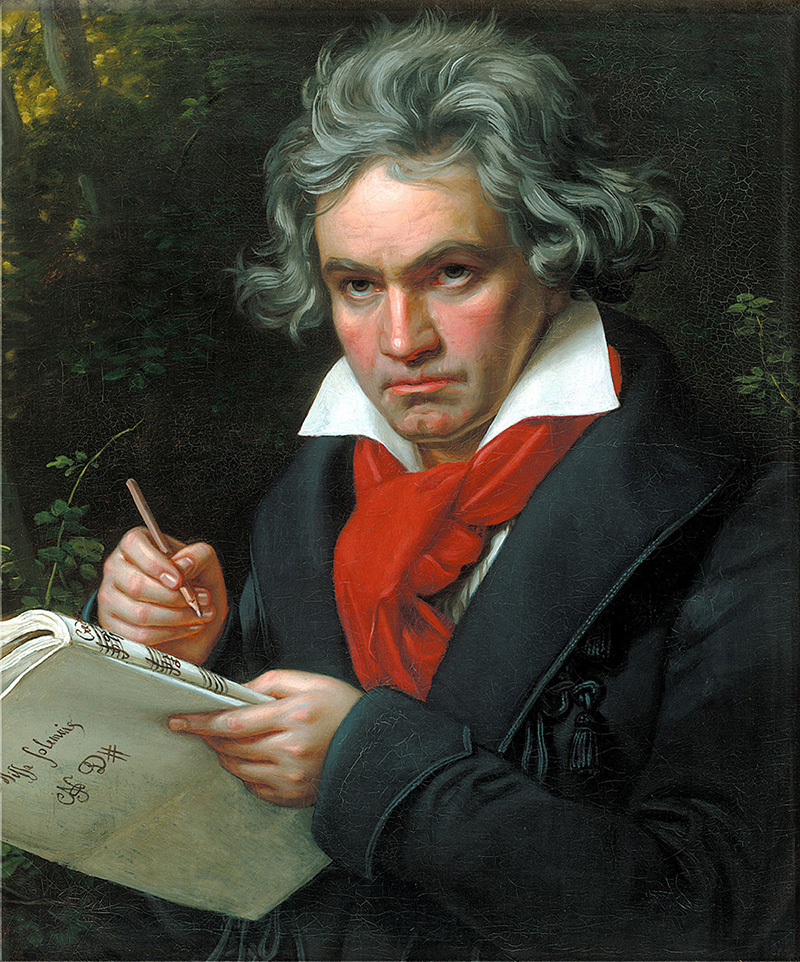
Born: baptized December 17, 1770, Bonn, Germany
Died: March 26, 1827, Vienna, Austria
Concerto No. 5 in E-flat Major for Piano and Orchestra, Op. 73, Emperor
- Composed: 1809
- Premiere: November 28, 1811 in Leipzig, Johann Philipp Christian Schulz conducting the Gewandhaus Orchestra; Friedrich Schneider, piano
- CSO Notable Performances:
- First: March 1897, Frank Van der Stucken conducting; Teresa Carreño, piano.
- Most Recent: May 2019, Louis Langrée conducting; Daniil Trifonov, piano.
- Instrumentation: solo piano, 2 flutes, 2 oboes, 2 clarinets, 2 bassoons, 2 horns, 2 trumpets, timpani, strings
- Duration: approx. 38 minutes
The beauty and sensitivity that pervade Beethoven’s Fifth Piano Concerto seem to contradict contemporary portraits of the composer, in which he appears brooding and resentful, with rage festering just below the surface. In the year 1809, Beethoven certainly had plenty to be disgruntled about. Europe was in the throes of the Napoleonic wars and Austria had declared war on France. The city was under bombardment, and Viennese nobility had fled the city for safer territory, with the Archduke Ferdinand, Beethoven’s pupil and financial backer, among them.
In Vienna, under the occupation of French troops, living conditions had begun to deteriorate. The local population was required to foot the cost of soldier upkeep, which drained the resources for food and daily necessities. In addition, Austria was held responsible for reparations as well as heavy taxes. Beethoven wrote to acquaintances in Leipzig, “We are lacking money here — we need twice as much as usual — damned war!” and later, “We no longer even have decent, edible bread.”
The composer had initially expressed admiration for Napoleon and was even considering the music director post in Kassel at the court of Bonaparte’s brother, Jérôme. But during the siege and bombardment, huddled in the cellar of his brother Kaspar’s lodgings with pillows pressed to his ears, his attitude soured and his loyalty to Germany deepened.
Evidence of Beethoven’s patriotism surfaces in the preparatory scribblings made during the early stages of the Fifth Concerto. The music paper on which he worked out his ideas for the concerto also contains preliminary sketches for a musical setting for choir and orchestra of the poem Östreich [sic] über alles (“Austria Above All”) by Heinrich Joseph von Collin, a patriotic writer whose political songs resulted in persecution by the French. Further evidence of Beethoven’s feelings toward Bonaparte show up in the manuscript to the concerto, at the beginning of the second movement where the composer scribbled, Östreich [sic] löhne Napoleon — “Austria pay Napoleon back!”
Like Mozart and other Viennese musicians before him, Beethoven had written his first four concertos as vehicles showcasing his dual roles as pianist and composer. By the premiere of the Fourth Concerto in 1807, his hearing had already degenerated significantly, and his status as a performing artist was slipping. Knowing that his Fifth Concerto would need to be performed by someone else, he kept the composer in the spotlight but stripped the pianist of the autonomy that soloists had previously enjoyed. They had traditionally supplied their own embellishments, improvised filler for certain passages, and inserted personalized cadenzas toward the end of each movement to “finish” the piece for the audience, much in the same way that an interior decorator completes the work of the architect. In his Fifth Concerto, Beethoven took this liberty from the performer in two ways: first, he inserted cadenza passages, meticulously written down to the last note, into the opening of the first movement. Then, at the conclusion of the movement where audiences were primed to expect improvisation, Beethoven dictated in the score, Non si fa una cadenza, ma s’attacca subito il seguente — “Do not play a cadenza, but immediately go on to the following”.
Because the composer was no longer the soloist, his most effective economic strategy was to publish the concerto before it had even premiered, first in 1810 in London, then in 1811 in Leipzig. Unlike the other concertos, this publication was geared to dilettantes, so Beethoven wrote out a full reduction of the orchestral part for the soloist instead of the customary figured bass line. In addition to simplified alternatives (ossia) for the more difficult passages, he gave exceptionally precise instructions for articulations, expression marks and pedal indications.
A private premiere took place in January 1811 at the Viennese palace of Prince Joseph Lobkowitz with the Archduke Ferdinand as soloist, followed by a public premiere in the Leipzig Gewandhaus the following November. Viennese audiences first heard it in February 1812 when Beethoven’s pupil Carl Czerny performed the solo part. Among his piano concertos, it is the only one that the composer never performed.
The opening of the first movement thwarts all previous conventions: with no tempo and no meter, grand orchestra chords kick off flowery piano interjections. After the main tune appears in the violins, the clarinet and bassoon take up the contrasting second theme in a minor key. A chromatic flourish introduces the piano’s solo exposition before the music migrates unexpectedly to B minor and the soloist develops the themes in dialogue with the orchestra throughout a series of tonalities. Beethoven reintroduces the main themes and extends them with a brilliant climax: the first written fortississimo dynamic (fff) in music history.
The original tempo marking of movement two, Andante un poco moto, was later changed to Adagio by the composer, resulting in an unusually wide margin of tempo choices for this movement among modern-day pianists. The movement opens with muted strings playing a chorale in B major over a pizzicato bass. The piano enters presenting a new musical idea that drifts through several keys before a chain of trills brings back the key of B major. Beethoven transitions seamlessly into the last movement: bassoons change their last note by a half-step and pass it off to the horns while the piano foreshadows the theme of the final rondo. The soloist makes two unsuccessful attempts at the tune, and finally, on the third try, succeeds in launching the finale.
The Rondo opens not with the full orchestra, but with the pianist playing a joyful ascending motif to thunderous chords in the bass. Beethoven conforms to early 19th-century Viennese tradition in merging the structure of his Rondo with that of the classical sonata. This strategy tends to suit the composer more than the soloist, as it allows for a more sophisticated treatment of themes, more innovation and greater room for ingenuity than the simpler Rondo. In the final coda Beethoven presents the audience with another novelty: a duet between piano and timpani that slows and fades away. The piano explodes with a final burst of energy punctuated with three triumphant final chords.
The appeal of this concerto was in no small part due to recent changes in piano construction associated with the industrial revolution. Beethoven had lobbied throughout his career for bigger, louder and more sensitive instruments; by the year 1811, innovations in instrument design and manufacture enabled a greater range of articulation and expression, providing the composer with an instrument worthy of masterworks such as his Piano Concerto No. 5, his Hammerklavier Sonata, Op. 106, and his Diabelli Variations, Op. 120.
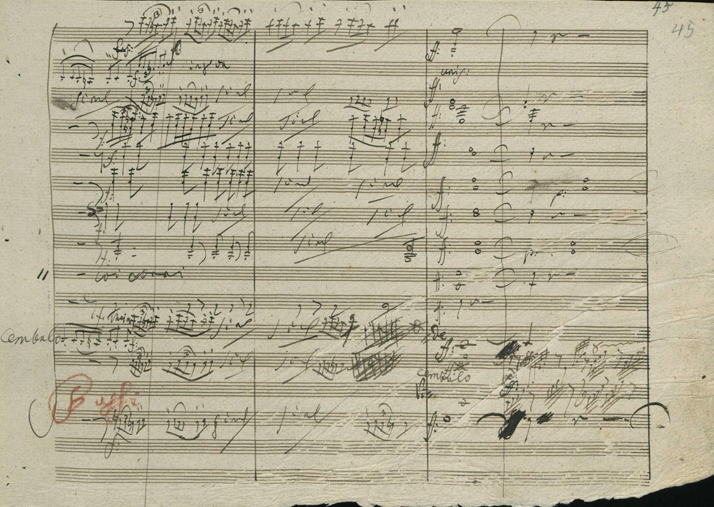 Beethoven reintroduces the main themes and extends them with a brilliant climax in Piano Concerto No. 5 in E-flat Major, movement I
—© Scott Buzza