Igor Stravinsky
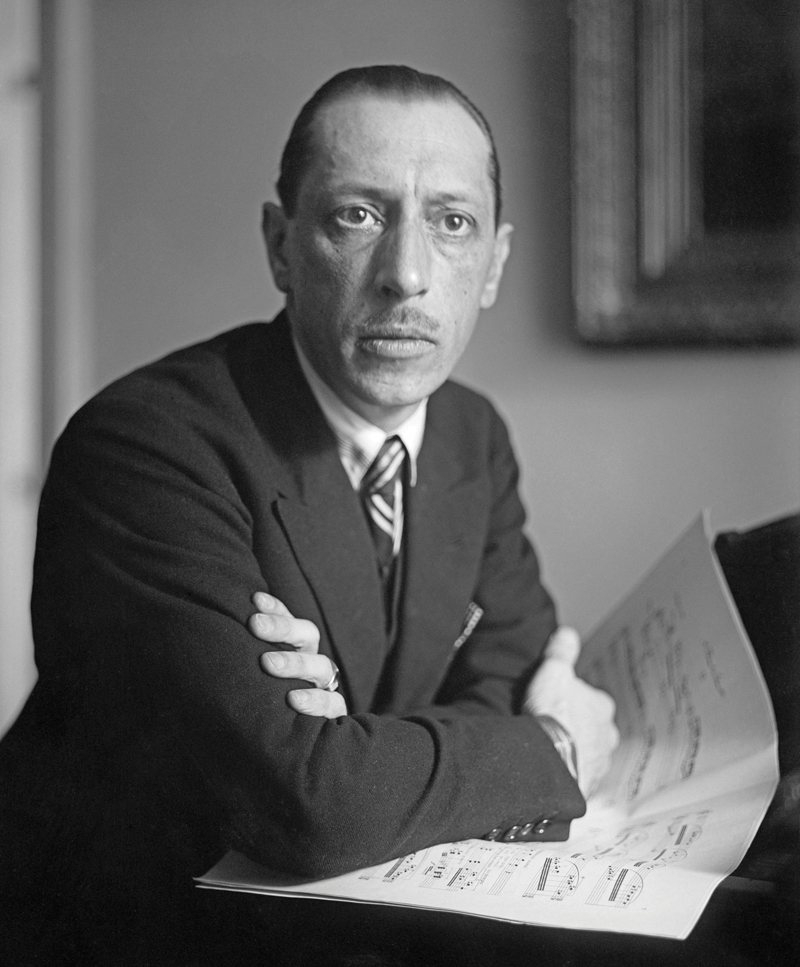
Born: June 18, 1882, Oranienbaum, Russia
Died: April 6, 1971, New York City
Les noces (“The Wedding”)
- Work Composed: 1914–1923
- Premiere: June 13, 1923 in Paris, Ernest Ansermet conducting
- Instrumentation: SATB chorus; soprano, alto, tenor baritone soloists; timpani, bass drum, chime, crotales, crash cymbals, field drum, snare drums, suspended cymbals, tambours de Basque, tenor drum, triangle, xylophone, 4 pianos
- Duration: approx. 24 minutes
Stravinsky started working on what would become Les noces the year after the premiere of The Rite of Spring. The piece went through multiple versions and did not reach its definitive form until nine years later. No other piece by Stravinsky had such a protracted and complex compositional history, but, then, the task that the composer had set for himself also was unusually complex.
Stravinsky wanted to represent a traditional Russian village wedding as an ancient religious ritual, which followed an extremely elaborate scenario. The series of events started with the initial visit of the matchmaker, followed by the formal agreement between the parties, the betrothal, the procession, the preparation of the bride, the actual wedding (known as venchániye or “crowning”) and the subsequent revelry. These various stages make up what is known as the svádebnaya igrá (wedding play). Stravinsky made a detailed study of each of these rites as documented by ethnographers and then created his own sequence based on what he had discovered.
The biggest problem Stravinsky encountered during the process of composition had to do with the instrumental accompaniment. He first began to score the work for large orchestra but soon rejected that possibility as impractical. He then thought of a smaller ensemble that included the cimbalom, the Hungarian hammered dulcimer he had used in a number of his works in the 1910s; this idea, too, was abandoned. It was not until 1921 — seven years after starting work on the project — that he hit upon the unique combination of four pianos with a large percussion battery, a combination that gave the work its unique sound. Having found his solution, he completed the work by 1923 and had it premiered in Paris, under the direction of Ernest Ansermet (1883–1969), on June 13 of that year. After the flop of the opera Mavra the year before, the great success of Les noces went a long way toward reconfirming Stravinsky’s reputation as one of the leading composers of his time.
Les noces opens with the preparation of the bride — all the earlier stages of the “wedding play” are omitted. The four scenes take us from there to the groom’s house and then to the wedding procession, followed by the post-nuptial feast. Significantly, the actual priestly benediction and the “I do” part are omitted; instead, the focus — except at the very end — is on family and friends, that is, the participation of the community. Particularly important are the laments, which were a crucial part of the wedding play. The bride sings a lament as she is led away to a foreign place, far from her parents, where she will have to join her husband’s family — and be a servant to that family. The bride’s mother sings her own lament about the departure of her beloved daughter. Other focal points during the celebration include the prayers to the Virgin Mary and to the saints, asking them to bless the union of the two young people — and the lyrical songs that use rich natural imagery to portray the love of Nastasia and Khvetis. Although Stravinsky introduces a wide range of textual motifs and musical characters, the score possesses a remarkable degree of stylistic unity. The four scenes are played without pause and the ostinatos [“obstinately” repeated harmonic and rhythmic patterns] continue relentlessly throughout the work. The roles of the bride, the groom and the parents are not assigned to individual singers; the same soloists may impersonate different characters at different times.
Stravinsky’s disciple, the conductor Robert Craft (1923–2015), observed that (except for the ending) there is only a single bar in the entire work in which the voices are silent. The singing is almost continuous, and yet the contribution of the instrumental ensemble is immense. This is, paradoxically, never more obvious than during the episode when all the instruments pause for the unaccompanied duet of two male soloists, both singing the words of the groom who asks his parents for their blessing. Here, and throughout the work, the singing is mostly syllabic, that is, there is only one note sung to each syllable of the text. At a tempo that is usually quite fast, this means that the words go by rather quickly — again with one major exception. The mother’s lament derives its gripping effect from its long-held notes and the expressive “bending” of the pitches. Another memorable moment is the song about the swan in the sea, with its lyrical inflections, signaling a shift, in the last section of the work, away from the public world and into the private sphere into which the newlyweds are soon to retreat. The song of the bridegroom at the very end celebrates marital bliss like few other works in the modern era (or any era, for that matter).
—©Peter Laki