Carl Orff
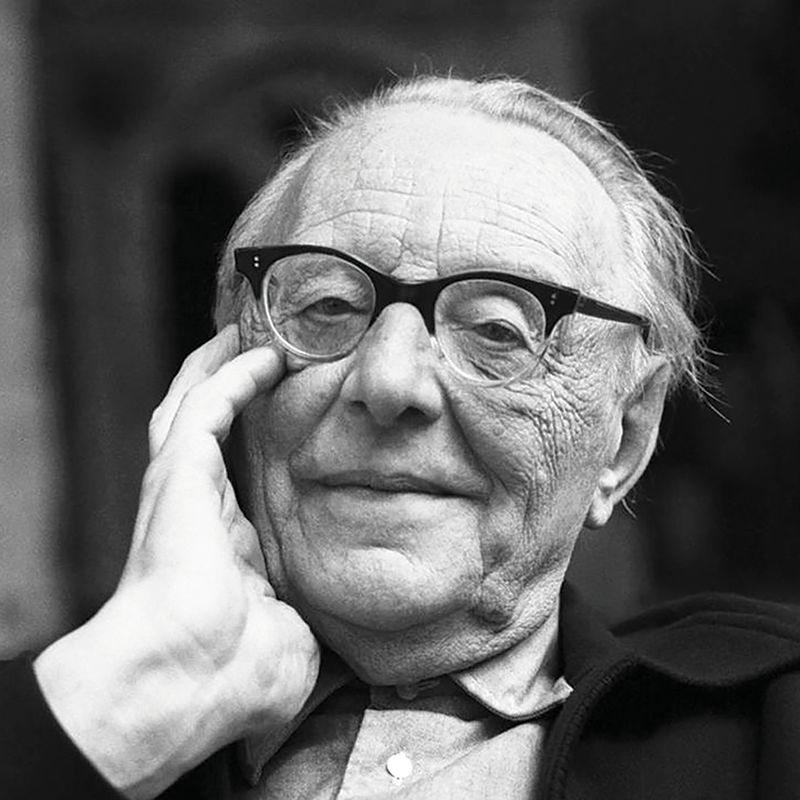
Born: July 10, 1895, Munich, Germany
Died: March 29, 1982, Munich
Catulli Carmina (“The Songs of Catullus”)
- Work Composed: 1940–1943
- Premiere: November 6, 1943, at the Leipzig City Theater in a double bill with Carmina Burana, production by Tatiana Gsovsky and Hans Nydeken-Gebhard, scenography by Max Elter; Paul Schmitz conducting
- Instrumentation: SATB chorus, soprano and tenor soloists, timpani, bass drum, crash cymbals, 2 glockenspiel, litofono, maracas, metallofono (vibraphone without motor), small cymbals, suspended cymbals, tam-tam, tenor xylophone, triangle, wood block, xylophone
- Duration: approx. 36 minutes
Carl Orff established his international reputation in 1937 with Carmina Burana, based on 13th-century texts written by an amorphous band known as “Goliards,” wandering scholars and ecclesiastics who were often esteemed teachers and recipients of courtly patronage. Their poems, in a heady mixture of Latin, old German and old French, gave a vivid, earthy portrait of Medieval life, attacking the defects of the Church, satirizing contemporary manners and morals, criticizing the omnipotence of money, and praising the sensual joys of food, drink and physical love.
Orff encountered these lusty lyrics for the first time in the 1930s and was immediately struck by their theatrical potential. Like Aaron Copland and Virgil Thomson in the United States, Orff at that time was searching for a simpler, more direct musical expression that could immediately affect listeners. Orff’s view, however, was more Teutonically philosophical than that of the Americans, who were seeking a music for the common man, one related to everyday life. Orff sought to create a musical idiom that would serve as a means of drawing listeners away from their daily experiences and closer to the realization of oneness with the universe. In the words of the composer’s biographer Andreas Liess, “Orff’s spiritual form is molded by the superimposition of a high intellect on a primitive creative instinct,” thus establishing a tension between the rational (intellect) and the irrational (instinct).
To portray the connection between the physical and spiritual spheres, Orff turned to the theater. His theater, however, was hardly the conventional one. Orff’s modern vision stripped away not only the Romantic musical language of 19th-century opera, but also eliminated its elaborate stagecraft, costumes and scenery, reducing it to its essential elements. Orff’s reform even went so far as to question the validity of any works written before 1935, even his own, to express the state of modern man, and he told his publisher to destroy all of his music that “unfortunately” had been printed. The first piece that embodied Orff’s new outlook was Carmina Burana.
The effect of Orff’s theatricality is rooted in the monumental simplicity of the musical style by which he sought to depict the primitive, instinctive side of mankind. “The simpler and more reduced to essentials a statement is, the more immediate and profound its effect,” he maintained. It is precisely through this imposed simplicity that Orff attempted to draw listeners to their instinctual awareness of “oneness with the universe.” Whether he succeeded as philosopher is debatable. Hanspeter Krellmann wrote in the New Grove Dictionary of Music and Musicians:
The four aspects of Orff’s musical theater [tragedy of archetypes, visionary embodiment of metaphysical ideas, bizarre fantasy, and physical exuberance] are usually intertwined; and it is apparent from the works that Orff’s main concern is not with the exposition of human nature in tragedy, nor with whimsical fancy, nor with the statement of supernatural truths, nor with joyous exultation. His intention seems to be to create a spectacle.
Following the triumph of the premiere of Carmina Burana in Frankfurt in 1937, Orff received frequent offers to compose a theatrical sequel to it that would fill out an evening-length double bill. “After many rejected plans,” he recalled, “I had an idea to return to Catullus’ poems,” which he had discovered in the 1930s as part of his study of Latin and Medieval sources for their musical potential. “Catullus remained dear to my heart,” he continued, and, in 1940, he conceived the Catulli Carmina, Ludi Scaenici — “Songs of Catullus, Stage Games,” a scenic cantata. He chose 12 of the Roman poet’s verses, scored them for chorus, soprano, tenor, four pianos and percussion, and placed them in a dramatic setting based on the poet’s own documented won-and-lost love and his accounts of solitary longing and intimate encounters.
Catulli Carmina opens with a Praelusio (“Prelude”) for chorus and orchestra, set to Orff’s own Latin text, in which young lovers ardently and graphically proclaim that their love will be eternal. Their youthful naivete is cut off by mocking from a group of old men: “Forever! Forever! Forever! How ridiculous, utter folly. Listen to the songs of Catullus.” Three succinct acts (7–8 minutes) of a play follow, scored entirely for voices without instrumental accompaniment and based on Catullus’ love affair, with the tenor soloist representing the poet and the soprano his beloved Lesbia. The chorus comments during the play in the manner of classical Greek theater, and dancers on stage portray the characters as the tale unfolds. Mirroring the formal symmetry and philosophical progression of Carmina Burana, in which the powerful chorus Fortuna Imperatrix Mundi (“Fortune, Empress of the World”) stands as a gateway into and out of the Medieval world, so Catulli Carmina closes with a brief reprise of the music, sentiment and orchestral accompaniment of the Praelusio: Young men and women: “Forever, forever, I am yours.” Old men: “Ah, me!” Orff titled this moralistic coda to Catulli Carmina an Exodium — a comic addendum to a tragic drama.
With Carmina Burana (1937) evoking the Medieval world and Catulli Carmina (1943) harking back to ancient Rome, Orff completed his trilogy of “scenic cantatas” in 1951 with Trionfo di Afrodite (“The Triumph of Aphrodite”), set to poetry of Catullus (in Latin) and Sappho and Euripides (in Greek). This closing work of the trilogy (collectively titled Trionfi) was based on an ancient wedding ceremony but titled with the Italian Renaissance term Trionfo, referring to the allegorical masked court processions that celebrated virtue’s triumph over the forces of darkness.
—©Dr. Richard E. Rodda