Gaius Valerius Catullus
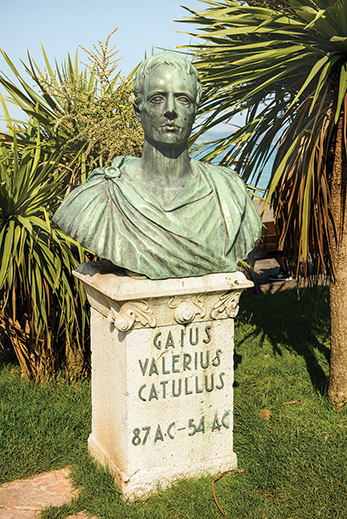
Gaius Valerius Catullus (84–54 B.C.) embarked on a successful poetic career in ancient Rome during a period of great artistic and cultural flourishing, when a stretch of relative peace between devastating civil wars allowed Rome’s elite to occupy their leisure time in pursuit of literary achievement. Catullus belonged to a cadre of Roman poets known as the “neoterics,” who rejected the sweeping monumentality of epic in favor of crafting refined, polished and elegant works of smaller scope. One hundred and sixteen of Catullus’ poems survive, showcasing in their broad variety of subject matter and complex lyric meters his exceptional versatility as a poet, literary critic and humanist invested in exploring the depths and boundaries of human emotion. His poetry includes a breathtaking range of style and register: within his surviving corpus, one can find highly learned and sophisticated adaptations of ancient Greek models, cheeky takedowns of social adversaries (featuring bold accusations of thievery, appalling lack of hygiene or dreadful writing skills), and earnest articulations of grief for lost loved ones. For all the erudition, charm and elevated wit that can be found within his writings, there is also a fair amount of what modern audiences might deem shocking or obscene.
While a virtuoso of Latin poetics in every respect, Catullus is perhaps best known for his cycle of love poems featuring “Lesbia,” a pseudonym derived from the Greek poet Sappho’s home island of Lesbos. Catullus’ poems for and about Lesbia paint a picture of passion, obsession, jealousy, betrayal and heartbreak. His amatory poetic persona, self-styled “Catullus” and therefore difficult to separate entirely from the author himself, grapples mightily with the conflicting emotions arising from this fraught love affair: “I hate and I love,” he declares in Poem 85 (odi et amo). “Why, you ask? I don’t know. But I feel it happening and I am tormented.” This tumultuous relationship with Lesbia is the subject of 25 poems, ranging in tone from saccharine to savage, offering Catullus (and his reader) the opportunity to explore how love and lust meet, and clash, at the intersection of anguish and pleasure.
Scholars have long suspected that behind the pseudonym Lesbia existed a real woman called Clodia, a respectable Roman citizen whose elite civic status, along with the fact that she was married to a man who was very much not Catullus, would have made her affair with the poet particularly scandalous. Others propose that Lesbia should be taken as a high-class courtesan, as is often the case with pseudonymous women in Roman erotic poetry; even a non-adulterous relationship with a sex-laborer could be scandalous in ancient Rome if it drew a citizen man’s focus away from more masculine pursuits like politics and war. Given that the Rome of Catullus’ floruit was entering the final decades of its republic — an era of relatively free literary expression without official censorship or punishments for ruffling political or personal feathers — Catullus was entirely free to explore the pleasures and pains of this forbidden love affair, even in poems that would be circulated and openly discussed among Rome’s literate elite.
When things are going well with Lesbia, Catullus showers her with praise and affection, as in Poem 5, in which he encourages her to bestow thousands of kisses upon him and to ignore petty, judgmental gossip: Vivamus, mea Lesbia, atque amemus / rumoresque senum severiorum / omnes unius aestimemus assis! (“Let us live, my Lesbia, and let us love, and let us consider the rumors of pretentious old men to be worth hardly a penny!”). To fully capture the depths of his obsession, Catullus turns in Poem 51 to the words of Sappho, adapting into Latin some of the Greek poetess’ most famous lines: “That man sitting beside you seems to me to be equal to a god, even (if it isn’t sacrilege to say) to surpass the gods, who gazes at you and hears you laughing sweetly, which rips all my senses from me, wretched … ”. This poem is an extraordinary feat of translation, adaptation and innovation, as Catullus skillfully weaves the words and themes of Sappho’s ancient Greek into a Latinate version of the Sapphic stanza. Catullus even adds his own original stanza after Sappho’s words conclude, punctuating the poem with a stern address to himself: otium, Catulle, tibi molestum est (“leisure gets you into trouble, Catullus”).
When things are going poorly with Lesbia, however, Catullus stoops quickly to vicious invective, determined to punish her alleged infidelities. He rebukes himself, in Poem 8, for continuing to pine for her after she has rejected him (“Miserable Catullus, stop being a fool, and accept that what you know has been lost is gone”), before berating Lesbia with reminders that no one will ever love her as he did. In the depths of jealous rage, he accuses Lesbia of sleeping with 300 men (Poem 11) and of prostituting herself in Rome’s back alleys (Poem 58). There are numerous such places throughout his corpus where he articulates overt and unapologetic misogyny, a substrate of the poetic persona’s demeanor that appears to be activated, in particular, by the sting of romantic rejection.
Lesbia is not the only of Catullus’ lovers immortalized in his poetry. He wrote poems for other women, including a rather bawdy proposition to a woman called Ipsitilla (Poem 32), and a short cycle for a young man called Juventius, who seems to have inspired in Catullus much the same passions (and some of the same vitriol) as Lesbia. The question of Catullus’ sexuality, or what the modern world might define as “sexual orientation,” is entangled with complicated Roman cultural norms that identified active (versus passive) sexual activity as appropriate for elite men, regardless of whether the object of their lust was a man or a woman. We can see these complex definitions of sexuality and masculinity at work, for example, in Poem 16, in which Catullus threatens his male critics with violent sexual penetration of their anal and oral orifices; for the Romans, the active nature of these sexual acts (and their forcing of passive roles onto the recipients) was an aggressive assertion of masculinity.
Catullus died young, around the age of 30, leaving behind a rich poetic legacy inspiring centuries of scholarship, creative adaptation and enthusiastic reception on a global scale. His observations on life, love and loss, whether flippant and crude or earnest and eloquent, offer plentiful insight into the meaningful connections between the ancient Roman world and our own: Catullus’ poetics model what it means to love deeply, to feel intensely and to lay those passionate emotions bare, for better or worse, in the pursuit of artistic achievement.
—©Dr. Caitlin Hines, Assistant Professor, Department of Classics, University of Cincinnati