George Gershwin
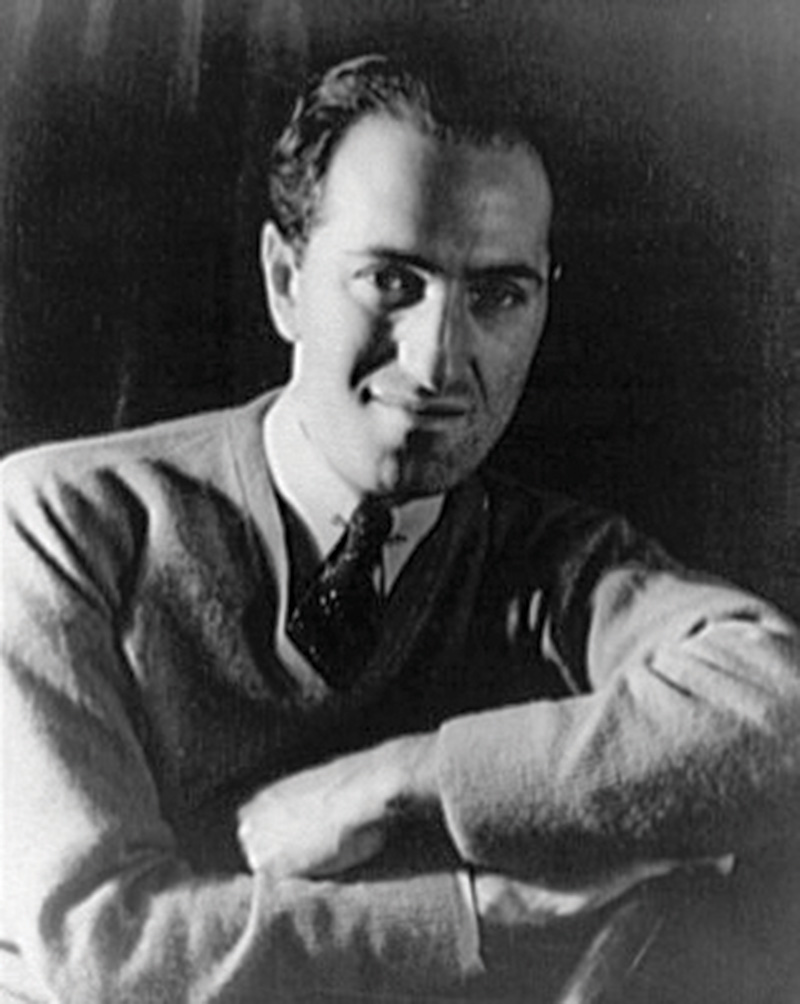
Born: September 26, 1898, New York, New York
Died: July 11, 1937, Los Angeles, California
Excerpts from Porgy and Bess
- Work Composed: 1934–35
- Premiere: October 10, 1935 at the Alvin Theatre, New York City
- Instrumentation: SATB chorus, vocal soloists, 2 flutes (incl. piccolo), 2 oboes (incl. English horn), 3 clarinets, bass clarinet, 2 alto saxophones, tenor saxophone, bassoon, 3 horns, 3 trumpets, 2 trombones, tuba, timpani, African drums, bass drum, crash cymbals, drum set, glockenspiel, sandpaper, snare drum, suspended cymbals, tom-tom, train whistle, wood block, xylophone, banjo, pianos, strings
- Duration: approx. 55 minutes
George Gershwin first encountered DuBose Heyward’s 1925 novella Porgy in 1926 while entrenched in rehearsals for his latest musical. According to Heyward’s wife, Dorothy (who adapted the novella into a successful play in 1927), Gershwin began reading late in the evening and, by the early morning, had drafted a letter appealing to the author about an operatic collaboration. In this telling, Gershwin acted on impulse, but opera had likely been on his mind since at least his first attempt, 1922’s poorly received Blue Monday Blues. And, in 1924, the Metropolitan Opera’s Otto Kahn had approached him about writing a “jazz opera” (Gershwin was third in line after Irving Berlin and Jerome Kern declined). Not until nine years after reading Porgy did Gershwin’s Porgy and Bess premiere, in October 1935 at the Alvin Theatre (now Neil Simon Theatre) on Broadway, a showcase for the Heywards and Gershwin’s brother, Ira, that lasted until early 1936.
The opera’s plot revolves around the title characters Porgy and Bess, Gullah-speaking residents of Catfish Row, a tenement district in Charleston, South Carolina. After a brief orchestral overture and one of the opera’s most famous numbers (the lullaby “Summertime”), a gambling scuffle results in Crown (Bess’ partner) murdering Robbins. Crown flees, leaving Bess to find refuge with the disabled beggar, Porgy, for whom she develops feelings. Bess becomes caught between these two men and local vice-peddler Sportin’ Life, who tempts her to go to New York with him in Crown’s absence. Soon, a storm brings the deaths of more residents and Crown’s return. This transpires while lawmen investigate Robbins’ death, briefly jailing Porgy for obstruction. Bess succumbs to Sportin’ Life’s pressure while Porgy is gone, and the opera ends with Porgy leaving to find Bess in New York. [Ed. For a synopsis of the complete opera, please visit metopera.org/discover/synopses/porgy-and-bess.]
Critics have noted that Heyward’s novella is elliptical, a broken series of snapshots, but the operatic format alleviates disjunction through musical continuity. Heyward included lyrics to sung spiritual interludes in the original novella, asserting their necessity to understanding the characters’ worldviews, which was possibly a point of appeal for Gershwin. In Gershwin’s hands, the interludes became many of the opera’s best-known numbers, and he followed grand operatic convention by incorporating their melodies and rhythms into the opera’s fabric, outlining the drama with song quotes and limited leitmotifs. The opening overture’s rhythmic propulsion, for example, reappears during fights and the melodramatic storm scene. It further combines with fragments of “I Got Plenty o’ Nuttin’” for the finale and “I’m On My Way” as Porgy leaves to rescue Bess from New York (and Sportin’ Life), suggesting associations with action and self-assertion.
Perhaps Dorothy Heyward’s anecdote of Gershwin’s late-night epiphany belies assumptions about Gershwin’s compositional activity and his rigor, with the volume of music he composed during his relatively short life suggesting he worked with uninhibited ease. But when asked, Gershwin modestly claimed that he labored over even small musical phrases as he crafted the music for hundreds of songs, and having lacked earlier formal training in composition, he had approached Nadia Boulanger and Maurice Ravel for lessons (both declined, allegedly anxious of ruining his talent). This image of Gershwin more accurately comports with his conscientious effort on Porgy and Bess. It is his largest-scale work and followed a string of concert-oriented pieces written over the previous decade since Rhapsody in Blue in 1924.
While the commercial failure of Blue Monday Blues may have compelled Gershwin to tentativeness and slow work, he also seems to have understood the gravity of the project. He insisted that the opera be performed by a Black cast for authenticity, which precluded the Metropolitan Opera performing the work as it did not have any Black singers in its roster. Gershwin’s wish has been widely honored, establishing a precedent of social and civil rights actions around the opera’s performances. Artistically, in conversations with Heyward, Gershwin assured that he would begin writing the music only when he was technically prepared. He studied Richard Wagner’s Die Meistersinger and Georges Bizet’s Carmen as models, and he had also seen Alban Berg’s Wozzeck in 1931, an opera bearing grim affinities with details of Porgy and Bess. By 1933, George, Ira and Heyward had signed a production contract; George began composing in 1934, and he completed orchestration of the project in early 1935 (the latter was a craft he embraced after early critiques about delegating the task for Rhapsody in Blue).
Within the repertoire, Porgy and Bess stands alongside warhorses in annual performance frequency and incorporates their conventions. It trades in elements that popularized late-19th-century Italian verismo operas from Giacomo Puccini and Giuseppe Verdi, where roughness and grit, emotional struggles and daily experiences shine. As an opera incorporating syncopated rhythms and jazz idioms, it follows Scott Joplin’s Treemonisha (1911), Harry Lawrence Freeman’s Voodoo (1913) and Franke Harling’s A Light from St. Agnes (1925), among others. Perhaps unsurprisingly, given Gershwin’s stylistic range, Porgy and Bess resists generic pigeonholing. Though often staged by opera companies today, its premiere on Broadway followed trial performances in Boston, a trajectory more typical of musical comedy than grand opera.
The opera’s legacy draws partly from Gershwin’s knack for tunes, which he leveraged in different ways. Composer-theorist David Schiff has described Gershwin’s technique in large-format works as “tunes into themes,” where seeds of melodic snippets are nurtured and sequenced together, as in Rhapsody in Blue or An American in Paris. Using his business intuition, Gershwin established the Gershwin Publishing Company to sell the opera’s music, and many of its songs sold well as standalone sheet music. The most famous numbers from Porgy and Bess are mainstays for musicians. Miles Davis recorded a full album of Gil Evans arrangements in 1959, and Billie Holiday and Nina Simone performed and recorded “I Loves You Porgy.” Duke Ellington — who alleged Gershwin’s opera was inauthentic — even recorded a rendition of “Summertime” on his 1961 album, Piano in the Foreground, that is evocative, ascetic and caustic. In concert, performances of Porgy and Bess showcase these and other of the opera’s most striking musical selections, speaking to the opera’s lasting power and its composer’s prodigious craft.
—©Jacques Dupuis