William Grant Still
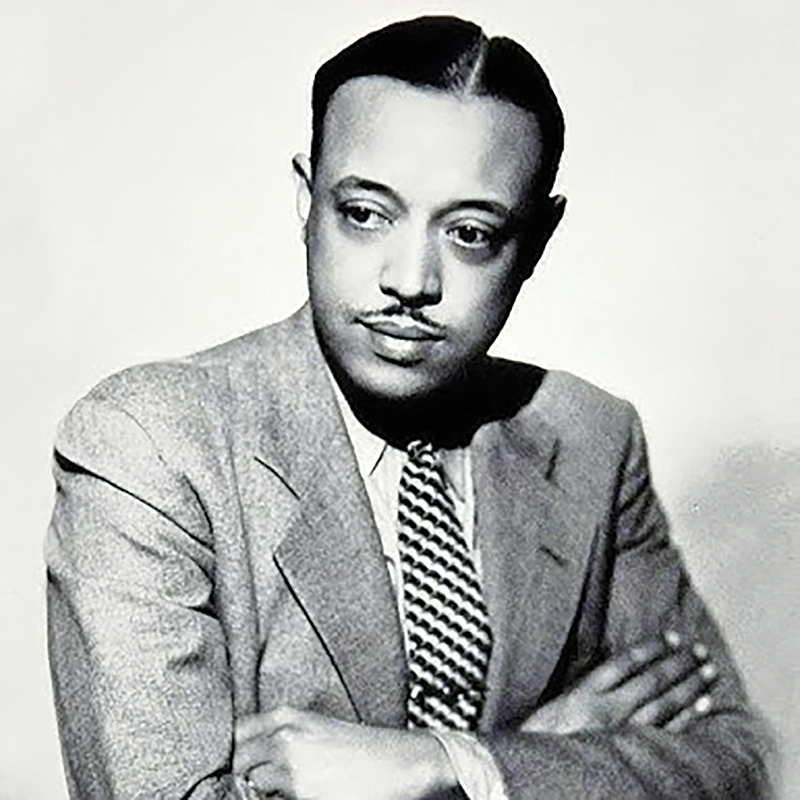
Born: May 11, 1895, Woodville, Mississippi
Died: December 3, 1978, Los Angeles, California
Plain-Chant for America
- Work Composed: 1941
- Premiere: (baritone and orchestra) October 23, 1941, Carnegie Hall, John Barbirolli conducting the New York Philharmonic with Wilbur Evans, baritone; (chorus and orchestra) April 1968, New Orleans Philharmonic Symphony Orchestra and the Dillard University Chorus
- Instrumentation: SATB chorus, 3 flutes (incl. piccolo), 2 oboes, English horn, 2 clarinets, bass clarinet, 2 bassoons, 4 horns, 3 trumpets, 3 trombones, tuba, timpani, bass drum, crash cymbals, snare drum, suspended cymbals, triangle, harp, strings
- Duration: approx. 9 minutes
In 1941, it was becoming clear to most Americans that another world war was developing in Europe. Although America had yet to enter the conflict, the rise and spread of Nazism and fascism, coupled with growing militarism in Japan, posed a considerable threat to democracy. It was under this specter of impending war that William Grant Still wrote the composition, Plain-Chant for America. Earlier that year, the composer was commissioned by conductor John Barbirolli to write a piece for the centennial season of the New York Philharmonic. Initially, Still wrote a suite for the occasion but decided that something that rose to the poignancy of the occasion and the political moment was warranted.
Still was no stranger to the type of racism and xenophobia that underscored the rise of fascism in Europe. As a Black man born and raised in the Jim Crow South in 1895, he knew firsthand how racial hostilities and fears escalated to violence. He experienced the brutality associated with the First World War. In 1918, Still joined approximately 2.3 million Black men who enlisted to fight in World War I. He served in the Navy as both a musician and mess attendant. Like many of the other Black men who hoped that their display of patriotism and willingness to fight for democracy would initiate social change in America, Still was shocked by the violent backlash that came instead. In 1919, as he settled into a musical life in Harlem working for bluesman and musical entrepreneur W.C. Handy, Still watched as bloody race riots swept through Black communities. Although Still had emerged as the leader of a vanguard of Black composers and concert artists that propelled the Black Renaissance movement in the two decades since the Red Summer, little had changed socially and economically for Black folks in America.
This no doubt was on the mind of William Grant Still in 1941. His wife, Verna Arvey, recounted in The New York Times in 1941 how Still awoke one morning with Katherine Garrison Chapin’s poem, “Plain-Chant for America” fresh in his mind. “It was then (in the summer of 1941) one of the most timely, inspiring and thought-provoking documents that had come to the composer’s attention.”
Published in 1939, “Plain-Chant for America,” part of a collection of poems and ballads of the same name, prophetically spoke of the potential dismantling of democracy and the continued spread of totalitarianism if Americans continued to be apathetic to and uninformed about the changing political environment. Chapin, who was commonly known as Mrs. Francis Bittle, was the wife of the Attorney General of the United States. She characterized her inspiration for the poem as follows:
An American poem had been germinating in my mind for a long time, but the final circumstance that thrust it into being was the fact that I had spent a few days in the company of some persons who were sympathetic with the Fascists, whose talk showed me vividly the gap between totalitarianism and the American democracy in which I believed. The emotion of the poem began there.
William Grant Still’s setting of Chapin’s poem was not the first time the composer looked to her words to underscore the narrative of brotherhood and unity that he attempted to promote through his music. A year earlier, the two collaborated on one of his most moving and provocative works, And They Lynched Him on a Tree. The work depicted the mob violence that subsequently led to the lynching of a Black man. But Plain-Chant for America would prove to be a different work in both poetic and musical tone.
First scored for soloist and piano and for baritone and orchestra, from the beginning, Plain-Chant for America strikes both a majestic and patriotic tone. An opening fanfare-like motive played by the horn soon gives way to motivic interplay between strings, horn and other brass instruments. Still gradually builds emotional tension, with musical language that conjures images of the approaching danger of tyranny. This tension is only resolved when the chorus enters with the opening line, “For the dream unfinished out of which we came. We stand together. While our Hemisphere darkens and our nations flame.”
What follows are episodic moments separating the various stanzas of poetry that remind us of how masterful Still was in writing lush harmonies and rhapsodic melodies that exploited the musical colors of the orchestra. His music provides a strong and dramatic setting for Chapin’s words.
Plain-Chant for America, for baritone and orchestra, debuted at Carnegie Hall on October 23, 1941, and was highly acclaimed by critics. The social and musical significance of Still’s composition grew as America entered World War II following the bombing of Pearl Harbor in December 1941, and it continued to be performed by orchestras and choruses throughout the war years.
In the late 1960s, another generation was awakened to the poignancy and importance of its message. It was then, in the midst of the chaos, violence and social unrest of that era in America, that Still rescored the work for chorus and orchestra. This version was premiered by the New Orleans Philharmonic Symphony Orchestra and the Dillard University Chorus 12 days after the assassination of Dr. Martin Luther King, Jr. Its message that “if freedom fails, we’ll fight for more freedom” paralleled the rallying cry of activists who propelled social movements that shaped America’s social identity during the last three decades of the 20th century.
Today’s performance of this work is a reminder that today’s political and social climate is not so different from the one that ignited Chapin’s prophetic vision and literary voice. Most importantly, William Grant Still’s Plain-Chant for America calls for us to move beyond the apathy and aloofness that pervade our current times and consider the fragility of democracy and freedom.
Plain-Chant for America remains one of Still’s most well-known and performed choral works. But most important is its larger legacy of advocating for social consciousness, civil rights and social change in America’s concert halls.
—©Tammy L. Kernodle, University Distinguished Professor and the Park Creative Arts Professor of Music at Miami University
Quotations taken from Verna Arvey, “New Chapin-Still Collaboration” New York Times; September 14, 1941.