Ludwig van Beethoven
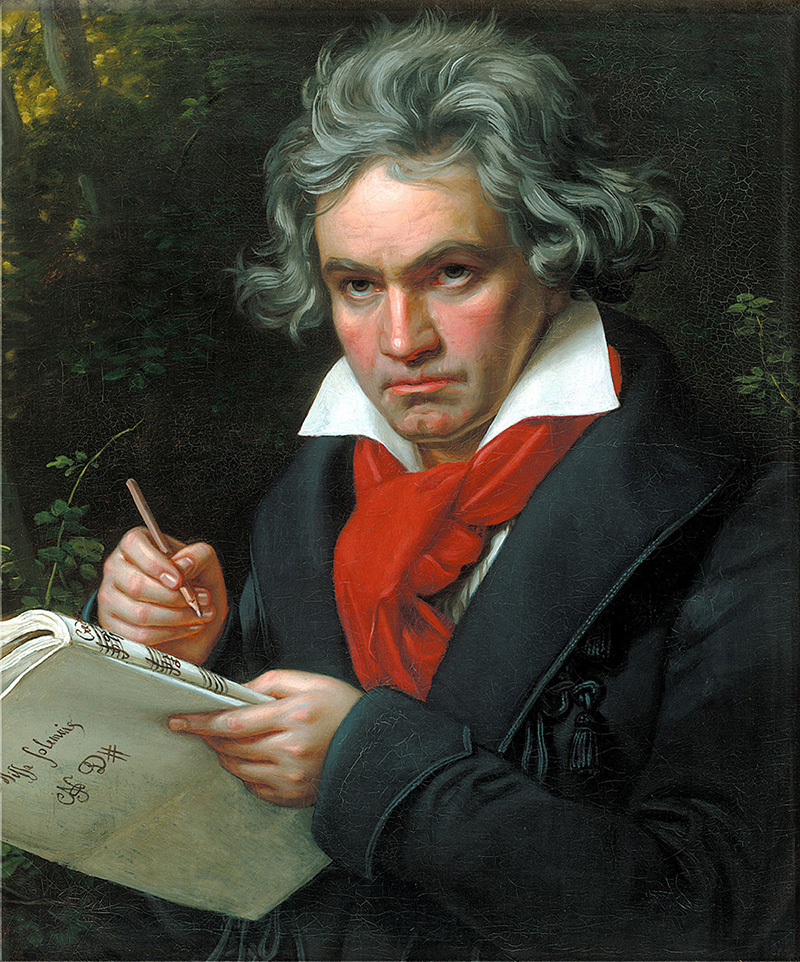
Born: baptized December 17, 1770, Bonn, Germany
Died: March 26, 1827, Vienna, Austria
Symphony No. 4 in B-flat Major, Op. 60
- Composed: 1806
- Premiere: The first performance was a private one at the Vienna home of Beethoven’s patron Prince Lobkowitz in March 1807. The first public performance was April 13, 1808, at Vienna’s Burgtheater.
- Instrumentation: flute, 2 oboes, 2 clarinets, 2 bassoons, 2 horns, 2 trumpets, timpani, strings
- CSO notable performances:
First: December 1897, Frank Van der Stucken conducting.
Most Recent: April 2018, Louis Langrée conducting. - Duration: approx. 35 minutes
Ludwig van Beethoven was a bit of a jerk. And yet, even when his sense of entitlement surpassed his oversized ego, an impressive roster of dukes, counts and princes continued to support him financially. They commissioned composition after composition, paying a steep fee in exchange for a written dedication on the title page of the print edition and exclusive performance rights for a limited period.
The background to his Fourth Symphony illustrates how little regard Beethoven held for his patrons. Count Franz von Oppersdorff was a connoisseur who maintained a private chamber orchestra at his schloss in Oberglogau (Głogówek in present-day Poland). He invited the composer to hear an in-house performance of his Second Symphony and then commissioned two new symphonies, Beethoven’s Fifth and Sixth, for a fee of 500 gulden. However, after some underhanded financial maneuvering, Beethoven sold off the dedication of the Fifth Symphony to a Bohemian aristocrat, Prince Franz Joseph Maximilian von Lobkowitz, and offered Oppersdorff the Fourth Symphony instead: day-old goods originally intended for another patron, Prince Karl Max Lichnowsky. Even though Beethoven assured Oppersdorff of exclusive rights to the Fourth Symphony for six months, he premiered it himself at Lobkowitz’s estate in March of 1807. The composer's attitude was imperious, not apologetic. As he notoriously wrote to Lichnowsky, “Prince, what you are, you are through the accident of birth; what I am, I am through myself.” Oppersdorff never did receive the other symphony he had paid for.
The common disparaging attitude toward Beethoven’s Fourth Symphony is reflected in the famous quip that he “wrote four symphonies: the Third, the Fifth, the Seventh and the Ninth.” It is true that the Fourth resembles the first two symphonies: it lacks the spectacle of the Third and the bombast of the Fifth. The 19th-century critic George Grove referred to its incongruity with those two monumental works in terms of “a slender Greek maiden standing between two Norse giants.” Virgil Thomson found it “dullish” and Carl Maria von Weber sarcastically complained about the slow introduction (“Every quarter of an hour we hear three or four notes”). On the other hand, Berlioz, Mendelssohn and Schumann praised it.
Beethoven's Fourth is a quintessentially classical work in form and character. As one critic noted in the Allgemeine musikalische Zeitung in 1807, “On the whole, the work is cheerful, accessible and very engaging, and is closer to the justifiably popular symphonies number one and two of this master than to numbers five and six.”
The Fourth represents a step back toward classical models in several ways. Its orchestration is smaller than that of the Third Symphony; the third horn is gone, and the absence of the second flute elevates the first flute to soloist status, reflected in the richness of wind solos throughout the four movements. The composer's harmonic language is more conservative in this symphony than in its predecessor, as well. Key relationships from one movement to the next are fully conventional, and development sections are not nearly as adventurous in their tonal meandering. But the most salient classical characteristic is the scale of the work. Whereas the Third and Fifth symphonies thwart audience expectations by expanding the length of each movement, totaling nearly an hour for the full work, the Fourth is much more concise, clocking in at 35 minutes.
The Adagio begins in the shadows, slowly, with a protracted introduction. As the music edges forward, punctuated with sigh motives, the harmony avoids B-flat major and instead passes through dark minor keys, evoking the mourning of a requiem. Then the darkness dissolves and the orchestra comes to life with a pulsating Allegro vivace, “fast and lively.” It is the contrast between the two extremes of bright and dark that sculpts the contours of the theme, more a rhythm than a melody, more felt than heard.
In the Adagio, Beethoven layers the ostinato of the second violins between a gentle melody above and a smooth countermelody below, to create a bas-relief in sound. The ambience shifts between serene and remorseful in an expansive arch of melody that Berlioz claimed could only have been composed by the Archangel Michael. Some critics have read a subtext of Beethoven’s unrequited love into the woodwind solos of this movement; others see merely a reminder that Beethoven could be as tuneful as Mozart when he chose to.
Many cultures have dances featuring rhythmic groups of twos bucking against groups of threes: the Bohemian version is the furiant and the south German counterpart is called a Zweifacher. Beethoven's Scherzo-Trio: Allegro vivace is of this ilk. Even though notation is in triple time, the aural disorientation begins at the onset, created through sharp accents and a quick tempo. However, there is still room for a good tune or two: in the trio section, the winds and strings banter back and forth in gestures of surprising grace and elegance. In its character, this movement has nothing in common with the minuet of previous generations; nor is it quite a true scherzo. It belongs to a category all its own and is solid evidence that even Beethoven had a sense of humor.
This movement is the only one in which the composer adds rather than subtracts: he telescopes the usual three-part form into six parts: scherzo, trio, scherzo, trio, scherzo, coda.
The Allegro ma non troppo finale opens with a whirlwind of 16th notes flying around the string section, only to be replaced by a second, more tuneful, theme in the winds. Set to rhythmic groups of twos against threes, it migrates throughout the orchestra before fragmenting into off-beats. The recapitulation of the first theme is one of the highlights of Beethoven's canon: not only did Beethoven call for the 18th-century Viennese bassoons to strain away from their bass range into their countertenor range, he also demanded that they do so quietly and dolce ("sweetly") — perhaps justifying the passage’s status as "the world's first bassoon joke."
—©Dr. Scot Buzza