Maurice Ravel
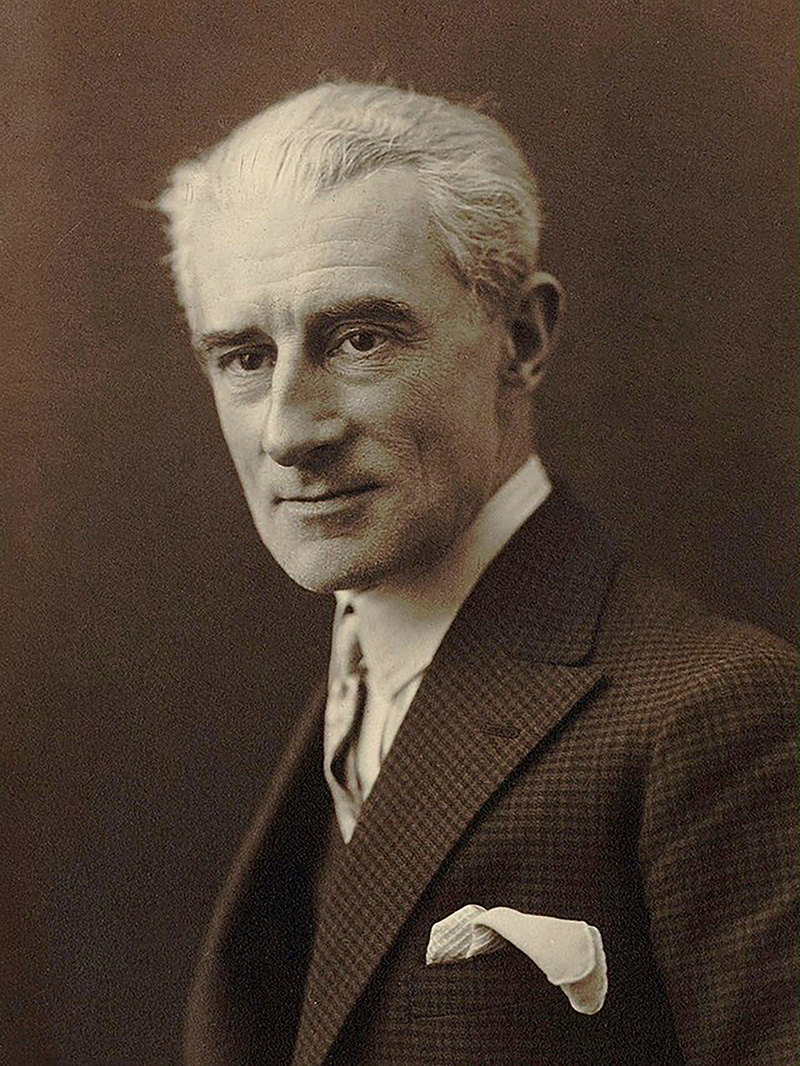
Born: March 7, 1875, Ciboure, France
Died: December 28, 1937, Paris, France
Concerto in D Major for Piano (Left Hand) and Orchestra
- Composed: piano suite 1914–1917, orchestral suite 1919
- Premiere: solo piano suite April 11, 1919, Marguerite Long, piano; orchestral suite February 28, 1920, Paris, Rhené-Baton conducting the Pasdeloup Orchestra
- Instrumentation: 2 flutes (incl. piccolo), 2 oboes (incl. English horn), 2 clarinets, 2 bassoons, 2 horns, trumpet, harp, strings
- CSO notable performances:
First: April 1926 as part of a Pops subscription concert, Ralph Lyford conducting. First CSO: February 1931, Fritz Reiner conducting. Most Recent: April 2012, Stéphane Denève conducting. - Duration: approx. 17 minutes
By the end of the 1920s, the fame of his Boléro had afforded Maurice Ravel celebrity status. Festivals of his music were held in Austria, England and Switzerland. He was made an honorary Doctor of Music by Oxford University. Even his Basque hometown, Ciboure, named their seafront walkway Quai Maurice Ravel. Yet, he himself was in crisis mode because his productivity had come to a full halt. After years of insomnia and occasional bouts of PTSD from his war experiences, he found it more difficult than ever to undertake fresh projects. It took the stimulation of travel to jumpstart his creativity again: a trip to northern Spain, a country he had invoked in many of his works but had never visited. Soon he found himself at work on two parallel projects: his Piano Concerto in G Major and the Piano Concerto for the Left Hand in D Major. Despite their common genesis, the two works are surprisingly different in style, expression and content.
The Austrian pianist Paul Wittgenstein (1887–1961) was no delicate artiste: he had inherited an iron will and strong physical constitution from his father, as well as a formidable personal fortune. His career as a pianist had just begun when World War I broke out, and the 26-year-old was sent off to serve on the Eastern Front, where he was shot and his right arm was amputated. After the war, he returned to the piano, seeking out suitable repertoire in libraries and museums. He began to refine his technique with one-hand arrangements of smaller piano works and popular arias, and he eventually turned to the leading composers of the day, commissioning works that could be tailored to his requirements. Among the 20 composers who wrote works for him were, in addition to Ravel, Richard Strauss, Paul Hindemith, Sergei Prokofiev, Erich Korngold and Benjamin Britten, but perhaps the best known is Ravel’s Concerto for the Left Hand.
With this assignment, Ravel faced several challenges. The first was to recreate the full range of harmonic sonorities with only one hand. As he told the French musicologist Michel-Dimitri Calvocoressi:
In a work of this kind, the essential thing is not to give the impression of a light fabric of sound, but on the contrary to create the illusion that it was written for both hands. I therefore chose a much more imposing style here, which is what the traditional concerto loves.
The second challenge Ravel faced was to maintain variety and interest throughout a concert-length work. The composer wrote in Le Journal in January of 1933:
A severe limitation of this sort poses a rather arduous problem for the composer. The attempts at resolving this problem, moreover, are extremely rare, and the best known among them are the Six Etudes for the Left Hand by Saint-Saëns. Because of their brevity and sectionalization, they avoid the most formidable aspect of the problem, which is to maintain interest in a work of extended scope while utilizing such limited means.
The fear of difficulty, however, is never as keen as the pleasure of contending with it, and, if possible, of overcoming it. That is why I acceded to Wittgenstein's request to compose a concerto for him. I carried out my task with enthusiasm, and it was completed in a year, which represents a minimum delay for me.
The opening of the work is no more than a dark, barely audible rumble in the bowels of the orchestra. Contrabassoon, basses and cellos are felt more than heard, until the music bleeds upward into the winds and strings and finally blossoms into a majestic backdrop for the solo piano entrance. The initial solo cadenza hints at the principal themes of the movement before rising up in a heroic display of dotted rhythms and fanfares. As the textures of the musical landscape become dreamier, the harmonies become hazier, and a delicate song emerges in the piano that drifts to the English horn with tonal colors that invoke Debussy’s Prélude à l’après-midi d’un faune.
The brass section jolts into the second half of the work with an angry march that leads into a more cynical 6/8 Allegro. The pianist seems to be improvising here, but soon reveals variations on previous themes, disguised with sharp accents and jazz harmonies.
The earlier Lento section returns, followed by another piano cadenza, this one more extended and even more daring in the expressive extremes it reaches for. The orchestra punctuates the end of the work with thrilling clatter.
When Wittgenstein first heard what Ravel had written for him, he made his displeasure known. He felt possessive of the work for which he had paid $6,000 U.S., and he had no qualms about making changes to the score. He began with revisions to the orchestration. Ravel’s friend, the pianist Marguerite Long, later recounted:
During the performance, I followed the score of the Concerto, which I did not yet know, and I could read our host’s creative faults on Ravel’s face, which became increasingly somber. As soon as the performance was over, I attempted a diversionary tactic with ambassador Clauzel, in order to avoid an incident. Alas, Ravel slowly walked towards Wittgenstein and said to him: “But that’s not it at all!”
Nor was the soloist pleased with the jazz-infused rhythms and elements of the second section. Ravel had been introduced to hot jazz, ragtime and the lindy hop on outings to Harlem with none other than George Gershwin, and he absolutely refused to compromise. As he told an interviewer for The Daily Telegraph in 1931:
A special feature is that, after the first part in this traditional style, a sudden change occurs and the jazz music begins. Only later does it become evident that this jazz music is really built on the same theme as the opening part.
A war of words with Wittgenstein followed and culminated in Ravel’s demand for a legally binding commitment to play the piece as written. The soloist refused. Ultimately, a truce must have been established because the two introduced the work to Parisian audiences in early 1933, with Ravel conducting. However, the composer passed away before the work was published, and it was Wittgenstein who supervised the first printing by the French publisher Durand. One must question who really had the last word.
—©Dr. Scot Buzza