Maurice Ravel
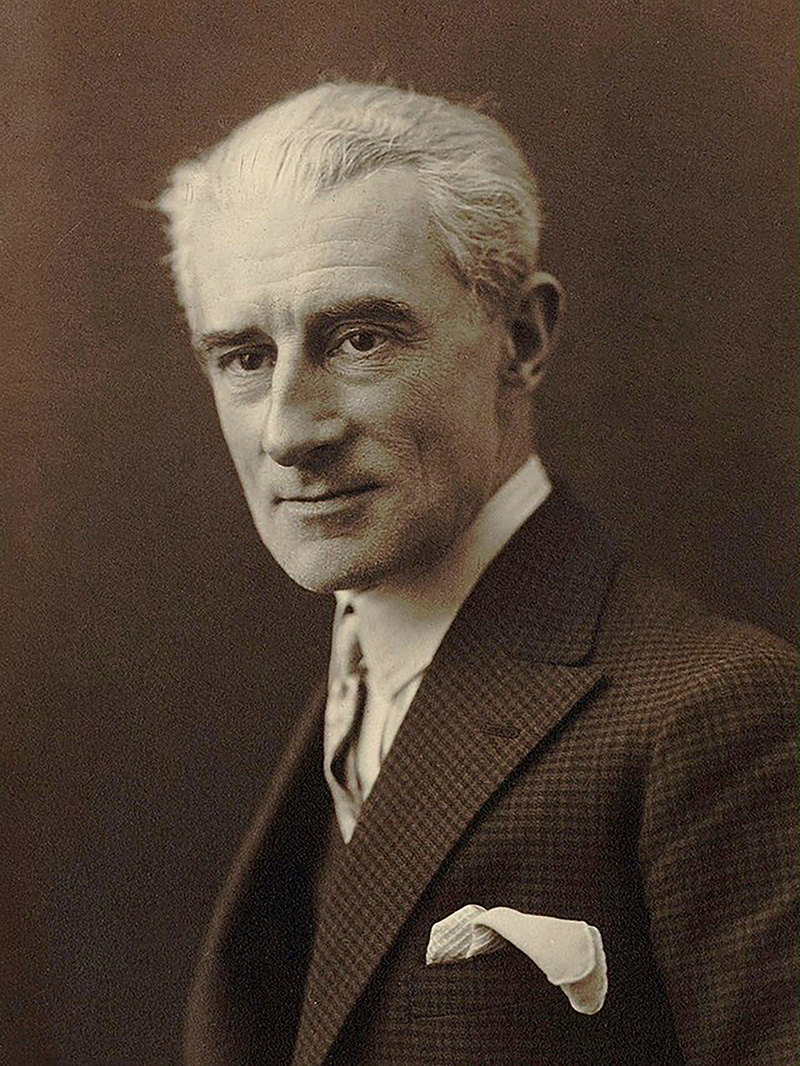
Born: March 7, 1875, Ciboure, France
Died: December 28, 1937, Paris, France
Le tombeau de Couperin
- Composed: piano suite 1914–1917, orchestral suite 1919
- Premiere: solo piano suite April 11, 1919, Marguerite Long, piano; orchestral suite February 28, 1920, Paris, Rhené-Baton conducting the Pasdeloup Orchestra
- Instrumentation: 2 flutes (incl. piccolo), 2 oboes (incl. English horn), 2 clarinets, 2 bassoons, 2 horns, trumpet, harp, strings
- CSO notable performances:
First: April 1926 as part of a Pops subscription concert, Ralph Lyford conducting.
First CSO: February 1931, Fritz Reiner conducting. Most Recent: April 2012, Stéphane Denève conducting. - Duration: approx. 17 minutes
Maurice Ravel was no apologist for war, but neither was he a stranger to it. At the outbreak of World War I, he was determined to enlist. However, he was 39 years old with a heart condition, a small stature and underweight, so he was rejected. He then volunteered to drive trucks under heavy bombardment for the Thirteenth Artillery Regiment and was posted to the front lines at Verdun. By the time of his discharge in 1917, he was depressed, thin and suffered from PTSD and chronic fatigue. Yet Ravel remained profoundly patriotic, and he understood that the wonder of music lies in its ability to voice aspects of the human experience words alone cannot express. So he made a deeply personal choice: rather than summoning compatriots to fight for glorious victory as Beethoven and Tchaikovsky had, or condemn the brutality of warfare as Haydn and Lili Boulanger had, he used his music to commemorate the loved ones he had lost.
His medium of choice was the tombeau (“tomb”), a 17th-century musical epitaph that was popularized by Baroque harpsichordists Johann Froberger, Jean-Henri D'Anglebert and Louis Couperin. He began his piano suite Le tombeau de Couperin in the autumn of 1914 and added subsequent movements over the next four years, as time allowed, up until the work’s premiere in 1919. He dedicated each of the original six movements to a fallen French soldier from among his friends, not only musical colleagues but also childhood friends, musicologists and painters. After the war, Ravel transcribed four of the six movements for orchestra, omitting only the Fugue and the Toccata, which he deemed too pianistic for orchestration. He reordered the remaining four movements and premiered the adapted work in Paris in early 1920.
The Prélude sets the tone for the suite. The oboe takes the lead with bright, 16th-note triplets in perpetual motion, and the rest of the orchestra joins in, continuing through a soup of keys and tonalities that finally boil over with a sweeping harp glissando. The movement is dedicated to Ravel’s friend, First Lieutenant Jacques Charlot. Charlot was a composer and pianist who had created piano arrangements of works by both Ravel and Claude Debussy for the music publisher Durand, as well as popular four-hand piano versions of many other works. Debussy also eulogized Charlot in the second movement to his En blanc et noir: “au lieutenant Jacques Charlot, tué à l'ennemi en 1915, le 3 mars” (“To lieutenant Jacques Charlot, killed by the enemy March 3, 1915”).
The Forlane is the oldest of the dance forms in the suite. The forlana has Friulian roots and is characterized by continual misplaced accents that deceive the ear in the same way the accompanying dance steps deceive the eye: is it in two or in three? Couperin had written his own forlane 200 years earlier, in his Fourth Concert Royal for flute and basso continuo, intended for chamber concerts in the private apartments of the Louis XIV, the Sun King. Ravel splashes his version with an exoticism similar to Couperin’s by rooting the tune in an imaginary church mode centered on E, but without a leading tone to pull the ear toward cadences, and concluding on an open fifth. The dance is dedicated to Gabriel Deluc, a painter from Ravel’s hometown in the Basque region who served as an army medic. Deluc was killed during reconnaissance at Souain-Perthes-lès-Hurlus on September 15, 1916.
The Minuet is the most sober, but also the most tender of the pieces in the suite. Despite its tempo, quick for a minuet, it maintains the dignity and stateliness of its Baroque counterpart. Its harmonies are overcast with melancholy through the layering of minor tonalities over the key of G major. In the middle strain, waves of grief wash over the gentle musette, a French dance associated with bagpipes. The piece is dedicated to Jean Dreyfus, the stepbrother of his former pupil, Alexis Roland-Manuel, and stepson of his “war godmother” (marraine de guerre), Mme. Fernand Dreyfus, who followed the trend fashionable among upper society matrons of “adopting” a soldier during the war. Ravel grew close to the family and, following his discharge from service, continued work on his Tombeau while recuperating for several months at the family’s estate in Lyon-la-Forêt. Details of Jean Dreyfus’ death are undocumented, but he is believed to have been killed in late 1916.
The Rigaudon is a Provençal dance for couples in duple meter, characterized by tiny hops and skips. Ravel offsets the vivacious opening with an introspective middle section in C minor, slower and colored with allusions to the Far East. Ravel maintained lifelong correspondence with the family of the two dedicatees of the movement, childhood friends from his hometown who had joined the service as soon as the war started. Pierre and Pascal Gaudin were killed by the same shell on their first day of service, November 12, 1914.
Ravel himself drew the illustration for the front page of the original Durand edition. It portrays a pedestal draped with cloth, upon which stands a baroque urn, and out of which sprout sprigs of laurel. Under the title Le tombeau de Couperin stands the composer's family monogram: the conjoined block letters M and R. Despite the drawing and its symbolism, Ravel’s Tombeau is not an austere piece of music. "Les morts sont déjà assez tristes dans leur silence éterne" the composer reportedly said, meaning, “The dead are already sad enough in their eternal silence.”
Indeed, the key to Ravel’s Tombeau lies in understanding the intricacies of the human expression of grief. The suffering then experienced collectively by society was deemed unacceptable to state overtly and thus could only be acknowledged indirectly. Music has always been part of mourning, and its roots in the expression of loss reach deep, from the psalmist David’s dirges to the myth of Orpheus and beyond. Ravel’s understanding of loss is reflected in the chiaroscuro (contrast between light and dark) of these dances: the brief forays into minor modes, the waves of muted strings covering the winds and the bittersweet undertow throughout the suite that belies its cheerful tunes.
—©Dr. Scot Buzza