Robert Schumann
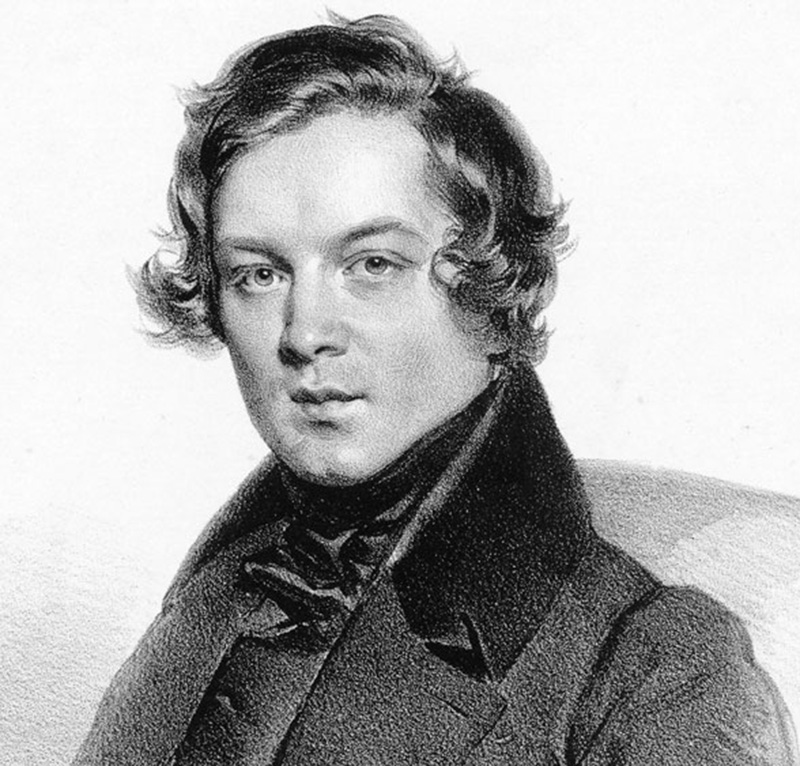
Born: June 8, 1810, Zwickau, Germany
Died: July 29, 1856, Endenich, Bonn, Germany
Symphony No. 4 in D Minor, Op. 120
- Composed: 1841, revised 1851
- Premiere: 1853, Robert Schumann conducting the Düsseldorf Orchestra
- Instrumentation: 2 flutes, 2 oboes, 2 clarinets, 2 bassoons, 4 horns, 2 trumpets, 3 trombones, timpani, strings
- CSO notable performances: First: November/December 1900; Frank Van der Stucken conducting. Most Recent: September 2016, Louis Langrée conducting.
- Duration: approx. 29 minutes
Robert Schumann’s Fourth Symphony is a compelling example of his evolving compositional voice. He completed the first version in 1841 and later revised it in 1851. His career unfolded in a series of periods during which he devoted himself to specific genres. Originally aspiring to be a concert pianist, Schumann shifted to composition after a hand injury, focusing first on piano music. Many of these works were inspired by Clara Wieck, an aspiring virtuoso pianist and his future wife. Although her father strongly opposed their union, the two were finally married in 1840. The joy of this moment inspired Schumann to turn to songs for solo voice and piano, a genre he had previously ignored. These are some of his most beautiful songs, many of which are still performed and acclaimed today.
In 1841, Schumann turned to orchestral works. Although he had not previously composed a multi-movement orchestral work, he had been studying the symphonic forms and had sketched ideas for a symphony when he was just 19. Later, he studied Beethoven’s symphonies and Berlioz’s pathbreaking Symphonie fantastique. In 1839, he acquired the manuscript of Schubert’s Ninth Symphony, which had not been performed in the composer’s lifetime. Schumann was so impressed with it that he arranged for Mendelssohn to conduct the premiere. He wrote to Clara passionately extolling its “heavenly length” and likening it to a novel in four volumes. He intertwined his admiration of the work with his love for Clara, writing that he wished “only that you should be my wife and that I also could write such symphonies.” Symphonies carried far more status than small genres, and Clara had already urged him to pour his creativity into orchestral works, rather than smaller ones for piano.
He composed his first orchestral works at a feverish pace, writing his First Symphony in just four days. The premiere in Leipzig in March 1841, which Mendelssohn conducted, received glowing reviews. He followed it with the Overture, Scherzo and Finale (Op. 52), completing it in less than a week. In contrast, the symphony that would be officially titled his Fourth took shape more gradually, as he worked on it intermittently from May through early October, 1841. When it was premiered in December, it met with a tepid reception, so Schumann put it aside and turned his attention to chamber music.
When he returned to composing symphonies, he published his Second Symphony in 1847, and his Third, the Rhenish, was warmly received when it was premiered in 1851. This success might have inspired him to return to the earlier 1841 symphony. While serving as the music director in Düsseldorf in December 1851, he revised the work and published it as his Fourth Symphony. He led its premiere with the Düsseldorf orchestra in 1853. In contrast to the work’s first version, the final version was warmly greeted by critics, with the Rheinische Musik-Zeitung describing it as an “ingenious sound-creation” and others praising its originality and beauty.
Symphony No. 4 is perhaps Schumann’s most innovative symphony. Its four movements are performed without the traditional pauses between, creating a seamless, unified musical narrative. The third movement flows directly from the second, and a transition links the third to the fourth. It seems he decided on this four-in-one structure during the revision process in 1851. He was likely inspired by the same type of structure in Schubert’s Wanderer Fantasy for solo piano (1822), and the movements in both works are also unified by recurring themes. The techniques that Schumann used to transform his themes were pioneered by another work he greatly admired — Berlioz’s Symphonie fantastique (1830).
Given the Fourth Symphony’s unusual structure and the influence of Schubert and Berlioz, it’s perhaps not surprising to learn that Schumann considered titling the work Symphonic Fantasy or “Fantasy on Several Themes.” However, he had also considered naming it after Clara, who inspired it. In 1841, he wrote in his diary, “I will paint her picture with flutes and oboes and harps.” Some commentators believe the opening theme, which is sometimes called the motto, represents Clara.
The motto is first heard in the slow introduction to the first movement. It is introduced by the bassoons, second violin and viola and then repeated by the clarinets, oboes and flutes. A variant of this idea is imbedded in the first theme of the movement’s fast section, and further variants occur in each of the other movements. The idea of manipulating a short melodic idea from the slow introduction during each of the following movements might have been inspired by the same procedure in Schubert’s Ninth Symphony (1824–26) and Mendelssohn’s Second Symphony (1840).
The second movement, a slow Romanze, opens with a deep, rich theme played by the oboe and cello. The motto then returns in the strings and winds, and in the contrasting middle section. The latter expands the motto’s range and transforms it into gently winding phrases played by a solo violin. In contrast, the more robust, almost belligerent Scherzo begins by turning the motto upside down (inverted) and passing it between the first violin and viola. But, its lighter Trio section revisits the Romanze’s winding version of the motto. When this section returns at the end of the movement, fragmented versions of the motto lead into a quiet, sustained passage that slackens the tempo in preparation for the slow introduction of the last movement.
The Finale opens with the main theme of the first movement, presented in both slow and fast variants much like the opening of the first movement itself. Although this introduction, which is similar to that of the first movement of Beethoven’s Ninth Symphony, begins softly and with an air of mystery, the main section quickly becomes more jubilant, and the second theme introduces a playful character. In the end, the movement culminates triumphantly, fully dispelling any lingering sense of mystery.
© Heather Platt, Sursa Distinguished Professor of Fine Arts, Ball State University