Johannes Brahms
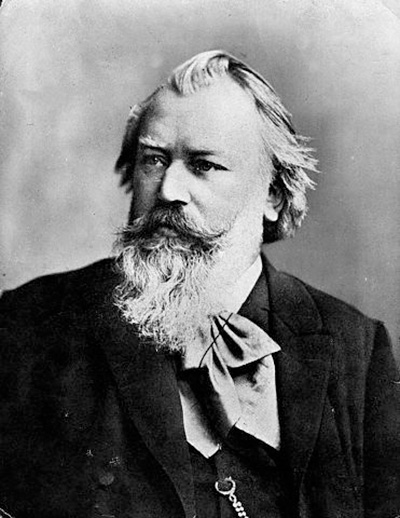
Born: May 7, 1833, Hamburg, Germany
Dead: April 3, 1897, Vienna, Austria
Concerto No 2 in B-flat Major for Piano and Orchestra, Op. 83
- Composed: 1878–1881
- Premiere: November 9, 1881, Alexander Erkel conducting the Budapest Philharmonic Orchestra with Brahms as pianist
- Instrumentation: solo piano, 2 flutes (incl. piccolo), 2 oboes, 2 clarinets, 2 bassoons, 4 horns, 2 trumpets, timpani, strings
- CSO notable performances: First: February 1896, Frank Van der Stucken conducting; Rafael Joseffy, piano. Most Recent: April 2017, Sir Andrew Davis conducting; Alessio Bax, piano. Notable: March 1963, Max Rudolf conducting; Van Cliburn, piano.
- Duration: approx. 46 minutes
Johannes Brahms completed his Second Piano Concerto in 1881 during a particularly enjoyable period in his life. His works were being widely celebrated throughout Europe, and he had set aside the voices of difficult music critics and his own self-doubts that had plagued him in earlier years. This more optimistic and confident phase was observed by contemporaries, including Eduard Hanslick, the composer’s friend and leading advocate, in the Viennese newspapers. In contrast to the tension and heroic struggles that characterize his First Piano Concerto (1859) and First Symphony (composed between 1855 and 1876), the Second Piano Concerto is relaxed and, at times, joyous. This lyricism and vibrancy also permeate many sections of works he completed around the same time, including his Second Symphony, Violin Concerto and Academic Festival Overture. Moreover, despite its length, Brahms completed the Second Concerto with less indecision and difficulty than his first.
After initially sketching the work in 1878, Brahms worked on the Second Concerto intermittently, completing it in the summer of 1881 while vacationing in Pressbaum, a village near Vienna. It’s a somewhat unusual concerto because it includes a scherzo-style movement immediately after the first movement, resulting in four movements instead of the standard three. Also, unlike other concertos, the piano acts as a full participant in developing the themes. Rather than a constant stream of virtuosic flourishes, the piano plays the themes while dialoguing with some of the orchestral instruments, or it accompanies the orchestra’s statements of the themes. Because of these characteristics, Hanslick famously described the concerto as “a symphony for orchestra with pianoforte obbligato,” a description that many commentators subsequently adopted. Of course, like other 19th-century concertos, the piano part is technically demanding, with passages that quickly cover the instrument’s entire range by using massive chords or extensive scale-like figurations. This blending of the symphonic development and concerto-style virtuosity is characteristic of Brahms’ widely admired violin concerto, though Brahms took it a stage further in the piano concerto.
Although Brahms was known to be gruff, especially when dealing with people he did not admire or know, his sense of humor was evident with close friends. He often used ironic terms when describing elements of new compositions that he expected critics to disapprove of. He referred to the new concerto as “the long terror” because of its unusual length and demands, and he referred to his friends who heard an early version of the work as “the victims.” He told Elisabeth von Herzogenberg, another trusted friend, that the concerto was “tiny tiny” with a “tiny tiny” scherzo, and he described the complex first and third movements as “simple.”
In the summer of 1881, Brahms tested the new concerto by playing his friends a version he had created for two pianos. Then he played the solo piano part during a private trial performance of the concerto with the Meiningen Orchestra, a world-class orchestra conducted by Hans von Bülow, one of his many supporters. The official premiere took place on November 9, 1881 in Budapest with Brahms himself performing the solo piano part. This concert also featured performances of his Academic Festival Overture and First Symphony, both conducted by the composer. Directly after the premiere, Brahms also appeared as the soloist in at least 19 performances of the concerto in Germany, Austria and The Netherlands, all of which used the handwritten manuscript of the work. Based on his experiences with these early performances Brahms made a few changes, and the final version of the score was published in July 1882. The last time Brahms performed the concerto was likely in March 1886 in a concert in Dresden; he later conducted it in concerts that often included his Academic Festival Overture.
American conductors and music lovers eagerly awaited the published score. In 1882, a writer for The New York Times complained that the concerto was being “kept from other orchestras” because the composer continued to perform it from the manuscript instead of publishing it. The long-awaited American premiere took place in December 1882, when a New York performance was led by Theodore Thomas, with Rafael Joseffy as the soloist. The audience reportedly gave the piece their “breathless attention,” and Joseffy, a well-loved Brahms interpreter, performed so impressively that he was brought back for four curtain calls. Thomas and Joseffy performed the work with orchestras in other cities, and, in 1896, Joseffy joined conductor Frank Van der Stucken for a performance with the Cincinnati Symphony Orchestra.
The concerto begins in a highly unusual and memorable way. Rather than chords from the full orchestra, a plaintive melody is played by the French horn, an instrument that recalls this theme later in the movement. The solo piano then begins a soft dialog with the horn before segueing into a louder, cadenza-like virtuosic passage, reminiscent of the piano’s entry in Beethoven’s E-flat Piano Concerto, a work that Brahms greatly admired. Finally, the full orchestra begins a more typical presentation of the movement’s main themes.
Although the second movement is marked “Allegro appassionato,” Brahms and his friends referred to it as a scherzo. Scherzos are often light and playful, but this one is tinged with the type of tragedy and drama that characterized the composer’s First Piano Concerto. It opens with a dramatic piano solo, but other instruments are also highlighted throughout the movement, as, for instance, when the horns, bassoon and clarinet present a chorale-like theme in the middle section of the movement.
Perhaps drawing on the concept of the opening horn in the first movement, the slow third movement begins with a gorgeous theme played by the solo cello. Although the piano presents the other themes, it never has this cello melody, and at one point it joins the other strings in quietly accompanying the cello’s performance of it. Brahms often recycled ideas in multiple works, and this opening melody is very similar to the one he used for his 1886 song Immer leiser wird mein Schlummer (“My Slumber Grows More and More Peaceful”). The text of this moving song tells of a dying girl valiantly trying to stay alive until her beloved arrives.
Just as the second movement began with a piano solo, so, too, does the Finale. However, while the second movement’s solo is loud and dramatic, the Finale’s is soft and playful, establishing the spirited mood of the entire movement. Lightly textured phrases, which alternate frisky and leisurely moods, feature liquid cascading piano solos and exposed writing for the winds. Ultimately, the piano joins the full orchestra in a triumphant conclusion.
© Heather Platt, Sursa Distinguished Professor of Fine Arts, Ball State University