Sergei Rachmaninoff
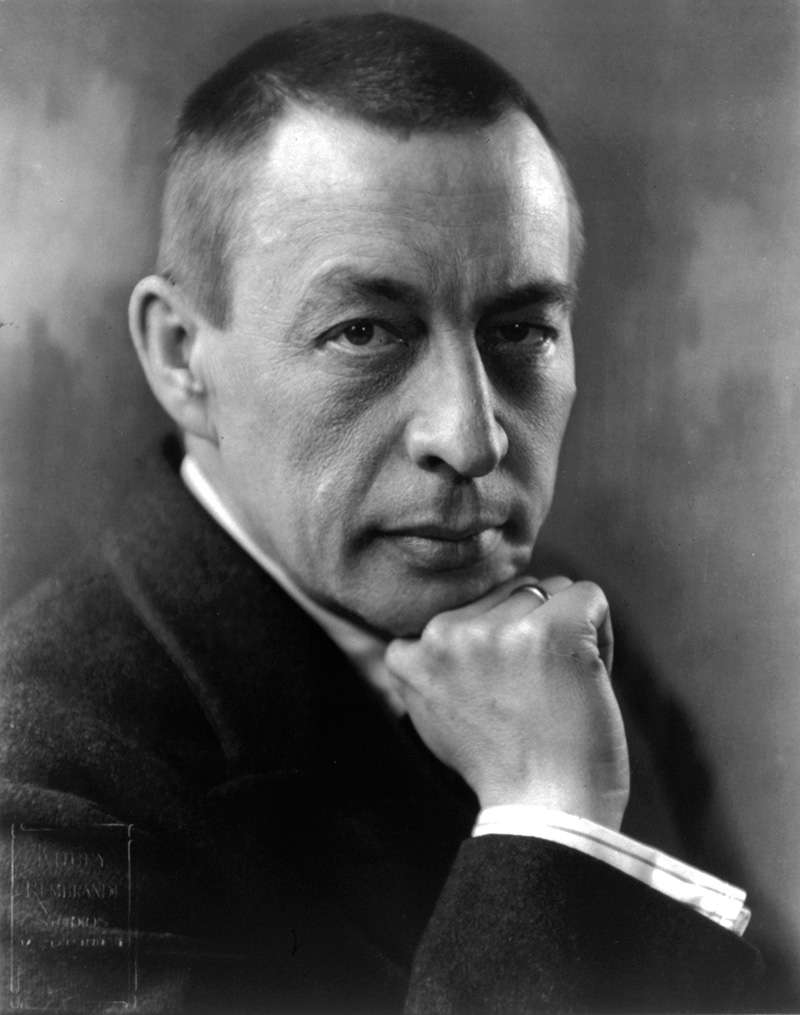
Born: April 1, 1873, Semyonovo, Russia
Died: March 28, 1943, Beverly Hills, California
Symphony No. 2 in E Minor, Op. 27
- Composed: 1906–1907
- Premiere: February 8, 1908, Mariinsky Theatre, St. Petersburg, Russia, Sergei Rachmaninoff conducting.
- Instrumentation: 3 flutes (incl. piccolo), 3 oboes (incl. English horn), 2 clarinets, bass clarinet, 2 bassoons, 4 horns, 3 trumpets, 3 trombones, tuba, timpani, bass drum, crash cymbals, glockenspiel, snare drum, strings
- CSO Notable Performances:
- First: February 1918, Henry Hadley conducting.
- Most Recent: May 2022, Louis Langrée conducting.
- Notable: As part of the 2009 Japan tour, Paavo Järvi conducting.
- Duration: approx. 60 minutes
To tell the stories of Sergei Rachmaninoff’s symphonies is to give a capsule biography of the composer. In this genre, aside from a student essay of which only the first movement survives, are three numbered symphonies, plus the choral symphony The Bells — each from a different period in the composer’s life. Together, they illustrate his unique artistic journey, his struggles, and his triumphs in Russia and in the West.
By the time Rachmaninoff wrote his first symphony at the age of 22, he had already established himself as one of the most talented Russian musicians of his generation. However, the premiere turned out to be a disaster. The conductor, Alexander Glazunov, a famous composer and professor at the St. Petersburg Conservatory, was apparently unsympathetic to the music of a Muscovite (there was an open rivalry between the two Russian capitals). The performance was evidently unconvincing and critics found the symphony seriously flawed — thrusting Rachmaninoff into such a state of depression that he was unable to write any music for three entire years. He only recovered his ability to work through the intervention of a psychiatrist who used hypnosis to restore his self-confidence.
Even so, and despite the resounding success of his Second Piano Concerto in 1901, it took several more years before Rachmaninoff attempted another symphony. In the meantime, he was extremely busy as an opera conductor at the Bolshoi Theatre in Moscow. Finally, in 1906, he made a radical decision. He cancelled all his engagements and left Russia in order to work on his composition projects undisturbed. Together with his wife and baby daughter, he took up residence in Dresden and worked on his Second Symphony there, as well as at his summer estate near Moscow. Premiered in St. Petersburg under the composer’s baton on February 8, 1908, the new work was well received. (Within a year, the symphony was also introduced to the United States, by Modest Altschuler and the Russian Musical Society in New York on January 14, 1909.) The years that followed — until the revolutions of 1917 and Rachmaninoff’s emigration — marked his most prolific period: the 1910s saw the birth of the Third Piano Concerto, two great liturgical works (the Liturgy of St. John Chrysostom and the Vespers), as well as The Bells.
After leaving Russia, by contrast, Rachmaninoff composed very little. His busy concert schedule as a virtuoso pianist left hardly any time for writing. Rachmaninoff settled in the United States, but soon acquired a villa in Switzerland, where he began to compose again during his vacations. It was there that he wrote his last important works, including the Rhapsody on a Theme of Paganini and the Third Symphony.
The Second Symphony begins with a Largo introduction whose opening motif, first presented by the cellos and basses, recurs in varied form throughout the symphony. Its main features are a stepwise motion (first ascending, then descending) and a rhythmic pattern with ties across the barline. This material dominates both the lengthy introduction and the subsequent main section of the movement. First soft and subdued, the main theme is gradually transformed, through variation and development, and reappears forte, played by the full orchestra. A second melodic idea is based on an alternation between woodwind and strings, and is brought to a climax, only to fade back to pianissimo. The beginning of the development section is marked by the return of the main theme as a violin solo. The theme is soon taken over by the clarinet and dissolves in fast-moving figurations in both winds and strings. After a new emotional high point, the recapitulation begins, focusing mostly on the second theme, now appearing in a major instead of a minor key. The coda, however, reverts to E minor, the main tonality, and brings the movement to a ringing close.
The second movement is a scherzo (a light-hearted fast piece) that also has a contrasting secondary theme, something that is more typical in sonata-form movements than in scherzos. The main melody is played first by the horns and then by the violins against a lively rhythmic background. The second theme, without being a direct quote of the first movement’s main idea, shares with it a stepwise motion and its characteristic rhythm. It is followed by a return of the main theme. The Trio (middle section) also contains two distinct materials: the first is played staccato (short, separated notes) by the violins, while the second, with brass and percussion as the protagonists, is a mixture of a march and a church hymn, with unexpected off-beat accents. A return to the main section brings back both of its themes, before the movement ends with some reminiscences of the march from the Trio.
The third movement Adagio begins with an expressive violin melody followed by a clarinet solo, in the mold of the symphony’s earlier themes, in stepwise motion. A third idea, played by the first violins, receives a counterpoint from the other strings and the woodwinds and leads back to the first theme, now heard in a full orchestral fortissimo. The middle section starts very softly with English horn and oboe solos. A new climax is reached, soon to recede into a decrescendo and, finally, a long silence. In the recapitulation the first theme is taken over by the horn. The other two ideas also return, in richer orchestration than before and contrapuntally combined with parts of the first theme. Like the second movement, the third also ends with an allusion to material heard in its middle section.
The Finale, written in a bright E major, starts with a fanfare-like theme played by the entire orchestra. It is followed by a transition with horns, timpani and double bass, leading into a march for winds, not unlike the one in the second movement. The main theme returns, then gives way to a broad melody, eventually winding down to pianissimo chords over a long-held pedal note. After a short recall of the third movement’s main theme, a development section begins with mostly new melodic ideas, among which a descending scale gains increasing prominence. The recapitulation brings back the fanfare, the march, the broad melody and the descending scale, combining them all in the symphony’s triumphant conclusion.
—©Peter Laki