Bohuslav Martinů
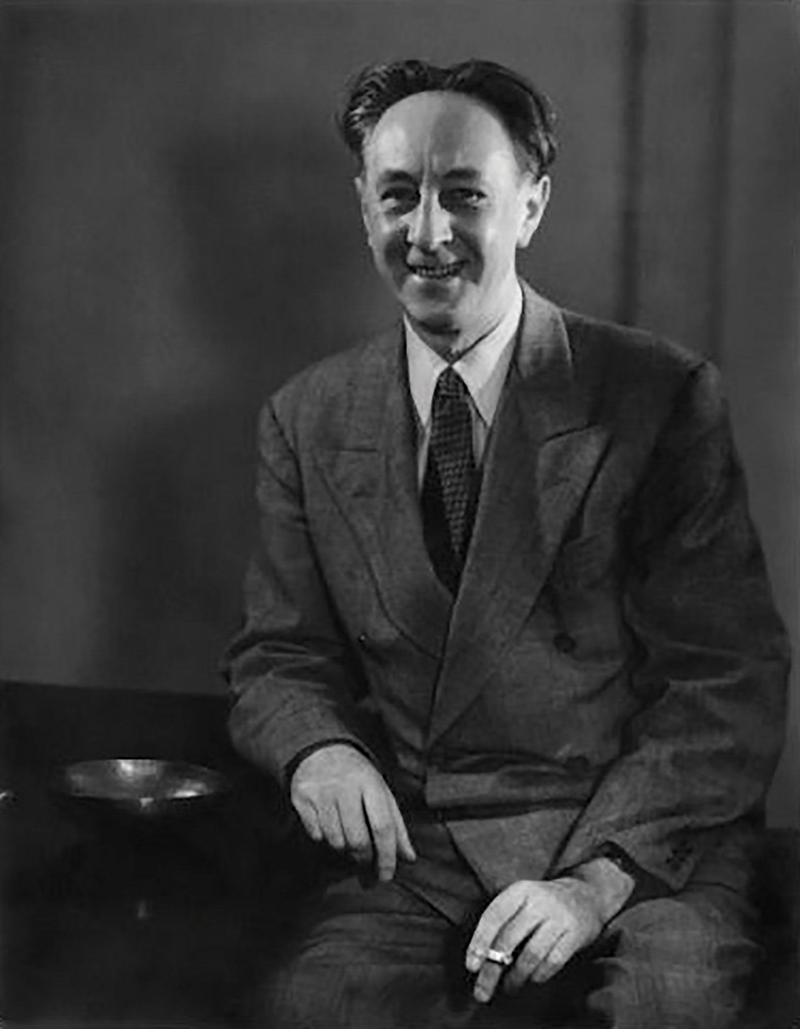
Born: December 8, 1890, Polička, Bohemia
Died: August 28, 1959, Liestal, Switzerland
La revue de cuisine, H. 161
- Composed: 1927
- Premiere: (concert suite) January 5, 1930, Paris
- Duration: approx. 15 minutes
When Gershwin’s Rhapsody in Blue was first performed in New York in 1924, it was billed, somewhat tentatively, as an “experiment” in the fusion of jazz and European-based classical music. In Europe, composers had been “experimenting” with the same fusion for some time, having been enthralled by this American art form ever since it first reached their shores. By the mid-1920s, composers like Igor Stravinsky, Paul Hindemith and Darius Milhaud had proven that the experiment worked. To them, jazz was refreshingly different from European music; it was exciting and “cool,” and it seemed to fit in naturally with many new artistic trends, from surrealism and Dada to exoticism and neo-classicism.
The undisputed center of European jazz was Paris, where many outstanding American musicians, from Sidney Bechet to Josephine Baker, made their homes. When the young Bohuslav Martinů moved from Czechoslovakia to the French capital in 1923 in order to complete his training in composition, he found himself in the middle of this vibrant scene, which he thoroughly enjoyed.
Poor and unknown, Martinů found access to Parisian intellectual circles partly through his composition teacher Albert Roussel, and partly through his compatriot Václav Nebeský, a prominent art critic, theorist and collector, who was living and working in Paris at the time and was well connected in the artistic circles of the city. For several years, the young composer lived with Nebeský and his family in a fashionable neighbourhood near several of the most frequented cafés in Montparnasse; this period was crucial for his artistic and intellectual development. In addition to Stravinsky, whose music he already knew, he encountered the music of the composers' collective "Les Six," Béla Bartók and Sergei Prokofiev — as well as, of course, jazz. As a result of all these new experiences, his musical style completely changed from the post-Romanticism and Czech national influences seen in many of his early works, and he embarked in new artistic directions, exploring many aspects of 1920s avant-garde.
The ambitious and extraordinarily prolific musician first attracted attention with a 10-minute orchestra piece called Half-Time (1924), which was inspired by a soccer game. His next work, La bagarre (“The Brawl”) received its premiere in Boston under Serge Koussevitzky. Increasingly in demand internationally, Martinů still maintained contact with his homeland. In 1927, he received an invitation to write a ballet score for Jarmila Kröschlová, an important pioneer of modern dance in Czechoslovakia. The resulting jazz-inspired Kitchen Revue was immediately appreciated in Martinů’s homeland, which, in the 1920s, already boasted a blossoming jazz scene with outstanding artists such as Rudolf Dvorský and Jaroslav Ježek.
The extremely versatile Kröschlová wrote the script and created the choreography for The Kitchen Revue, in addition to performing the ballet with her troupe. The commission was made possible by Nebeský’s wife Božena, who also received the dedication of the finished work.
In The Kitchen Revue, Martinů’s interest in jazz goes hand in hand with his predilection for all things grotesque. Kröschlová’s libretto, about the amorous entanglements of pots and pans in a kitchen, is itself a quintessential product of les années folles (the “crazy years,” as the 1920s were widely known).
In his book on Martinů, musicologist Miloš Šafránek, a long-time friend of the composer’s, summarized the plot as follows:
The marriage of Pot and Lid is in danger of being broken up by the restless, change-craving Twirling-stick, the most active character in the plot. Pot succumbs to the seductions of Twirling-stick and is so inflamed by passion that Lid, who sits on his head, falls off it and rolls away in a corner. Had it not been for the orderly Broom, Dish-cloth would have taken advantage of the situation to lure Lid from the path of virtue. But Broom challenges Dish-cloth to a duel, which sends Twirling-stick into an ecstasy, thus kindling still more the passions of the two belligerents, who eventually retire from the dueling-ground with broken limbs. Twirling-stick again turns her attention to Pot, but Pot longs for Lid, and Lid is nowhere to be found. Then somebody’s enormous foot appears before the footlights and kicks Lid on the stage, to the great joy of all. Broom takes Lid back to Pot, Twirling-stick and Dish-cloth break into a dance. Broom, Pot and Lid are the happiest trio in the world.
The Kitchen Revue received its premiere in Prague in November 1927, under the original title Pokušení svatouška hrnce (“Temptation of the Saintly Pot”). Three years later, Martinů arranged the ballet score as a concert suite that contains most of the music from the show. This suite was first performed in Paris on January 5, 1930.
The scoring, for clarinet, bassoon, trumpet, violin, cello and piano, is rather close to Stravinsky’s The Soldier’s Tale (1918), a particular favorite of Martinů’s, and also shares its jazz inspiration. Both works include a tango, as well as some march-like numbers with many irregular meter changes that would trip up anyone trying to actually march to the music. The Charleston movement is a tribute to a jazz dance form that was very much in fashion, just two years after Gershwin used it in his Concerto in F (1925).
In a concert performance, it is easy to overlook the precision with which Martinů’s music illustrates the various actions of the lustful kitchen utensils. For instance, when Twirling-stick stirs Pot, the violin and the cello play a repeated figure of turns around a central pitch. When Lid falls off Pot, the unaccompanied clarinet plays a rapid descending motif. One can easily visualize the duel between Broom and Dish-cloth when hearing the dramatically charged introduction to the third movement. And when, after all this drama, Pot and Lid are happily reunited, all the utensils seem to take a bow together in the melody that concludes the piece.
This light-hearted and unassuming work became one of Martinů’s most frequently performed compositions, one of which the composer, usually modest to a fault, admitted to being rather proud. The Parisian publishing house Leduc, which printed the suite in 1930, immediately gave the composer a contract for a whole group of other compositions. The Kitchen Revue was also one of Martinů’s first works to be recorded.
—©Peter Laki