Johannes Brahms
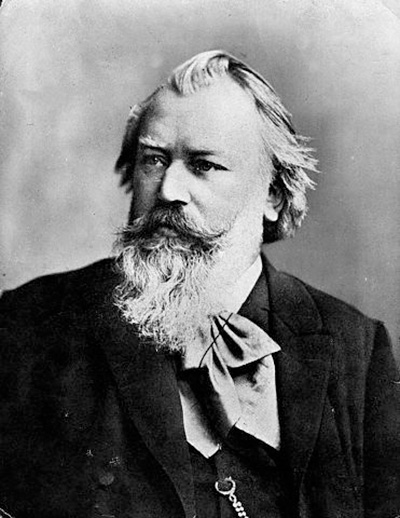
Born: May 7, 1833, Hamburg, Germany
Died: April 3, 1897, Vienna, Austria
Piano Trio No. 2 in C Major, Op. 87
- Composed: 1880 and 1882
- Premiere: 1882, Frankfurt am Main, Johannes Brahms, piano
- Duration: approx. 29 minutes
Johannes Brahms’ Op. 87 is the most joyous of his three piano trios. He composed it during one of the happiest periods of his life, when the success of each new composition was virtually assured. He wrote the first movement in the summer of 1880, during his vacation in the Austrian town of Bad Ischl, about 170 miles from his home in Vienna. He completed the remaining three movements in 1882 at the same location. Brahms adored the quiet pleasures of Ischl, where he could enjoy daily walks and relax with friends. Although he was on vacation and claimed to one friend that he was loafing around, those summers were remarkably productive: in addition to the Op. 87 Trio, he composed the widely popular Academic Festival Overture and the beautiful String Quintet, Op. 88.
Brahms had initially planned to write a pair of piano trios, completing first movements for each in 1880 and earning his friends’ praise for both. But he decided to finish only one, the Op. 87. Several years later, in 1886, he wrote another trio (Op. 101) that some believe is a partner of Op. 87. Coincidentally, this third trio also emerged during a summer vacation, this time in Hofstetten, Switzerland. Both Op. 87 and Op. 101 are more concise than his first trio, Op. 8, which Brahms wrote in 1853–54, at the beginning of his career. He had struggled with this early work and was so displeased with it that, in 1890, he drastically revised and shortened it. In contrast, Op. 87 came together with ease. Indeed, Brahms’ close friend Theodor Billroth, who heard the first movement of the Op. 87 Trio shortly after it was composed, praised the work as a product of “effortless creativity.” Brahms told his publisher that he was quite pleased with the work — an uncharacteristic remark for so self-critical a composer.
Brahms himself played the piano part in the early performances, including in the 1882 premiere in Frankfurt am Main. His lifelong friend Clara Schumann, a renowned pianist with keen musical judgment, was somewhat surprised by his decision to perform and was not pleased with the result. She remarked with some exasperation, “Brahms plays more and more abominably — it is now nothing but thump, bang and scrabble.” By this time, Brahms was mainly earning his living as a composer, and it was no longer necessary for him to concertize. While his playing technique was still powerful and he continued to perform his own works, some of his other friends witnessed similarly less-than-optimal performances.
The trio begins in an unconventional way, with the violin and cello introducing the first theme without the piano. In chamber works such as string quartets, each instrument is an independent voice, and all take turns playing the main melodies. In Op. 87, however, Brahms treats the cello and violin as a unit that balances the larger sound of the piano, and they frequently unite in presenting the main themes. This pairing contributes to the work’s orchestral-style sound, which has drawn the admiration of Brahms’ contemporaries and modern commentators.
The first of the four movements unfolds with a wealth of interwoven melodies, each emerging seamlessly from its predecessor. The opening theme reappears throughout, most notably in the middle section when the cello presents a sustained, lyrical transformation, with the piano softly accompanying in running figures. Curiously, the only time the piano plays this theme is when it joins the strings at the very end of the movement. Of course, the piano presents some of the other themes, including those in the second half of the first section. This passage features at least four ideas, each with its own rhythmic pattern. Despite their contrasting characters, Brahms achieves remarkable continuity, weaving them together with minimal transitional material.
The slow second movement consists of a theme and five variations. Its snap-like rhythms suggest the influence of Hungarian folksongs, a genre that also colors several of Brahms’ instrumental works. When the strings first present the theme, the piano counters with off-beat chords, functioning more like an independent voice than a submissive accompaniment. This type of rhythmic play recurs in the other movements as well. Remarkably, most of the variations are played softly, but the third is strikingly bold, beginning with forceful chords from each instrument. The following variations return to the soft dynamic level, but they are more lyrical than the previous ones, anticipating the central section of the next movement.
The Scherzo introduces an entirely different sound world. Its outer sections are hushed and mysterious. Rather than beginning with a lyrical melody, the strings play fast, low, repeated notes that start and stop in unexpected ways. The piano adds another layer of mystery with ghostly rising figures that don’t seem to lead anywhere. Its fast notes must be played softly and very delicately, which can be difficult for a pianist to maintain. The movement’s light staccato notes led Brahms’ contemporaries to suggest the influence of Mendelssohn’s fairy style, but the chromatic harmonies create a spookier atmosphere. Brahms would later revisit this ghostly atmosphere in his Op. 101 Trio, though it is not as haunting as here. The movement’s central section is characterized by a more traditional texture than the surrounding ones; it features a soaring, legato melody, first introduced by the violin.
The Finale’s marking of allegro giocoso (fast and playful) instantly encapsulates the movement, and also its departure from the complexities and tensions of the preceding movements. Some of the repeated-note figures in the accompaniment and the piano’s swirling figurations may recall the Scherzo, but here they take on a brighter, more buoyant character. Similarly, instead of continuing the previous movements’ tensions between the piano and strings, the instruments join forces in creating a relaxed mood. Critics have long admired its economy and concision, yet the movement also features an unusually expansive coda, nearly a quarter of its length. This coda begins with a broad, lingering version of the main theme that briefly suspends the prevailing momentum, but this mood quickly gives way to a grand fortissimo close with cascading phrases, crowning the work Clara Schumann declared to be “magnificent!”
—©Heather Platt, Sursa Distinguished Professor of Fine Arts, Ball State University