Edgard Varèse
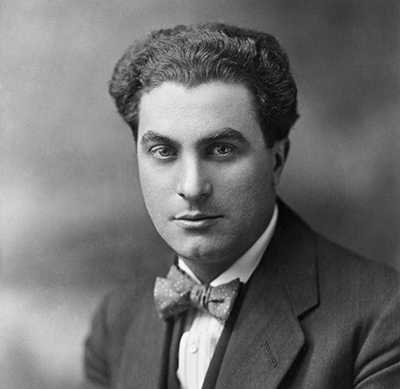
Born: December 22, 1883, Paris, France
Died: November 6, 1965, New York, New York
Déserts
- Composed: 1950–1954
- Premiere: December 2, 1954 at the Théâtre des Champs-Élysées in Paris, France conducted by Hermann Scherchen.
- Instrumentation: 2 flutes (incl. piccolo), piccolo, 2 clarinets (incl. E-flat clarinet), bass clarinet, 2 horns, 3 trumpets, 3 trombones, 2 tubas, timpani, Chinese blocks, metal sheet, vibraphone, tambour de basque, tom tom, slapstick, suspended cymbals, side drum, snare drum, maracas, guiro, lathes, gong, glockenspiel, field drum, cowbell, claves, chimes, bass drums, wood drums, two-channel magnetic tape, piano and strings.
- Duration: approx. 22 minutes
Film Production Credits:
Kira Perov Executive Producer
Peter Kirby Producer
Harry Dawson Director of Photography
Philip Esposito Actor
Dennis Kightley Art Director
Commissioned by ZDF German Television and Ensemble Modern.
Acoustic Limitations
In the same way that the development of photography techniques influenced the medium of painting, the invention of the magnetic tape recorder promised an exciting new intersection between electronic music and acoustic performance in the early 20th century. French composer Edgard Varèse was drawn to that notion, and he began testing the boundaries between the two media, with the support of an avant-garde social circle that included Satie, Villa-Lobos, Cowell, Trotsky and Picasso, among others.
As a young student at the Paris Conservatoire, Varèse had initially studied mathematics and engineering and thus he conceived music as a phenomenon of physics. In his understanding, “Not until the air between the listener's ear and the instrument has been disturbed does music occur.” The limitations of acoustic musical instruments frustrated him. He explained, “In order to anticipate the result a composer must understand the mechanics of the instruments and must know just as much as possible about acoustics. ... I need an entirely new medium of expression: a sound-producing machine, not a sound-reproducing one."
Upon his move to New York City in 1916, Varèse began absorbing the urban soundscape of the New World and pondered ways to marry it to musical composition. With Carlos Salzedo, in Greenwich Village he founded the International Composers’ Guild to premiere works by Bartók, Berg, Ives, Ravel, Poulenc and Webern. Some of Varèse’s earlier works, such as Density 21.5 for flute and Ionisation for percussion ensemble, had garnered public attention, but they still fell short of his dream of an unlimited sonic palette. With his 1924 Intégrales for winds, brass and percussion, he conceived “spatial projection,” that is, the placing of specific instruments in predetermined places within the hall, as a fundamental element of performance.
Eventually and perhaps inevitably, upon acquiring a magnetic tape recorder in 1953, Varèse began to pursue his idea of music that was engineered rather than performed. He returned to the New York factories and industrial zones that had caught his ear decades earlier, and he began to record their ambient sounds. From those recordings he cut and manipulated volume, duration, pitch, timbre and resonance to create three sequences, which he then wove into his work for brass, winds and percussion, Déserts. The underlying meaning of his title is significant: it was not merely sand dunes that the composer envisioned but rather “mountains and snow, outer space, deserted city streets … also this distant inner space where a human being is alone in a world of mystery and essential solitude.” Thus, the work was intended to be introspective rather than extroverted, contemplative rather than declamatory.
Déserts
The instrumental palette that Varèse draws from in this work is unusually broad. The two flute players both alternate with piccolo, while the two clarinet players double on E-flat clarinet and bass clarinet. In addition to calling for two horns and three trumpets, he reinforces the bass range with three trombones, bass tuba and contrabass tuba. The percussion section includes usual instruments such as piano, timpani, cymbals and a full range of drums, as well as instruments that are less commonplace, such as cencerro, guiro, claves, Chinese blocks and two lathes. Varèse juxtaposes the entire instrumental ensemble with recorded sound reproduced on two magnetic tapes, played through stereo speakers on cue by a sound engineer, who must then cue the conductor for the instrumental entrances.
Déserts falls loosely into seven sections that are not movements, per se, but organizational units perceived by the listener. The first section is instrumental, and it functions as an exposition in the sense that it presents the musical material from which the rest of the work is generated. The brass instruments produce bell-like attacks that are answered by real bells, with occasional punctuation from xylophone and cymbals.
The first interpolation of electronic music follows. Beeps, scrapes and an unstable rumble in the bass are answered by percussion, leading into wailing glissandi and further bell strokes that recall the opening section.
The second instrumental section superimposes contrasting timbres in low, medium and high registers, to create an interplay of pitches and dynamics, and builds to a fortississimo outburst. Several new motives follow in the form of dialogues between wind and percussion, interspersed with silence.
The second interpolation of recorded music is centered on the percussion section. Relying on silence as much as sound, sporadic attacks from individual instruments evolve into two- and three-note motives, and then into polyrhythms. The woodblock and timpani then transition into the third instrumental section. That section is the most concise, but also the most ominous. After a violent opening, it settles into a rhythmic motive that passes around the ensemble, dissolving into longer and longer silences.
The third interpolation is the most emotionally taxing for the listener. Industrial and ambient sounds transform into layers of percussive blows, until a sequence of pulsing, sliding pitches builds upon itself toward a climax.
The final instrumental section seems to invoke images of decomposition. Several isolated sections of percussion motives gradually break down, settle into longer and longer silences, and eventually dissolve into emptiness, evoking the deserts of the work’s title.
Théâtre des Champs-Élysées
Parisian audiences in the early 20th century had a reputation for making their displeasure known aloud during live performances. The premiere of Déserts took place in the Théâtre des Champs-Élysées, which had been the site of another notorious audience disruption: the premiere of Stravinsky’s Rite of Spring (which was most certainly not the full-on riot of urban legend, but was unruly, nonetheless). The response to Déserts was particularly vitriolic for reasons that are obvious in hindsight: the work was sandwiched between pieces by Mozart and Tchaikovsky, and no attempt was made to prepare the conservative audience for what they were about to hear.
The premiere performance in December 1954 was broadcast live from the theater on OTRF, France’s radio and television broadcast corporation. The full recording of the broadcast, which is available online, is revealing. At around the 5:38-minute time stamp, audience members are heard to shout “Ta gueule!” and “Assez!” (“shut up!” and “that’s enough!”) and the full house bursts into laughter at several points throughout. Heckling punctuates the performance every several minutes and is countered with shushing.
Yet the conclusion of the work tells a more nuanced story. The final chord provokes an outburst, “C’est trop lent” (“it’s too slow!), followed by laughter, and a bit of booing is heard, but then the full audience responds with enthusiastic applause, with some even cheering and whistling, for a full two minutes. It seems as though at least some of those present understood the significance of the performance: a milestone in the innovative combination of instrumental and electronic forces to produce a masterful, unified creation possessing a depth that neither could accomplish alone, one in which sound, not the musical note, is the DNA of the artwork.