Alexander Scriabin
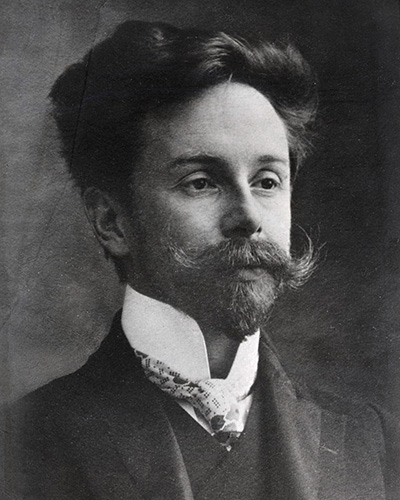
Born: January 6, 1872, Moscow, Russia
Died: April 27, 1915, Moscow, Russia
Symphony No. 5, Op. 60, Prometheus: Poem of Fire
- Composed: 1908-1910
- Premiere: March 2, 1911, Moscow, Russia
- Instrumentation: solo piano, 3 flutes, piccolo, 3 oboes, English horn, 3 clarinets, bass clarinet, 3 bassoons, contrabassoon, 8 horns, 5 trumpets, 3 trombones, tuba, timpani, triangle, suspended cymbals, bass drum, tam tam, chimes, glockenspiels, suspended cymbals, celeste, organ, clavier à lumières and strings.
- Duration: approx. 21 minutes
The Russian composer Alexander Scriabin (1872–1915) was obsessed with the idea that a work of art could change reality. He believed that the vibrations produced by the combination of sound and light could produce sympathetic resonance in the human body, dissolving matter and promoting spiritual advancement. In the final years of his life, Scriabin planned to create a Mysterium, a massive multimedia ritual combining music, colored lights, dancers, drama, architecture and scents, but these grandiose ambitions were cut short by his death in 1915. Scriabin’s fifth symphony, Prometheus: Poem of Fire, Op. 60, composed over the years 1908–1910, remained his final large-scale composition and his only experiment combining music and color.
The British critic Arthur Eaglefield Hull once called Scriabin’s Prometheus “the most densely theosophical piece of music ever written.” Hull was referring to Scriabin’s well-known admiration for Helena Blavatsky, the spiritual leader of the Theosophical Society, a global esoteric movement founded in 1875. Scriabin was never a member of the society, but he subscribed to its publications and consulted Blavatsky’s The Secret Doctrine as he was completing his fifth symphony.
Blavatsky proposed a novel interpretation of the myth of Prometheus, the rebellious Titan who defied Zeus by stealing fire from the gods and, as punishment, was chained to a rock for eternity. Blavatsky believed that Prometheus Bound, written by the Greek poet Aeschylus in the mid-5th century BCE, had been the central drama in the ancient Sabazian mysteries, a reenactment of the origin and spiritual evolution of humanity. She viewed Prometheus’ theft of fire as an allegory for the moment in which human beings acquired the “sacred spark” of intellect and creativity, which connected the human soul to the divine spirit of the cosmos. Scriabin’s Prometheus, Poem of Fire may be heard as an abstract theosophical mystery drama that both portrays cosmic history and, like the Mysterium, attempts to accelerate human spiritual enlightenment through an awe-inspiring aesthetic experience.
According to theosophy, music, color, electricity and other natural forces were derived from a single spiritual force called “Akasha,” after the Sanskrit word for limitless space. This conception likely informed Scriabin’s decision to write a tone poem scored for large orchestra, organ, choir, virtuoso solo piano and a mysterious electric instrument called the tastiera per luce. The luce, or “keyboard for light,” was supposed to project a dance of changing colors coordinated with the music. In Moscow, Scriabin worked with an electrical engineer to design a luce for the work’s 1911 premiere, but he decided to withdraw the luce from first performance due to “technical difficulties.” The first fully lighted performance of Prometheus occurred in 1915 at Carnegie Hall with the Russian National Orchestra accompanied by a lighting apparatus designed by engineers at Edison Testing Laboratory. Despite having the most advanced theatrical lighting system of its time, the Edison luce still could not produce the quick color changes and incredible special effects that Scriabin notated in his 1913 autograph copy of the score, such as lightning, fireworks and tongues of flame. In the century that followed, Scriabin’s Prometheus was often performed without lights, or it was performed with vague atmospheric color changes that did not follow the composer’s notation. In recent decades, technological advances have made it increasingly feasible to come closer to Scriabin’s original lighting notation.
The lush textures and soaring melodies of Prometheus resonate with music belonging to the 19th-century orchestral tradition, but its experimental harmonic language places the Poem of Fire firmly in the 20th century. Like other compositional innovators of his time, Scriabin avoided the major-minor tonal system. Instead, he composed Prometheus using a six-note scale comprising the “mystic chord,” which gives the work its unsettled, otherworldly sound. The changing colors of the luce not only help contribute to the mystical atmosphere but also have an intimate relationship to the music’s structure. A faster-moving sequence of colors corresponds to the rhythm and harmonic changes, while slower moving colors divide the work into sections corresponding to Blavatsky’s seven-stage narrative of human cosmic development.
Scriabin’s expressive score markings and early explanations of the work suggest that he imagined Prometheus as a theosophical cosmic ritual: The first three color stages of dark blue violet, fuchsia and grey represent the emergence of the human spirit from absolute divine cosmic unity. Scriabin called the horn’s opening melody the “theme of will.” This theme is accompanied by a “misty” dark blue violet, which he designated “the most spiritual color.” The piano enters with a fiery cadenza, suggesting its role as the Promethean hero, a part that Scriabin performed himself at the Moscow premiere. A violent red marks humanity’s complete descent into matter, and the piano’s concerto-like battle with the orchestra represents the metaphysical struggle between spiritual and material aspects. The yellow episode presents a recapitulation of themes heard in the opening of the work, but it also prepares the human spirit for dematerialization and final ascent to rejoin the divine cosmos. The chorus, who originally wore white to signal their role as ritual celebrants, enters with a mysterious wordless hum. As the large-scale color sequence returns to the opening dark blue violet, the chorus grandly sings “Eaohoaoho,” a mantra from The Secret Doctrine that invokes “eternal living unity.” The pianist begins a jagged, ecstatic ritual dance, which Scriabin described as a “dance among the flames,” and the work ends in “a whole sea of light and fire,” indicating an apocalyptic spiritual transcendence.
Scriabin’s use of color in Prometheus, Poem of Fire has often been viewed as evidence that the composer had synesthesia, a cognitive condition in which individual chords or keys elicit a corresponding color-image in the listener’s perception. However, close musical and historical analysis reveals that the colors were part of an intentional compositional design informed by Scriabin’s esoteric philosophy and his ambitions to create a multimedia ritual that would elevate the human spirit through the stimulation of multiple senses and the coordination of complex color-music vibrations.
© Dr. Anna Gawboy