Eclectic Mass
(with music by Carlos Simon, Giovanni Pierluigi da Palestrina, Johann Sebastian Bach, Margaret Bonds and George Frideric Handel)
- Eclectic Mass Instrumentation: SATB chorus, baritone soloist, narrator, 2 flutes, piccolo, 2 oboes, English horn, 2 clarinets, bass clarinet, 2 bassoons, contrabassoon, 4 horns, 3 trumpets, 3 trombones, tuba, timpani, bass drum, bell tree, chimes, China cymbal, congas, cowbell, crash cymbals, crotales, egg shaker, glockenspiel, marimba, mark tree, shaker, snare drum, splash cymbal, suspended cymbals, tam-tam, tambour de Basque, temple blocks, tom-toms, vibraphone, wood block, xylophone, drum set, electric bass, electric guitar, harp, piano, harpsichord, electric organ, strings
- Duration: approx. 56 minutes
What is a Mass?
The Mass is the most important service in the Roman rite, a ritual designed to commemorate, through the celebration of the Eucharist, the Last Supper of Jesus with his disciples (Luke 22:14–20). The word “Mass” is derived from its final words, “lte, missa est” (“Go forth, the Mass is ended”). The history and development of the Mass began with the early Christians of the Roman Empire, and its structure, components and rituals have changed throughout the centuries with interventions and codifications by various Catholic councils.
By the 7th century, the Mass had developed an intricate liturgy of chants, prayers and readings, which, over time, were organized in a framework of parts. The Mass has two large divisions: the proper of the Mass (includes texts that vary) and the ordinary of the Mass (includes texts that remain the same from Mass to Mass). Each of these divisions is further divided into sung and spoken parts.
As far as historians can tell, music has been part of the Mass from its inception. In fact, the opening pages of almost any book on Western music history would feature a long passage on the Mass. The early Catholic Church, with its power, wealth and status, provided a vast treasure of writings about music, music practices and music scores that survives to today, thereby creating historical documentation that is more complete than any other musical practice from before the Renaissance (15th–16th centuries).
The sung parts of the ordinary have become the primary focus of musical settings of the Mass. The sung ordinary of the Mass has five sections: Kyrie, Gloria, Credo, Sanctus and Agnus Dei (the benediction, or lte missa est, is often included as part of the official ordinary, but, by the 1400s, composers largely ignored this section).
The Renaissance era saw an explosion in composers writing for the ordinary of the Mass. During this era, so many new settings of the Mass were composed that, at the Council of Trent in 1562, the practice of how Masses were composed was a topic of discussion. Setting the ordinary of the Mass to music waned after the Renaissance, as composers turned to other large-scale forms of expression.
The Eclectic Mass
The May Festival’s performance of their own Eclectic Mass uses the ordinary of the Mass as a framework. Each of the five parts of the Mass is represented, but instead of the music being from a single composer, the Eclectic Mass pulls together works from a variety of sources and centuries. The principal material is from Carlos Simon’s Good News Mass, which was written in 2025. After the introit, the sonic world of the late-Renaissance composer Giovanni Pierluigi da Palestrina (1525–1594) is heard, followed by the 1700s and Johann Sebastian Bach and the mid-20th century American sound world of Margaret Bonds. The Eclectic Mass fragments the idea of the Mass ordinary and then reassembles it using voices that span centuries, continents and cultures.
Giovanni Pierluigi da Palestrina
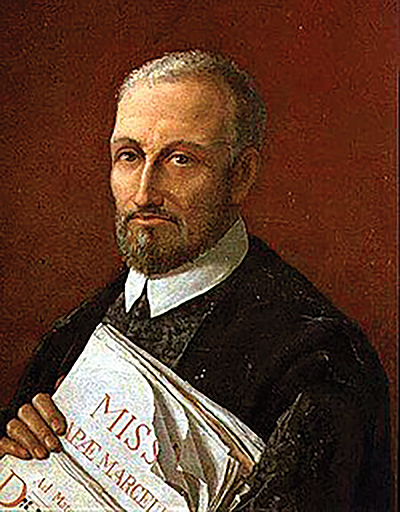
Born: Between February 3, 1525 and February 2, 1526, Palestrina, Papal States
Died: February 2, 1594, Rome, Papal States
Songs
- Instrumentation: with Zemlinsky’s Symphonic Songs; Norpoth arr.), soprano and baritone soloists, 2 flutes (incl. alto flute), piccolo, 3 oboes (incl. English horn), 3 clarinets (incl. E-flat clarinet, bass clarinet), 3 bassoons (incl. contrabassoon), 3 horns, 3 trumpets, 3 trombones, tuba, timpani, bass drum, crash cymbals, glockenspiel, high hat, jazz drums, rute, snare drum, suspended cymbals, tam-tam, tambour de Basque, triangle, vibraphone, wood drum, harp, piano, celeste, strings
Duration: approx. 22 minutes (with Zemlinsky’s Symphonic Songs)
Palestrina’s compositions defined the style of his time, and this style is principally based on his 105 Mass settings. Within Western music history, Palestrina’s style was the first to be deliberately preserved, taught and mimicked in later ages, including in 1725, when Johann Joseph Fux wrote his influential counterpoint book Gradus ad Parnassum (“Steps to Parnassum”) to teach young composers the style of Palestrina, or the stile antico (“old style”). (Fux’s counterpoint exercises can still be found in modern music theory textbooks and is the subject of semester-long courses in undergraduate and graduate training at music conservatories.)
Palestrina received his music education in Rome. He was appointed maestro di cappella of the Cappella Giulia at St. Peter’s Basilica by Pope Julius III in 1551. He was forced to leave that post in 1555 because of an order by Pope Paul IV, who decreed that all papal choristers should be clerical. Since Palestrina was a layman (he had married early and had four children), he could not continue as a papal chorister. But Palestrina returned to the Cappella Giulia under a new papacy in 1571 and remained there until his death.
Palestrina composed hundreds of works, including 105 Masses, more than 300 motets, 140 madrigals and much, much more, but it is his sacred music for which he came to be the almost legendary figure he is today.
During Palestrina’s lifetime, the debate within the Church was how the florid polyphonic lines of the music made the text hard to understand. His style, however, focused on text clarity with simpler melodies that almost resemble plain chant. The lines are often long, with most stepwise motion in rhythmic variety. Palestrina’s melodies are often composed of long lines with rhythmic variety and move by stepwise motion. He often abandons imitation and counterpoint for a homophonic texture (all voices singing in the same rhythm), allowing the text to be more easily understood.
Johann Sebastian Bach
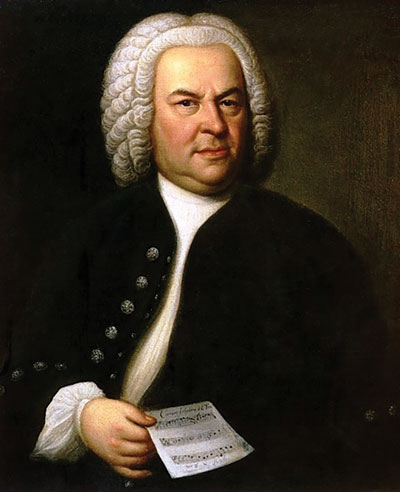
Born: March 21, 1685, Eisenach, Germany
Died: July 28, 1750, Leipzig, Germany
Johann Sebastian Bach was a prolific composer of the late Baroque period. He spent much of his adult life in service to the Lutheran church, and he was highly dedicated to German sacred music, having written more than 200 church cantatas, the St. Matthew Passion and St. John Passion, and numerous organ and keyboard works for church services.
The Gloria in Excelsis Deo, BWV 191, cantata began as a partial setting of the ordinary of the Mass. In 1733, Bach composed the Kyrie–Gloria Mass in B Minor, which included a Kyrie in three movements and a Gloria in nine movements. He wrote the work after the death of Augustus the Strong (the Elector of Saxony) and dedicated to the new sovereign, Frederick Augustus II. Bach sent the composition to Augustus II with the hopes that he might be appointed a court title, despite the compositional issue at hand — how a Lutheran church musician would appeal to a Catholic sovereign. Bach’s solution was to use the Kyrie and Gloria sections of the ordinary of the Mass, which the Lutherans and Catholics shared. Bach did receive an appointment to the Dresden court, but not until 1736. He used the Kyrie–Gloria Mass in B Minor again in 1748 as part of the now-iconic Mass in B Minor (BWV 232).
Bach wrote the Cantata BWV 191 in Leipzig for inclusion in a Christmas Day service. It is the only cantata within Bach’s oeuvre with a Latin text. The chorales are also unusually (for his cantatas) scored for a five-part choir that includes two soprano parts. The first movement of this cantata is almost identical to the first Gloria movement in the Kyrie–Gloria Mass in B Minor. The third movement, “Sicut erat in principio,” Bach developed from the “Cum sancto” movement of the Kyrie–Gloria Mass in B Minor.
Margaret Bonds
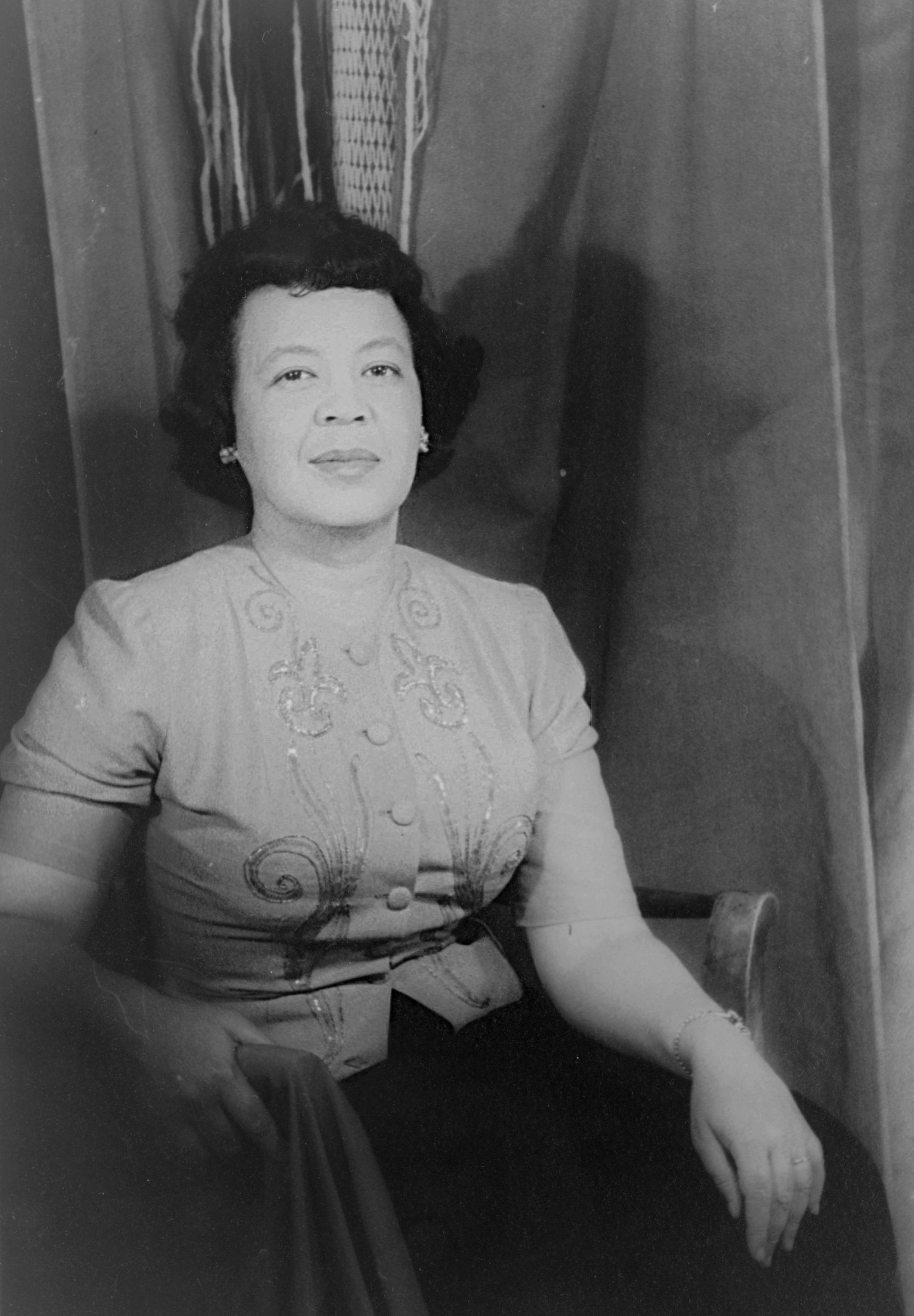
Born: March 3, 1913, Chicago, Illinois
Died: April 26, 1972, Los Angeles, California
W. E. B. Du Bois’ (1868–1963) Credo, which was first published in 1904 and revised in 1919–20, serves as the text to Margaret Bonds’ Credo. Within the framework of the ordinary of the Mass, the Credo is the setting of the Nicene or Apostles’ Creed. A Creed (from the Latin “Credo,” meaning “I believe”) is described in the Catechism as a “sign of recognition and communion between believers … a summary of the principal truths of the faith.” In John Michael Cooper’s book Margaret Bonds: The Montgomery Variations and Du Bois Credo, Du Bois’ Credo is said to be “a series of short, discrete, but topically and circumstantially related professions of belief — statements that, typically for manifestos, outline and justify a program for sweeping societal reform.”
Du Bois was a prominent leader of the Niagara Movement, founded in 1905 to oppose racial segregation and disenfranchisement while seeking equal rights. In 1909, Du Bois was also one of the founders of the National Association for the Advancement of Colored People (NAACP) . His prolific writings were aimed at the subjects of equality, racism and discrimination.
Of Du Bois’ Credo, Cooper writes:
The text of Credo was widely read, republished, and circulated for years to come, emerging as one of the most iconic texts of the Civil Rights movement before Martin Luther King, Jr.’s “I Have a Dream” speech. The text is a masterpiece of the strategy of dual-perspective: its verbiage of racial harmony and scriptural images of children in green pastures beside still waters — language designed to convince skeptical Whites that Du Bois was committed to a racial harmony founded in the Judeo-Christian institutions that they professed to adhere to — is nested in a fierce pride in Black lineage and self, condemnation of war, and (most importantly) the overarching thesis that racial equality and justice were not things that were granted by humans (let alone White society), but rather were divinely ordained. The text begins by proclaiming belief in God, and then proceeds to characterize God in each of its nine articles — so that the closing exhortation for “patience” emerges as an exhortation to perseverance in God’s divine mandate for racial equality.
Du Bois’ Credo opens Darkwater: Voices from Within the Veil, his 1920 autobiography that also contained essays, spirituals and poems. Darkwater is where Bonds read the Credo, but when she read it is unknown. Bonds completed the piano and vocal version of Credo by August of 1965, and, in October of that year, she wrote to Langston Hughes: “I live so much under the guidance of the Divine, I know there had to be a reason for me to set those words, so in time, something good will happen with ‘Credo,’ and sometimes in my own mind I hear it.”
The piano and vocal version premiered in Washington D.C. on March 12, 1967, with Bonds at the piano and choral director Frederick Wilkerson. Bonds writes about this concert in a letter to Langston Hughes on November 23, 1966: “The W. E. B. Dubois [sic] ‘Credo’ will be the star. It’s a very serious piece in the American idiom. It has some lines that are controversial — but I’m sure every line contained its Universal Truth — and with my Universal Language — Music — the Public will hear.”
Bonds began work on the orchestral version of Credo on January 12, 1966, which was to be performed at a concert in New York alongside some of her other chorus and orchestra music, including The Ballad of the Brown King. But this performance never came to be. The orchestra and chorus version of Bonds’ Credo was premiered in San Francisco by Albert McNeil and his McNeil Jubilee Singers. This was the last performance of the Credo in Bonds’ lifetime.
Bonds dedicated her Credo to the “memory of Abbie Mitchell and Langston Hughes.” Abbie Mitchell was a German, Jewish and African American soprano and close friend and collaborator of Bonds’ who also performed the role of Clara at the premiere of the Gershwins’ Porgy and Bess.
Bonds’ Credo would remain unpublished until 2020. The first complete performance of the piano and vocal version since the composer’s death was given in February 2022 by Conspirare, conducted by Craig Hella Johnson.
One year after Bonds’ death, on April 29, 1973, Albert McNeil mounted a performance of her Credo by the Compton Civic Symphony Orchestra and the Los Angles Jubilee Singers (Hans Lample, director). Shirley Graham Du Bois, W. E. B. Du Bois’ widow, attended this performance and reported it was “one of the most moving moments of [her] life.” She described Bonds’ Credo as “a work of art that is eternal — that will live as long as people love each other and really believe in brotherhood.”
—©Tyler M. Secor
About Carlos Simon’s Good News Mass
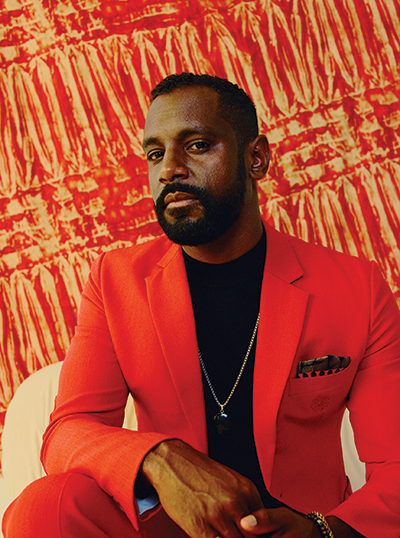
Born: 1986, Washington, D.C.
- Work Composed: 2022–2025
- Premiere: April 2025 Gustavo Dudamel conducting the Los Angeles Philharmonic
A metaphysical miracle critical Mass
materially pressed of human flesh
God breath and star dust
Hallowed be...
—poetry from Good News Mass (2025) by Marc Bamuthi Joseph
“God is here!” These three words resound as both proclamation and invitation in Carlos Simon’s Good News Mass, a groundbreaking orchestral composition with choir, soloists and spoken word artist that merges gospel fervor with the liturgical structure of the Catholic Mass. With libretto by Courtney Ware and poetry by spoken word artist Marc Bamuthi Joseph, this work navigates the deep waters of human experience — loss, thanksgiving, joy and hope — asking us to reflect on the divine presence in life’s struggles and triumphs. Infused with the rich traditions of African American spirituality, Good News Mass elevates the sounds of praise, storytelling and supplication into a transcendent musical experience.
Simon, a multi-genre composer shaped by his Pentecostal upbringing and Western-style conservatory training, creates a dialogue between his gospel music heritage and the traditions of the Black Catholic community. Drawing from his gospel roots, he joins a lineage of African American composers who have reimagined the Mass form, from Mary Lou Williams and Florence B. Price to contemporary artists like Kim Harris, M. Roger Holland, Robert Ray and Damien Sneed. In Good News Mass, Simon not only honors this legacy but also pushes it further, blending sacred traditions with multi-genre ingenuity to craft a Mass of, and for, our time.
As Simon explains, Good News Mass “explores the ups and downs of being human and finding God in the midst of it all. What does it mean to question the existence of God? Where is God during our seasons of loss? How is God experienced in times of joy and hope?” The composition is both deeply personal and universally resonant, offering listeners a liturgical journey of introspection and celebration….
Simon’s hallmark ability to weave together diverse musical idioms shines through, combining gospel harmonic syntax, choral grandeur, spoken wordsmithing and orchestral brilliance. Moreover, a unique feature of Good News Mass is its emphasis on orature, that is, the oral literatures central to Black religiosity. Joseph’s poetry recalls the West African griot tradition, enriching the performance’s narrative depth.
The multi-genre soloists, spoken word artist, and choir infuse the performance with the textures of traditionally versatile “Black church” worship: Hammond B3 organ, congregational singing, gospel choir antiphony and altar-call zeal, all underscored by Simon’s orchestral mastery.
Commissioned by the Los Angeles Philharmonic, National Symphony Orchestra, Sphinx Symphony Orchestra and Boston Symphony Orchestra, Good News Mass stands as a testament to the vitality of Black sacred music in contemporary classical spaces. Simon’s work not only affirms the divine in our midst but also reminds us that music itself can be a vessel of healing, hope and love. —Alisha Lola Jones