Margaret Bonds
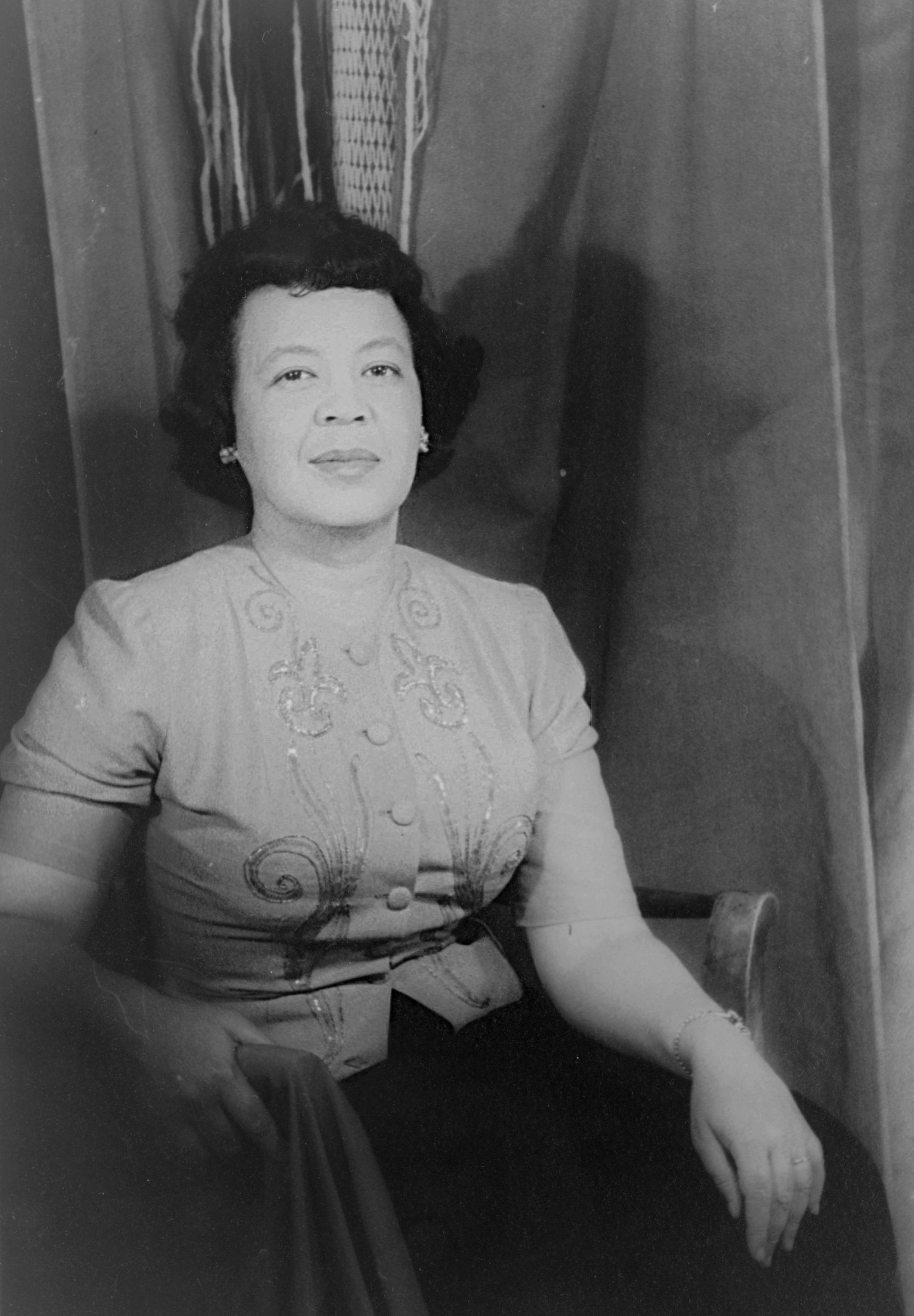
Born: March 3, 1913, Chicago, Illinois
Died: April 26, 1972, Los Angeles, California
Songs
- Instrumentation: with Zemlinsky’s Symphonic Songs; Norpoth arr.), soprano and baritone soloists, 2 flutes (incl. alto flute), piccolo, 3 oboes (incl. English horn), 3 clarinets (incl. E-flat clarinet, bass clarinet), 3 bassoons (incl. contrabassoon), 3 horns, 3 trumpets, 3 trombones, tuba, timpani, bass drum, crash cymbals, glockenspiel, high hat, jazz drums, rute, snare drum, suspended cymbals, tam-tam, tambour de Basque, triangle, vibraphone, wood drum, harp, piano, celeste, strings
Duration: approx. 22 minutes (with Zemlinsky’s Symphonic Songs)
In 1971, composer/pianist Margaret Allison Bonds participated in one of the few interviews conducted during her lifetime. In contextualizing her life and music within the larger genealogy of composers and concert artists that framed the Black classical aesthetic, she asserted, “I realized, very young, that I was the link … between Negro composers of the past. … You see my mother was friends with all of them. So, I realized that I was the link between these older people and the contemporaries.”
Indeed, by 1971, Bonds had proven to be part of the vanguard of composer/artists that advanced new sounds and approaches within the post-World War II concert hall. Born in Chicago in 1913, Margaret Bonds exemplified Black exceptionalism and excellence. Groomed in an environment that teemed with creativity, self-actualization and civic consciousness, Bonds emerged as a gifted and acclaimed pianist. As her compositional voice emerged, it bore the hallmarks of Chicago’s soundscape — blues, jazz, gospel.
Bonds emerged as a key cultural and musical voice as the Black Renaissance Movement in Harlem and Chicago transitioned into the mid-century Black civil rights movement. Where other Black composers wrestled with modern compositional approaches like atonality and serialism, Bonds continued to draw from Black music idioms such as gospel and jazz, establishing them as emblems of a Black post-modern aesthetic that shifted away from the musical language of Romanticism that permeated the music of New Negro-era composers. Her art songs and large-scale choral works advanced the poetic voices of Countee Cullen and Langston Hughes, as articulators of a new and radical form of Black consciousness that would correlate with the burgeoning wave of activism that permeated the last half of the 20th century.
While Bonds did not restrict her cultural and intellectual labor to the classical realm, it is that portion of her catalog that has been preserved both in score and performance more than any other. But it should be noted that, like many of her contemporaries, Bonds endured the bias of the publishing industry throughout her career, so many of her works remained unpublished at the time of her death in 1972. Despite these professional obstacles, many of her compositions circulated, in manuscript form, among performers. It was within this shadow culture, and a cultural infrastructure of churches, grassroots music organizations, Black colleges and a circle of musicians, that Margaret Bonds’ music thrived and became part of a “secondary canon” that was cultivated by Black and white concert artists for decades.
Art songs form a considerable part of Bonds’ catalog, and, through her settings of the poetry of Black writers, they reflect her desire to illuminate the historical and cultural significance of Black folk and their expressive culture. The songs featured in this concert exemplify Bonds’ engagement with the literary vanguard of the Harlem Renaissance and the eclecticism of her professional experiences.
Bonds found substantial work writing pop songs, producing jazz arrangements and writing for theatre productions throughout her career. The eclecticism of sound that framed these different professional settings provided some of the primary emblems that mark Bonds’ compositional voice — beautiful melodies, sensitive settings of poetry, rich and colorful harmonic settings, and complex rhythmic patterns. "April Rain Song" is an example of the popular songs Bonds composed. Until recently, this was a lesser-known facet of her catalog.
"To a Brown Girl Dead" is a solemn setting of Countee Cullen’s poem that marks the death of an unnamed Black girl. The melancholy nature of the work is established by a sequence of steady, half-note chords. As the song grows, the harmonies become more colorful and expansive, underscoring Cullen’s elegy for one whose beauty is unrecognized until death.
The remaining songs reflect Bonds’ continuous engagement with the poetry of close friend and collaborator Langston Hughes. Considered the leading voice of the Harlem Renaissance literati, Hughes was key to the development and progression of Bonds’ racial consciousness during her difficult years at Northwestern University. As one of the few Black students enrolled at the institution in the 1930s, Bonds faced overt discrimination:
I was in this prejudiced university, this terribly prejudiced place. … I came in
contact with this wonderful poem, “The Negro Speaks of Rivers,” and I’m
sure it helped my feelings of security. … And if I had any misgivings, which I would
have to have — here you are in a setup where the restaurants won’t serve you and
you’re going to college, you’re sacrificing, trying to get through school — and I know
that poem helped save me.”
Bonds finally met Hughes in 1936 and soon afterward set "The Negro Speaks of Rivers" to music. Although Bonds originally wrote the song for solo voice and piano, she later set it for mixed voices. The poetry surveys historical bodies of water adjacent to spaces inhabited by Black people. It moves from the Euphrates in Asia Minor to the Congo in central Africa, the Nile in Egypt and the Mississippi in the U.S. As with many of Bonds art songs, the melody and accompaniment move in divergent ways. The work opens with the river motive, which is articulated through a steady string of notes in the low register. This motive returns throughout the song, but only momentarily, before developing into a variant representing the different attributes of each river.
Songs of the Season is a cycle of four art songs commissioned by tenor Lawerence Watson in 1955. Two of the songs, "Poème d’automne" and "Winter Moon," were written in the 1930s, with the remaining being added in 1955. As the title states, each song reflects the ethos and attributes of each season. "Poème d’automne" and "Winter Moon" are written in minor keys. Bonds’ lyrical melodies are set against blues-tinged accompaniments.
Quotations from Helen Walker-Hill, From Spirituals to Symphonies: African American Women Composers and Their Music (University of Illinois Press, 2007).
—©Tammy L. Kernodle, University Distinguished professor and the Park Creative Arts Professor of Music at Miami University