Modest Mussorgsky
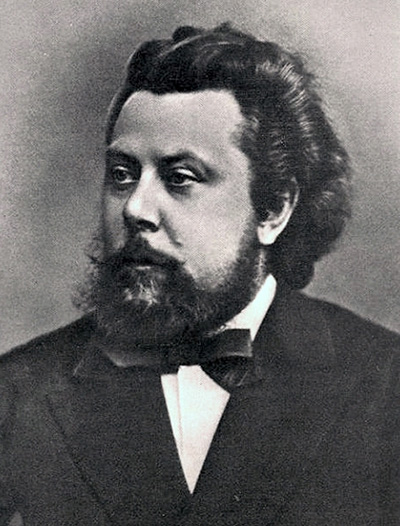
Born: March 21, 1839, Karevo, Pskov District, Russia
Died: March 28, 1881, Saint Petersburg, Russia
Pictures at an Exhibition
orch. Maurice Ravel (1875–1937), concept by Cristian Măcelaru, arr. for Jazz at Lincoln Center Orchestra by Sherman Irby
- Composed: 1874, orchestrated by Ravel in 1923
- Premiere: Orchestral version premiered May 3, 1923 in Paris, conducted by Sergei Koussevitzky
- Instrumentation: 2 flutes, 2 piccolos, 3 oboes (incl. English horn), 2 clarinets, bass clarinet, 2 bassoons, contrabassoon, alto saxophone, 4 horns, 3 trumpets, 3 trombones, tuba, timpani, bass drum, bell in E-flat, crash cymbals, glockenspiel, ratchet, snare drum, suspended cymbals, tam-tam, triangle, whip, xylophone, 2 harps, celeste, strings, Jazz at Lincoln Center Orchestra
- CSO notable performances: First: December 1929, Fritz Reiner conducting. Most recent: April 2023, Ramón Tebar conducting.
- Duration: approx. 45 minutes
Although the history of the Russian nation extends far back into the mists of time, the country’s cultural life is of relatively recent origin. Russian interest in art, music and theater dates only from the time of Peter the Great (1672–1725), the powerful monarch who coaxed his country into the modern world by importing ideas, technology and skilled practitioners from western Europe. To fuel the nation’s musical life, Peter, Catherine and their successors depended on a steady stream of well-compensated German, French and Italian artists who brought their latest tonal wares to the magnificent capital city of St. Petersburg. This tradition of imported music continued well into the 19th century: Berlioz enjoyed greater success in Russia than he did in his native France; Verdi composed La forza del Destino on a commission from St. Petersburg, where it was first performed.
In the years around 1850, with the spirit of nationalism sweeping across Europe, several young Russian artists banded together to rid their art of foreign influences, in order to establish a distinctive nationalist character for their works. Leading this movement was a group of composers known as “The Five,” whose members included Modest Mussorgsky, Nikolai Rimsky-Korsakov, Alexander Borodin, César Cui and Mily Balakirev. Among the allies that The Five found in other fields was the artist and architect Victor Hartmann, with whom Mussorgsky became close personal friends. Hartmann’s premature death at 39 stunned the composer and the entire Russian artistic community. Vladimir Stassov, a noted critic and the journalistic champion of the Russian arts movement, organized a memorial exhibit of Hartmann’s work in February 1874, and it was under the inspiration of that showing that Mussorgsky conceived his Pictures at an Exhibition for piano.
At the time of the exhibit, Mussorgsky was engaged in preparations for the first public performance of his opera Boris Godunov, and he was unable to devote any time to his Pictures until early summer. When he took up the piece in June, he worked with unaccustomed speed. “‘Hartmann’ is bubbling over, just as Boris did,” he wrote to a friend. “Ideas, melodies come to me of their own accord, like a banquet of music — I gorge and gorge and overeat myself. I can hardly manage to put them down on paper fast enough.” The movements mostly depict sketches, watercolors and architectural designs shown publicly at the Hartmann exhibit, though Mussorgsky based two or three sections on canvases that he had been shown privately by the artist before his death. The composer linked his sketches together with a musical “Promenade” in which he depicted his own rotund self-shuffling — in an uneven meter — from one picture to the next.
Although Mussorgsky was not given to much excitement over his own creations, he took special delight in this one. And in Maurice Ravel's masterful 1922 transcription for orchestra, created for the Parisian concerts of conductor Sergei Koussevitzky, it is a work of vivid impact to which listeners and performers alike can return with undiminished pleasure.
Promenade. According to Stassov, this recurring section depicts Mussorgsky “roving through the exhibition, now leisurely, now briskly in order to come close to a picture that had attracted his attention, and, at times sadly, thinking of his friend.”
The Gnome. Hartmann’s drawing is for a fantastic wooden nutcracker representing a gnome who gives off savage shrieks while he waddles about on short, bowed legs.
Promenade — The Old Castle. A troubadour (represented by the saxophone) sings a doleful lament before a foreboding, ruined ancient fortress.
Promenade — Tuileries. Mussorgsky’s subtitle is “Dispute of the Children after Play.” Hartmann’s picture shows a corner of the famous Parisian garden filled with nursemaids and their youthful charges.
Bydlo. Hartmann’s picture depicts a rugged wagon drawn by oxen. The peasant driver sings a plaintive melody (solo tuba) heard first from afar, then close-by, before the cart passes away into the distance.
Promenade — Ballet of the Chicks in Their Shells. Hartmann’s costume design for the 1871 fantasy ballet Trilby shows dancers enclosed in enormous egg shells, with only their arms, legs and heads protruding.
Samuel Goldenberg and Schmuÿle. [Ed. Richard Taruskin, in Musorgsky: Eight Essays and an Epilogue, correctly transcribes the title as “‘Samuel’ Goldenburg und ‘Schmuÿle.’” “The use of quotation marks points up the fact that the two zhidy (an antisemitic slur for diaspora Jews) have the same first name: one Germanized, the other in the original Yiddish. They are in fact one zhid, not two. The portrayal is a brazen insult: no matter how dignified or sophisticated or Europeanized a zhid’s exterior, on the inside he is a jabbering, pestering little ‘Schmuÿle.’” This movement’s longstanding title of “Two Jews: Rich and Poor” was invented by Stasov for his 1881 obituary of Mussorgsky. —Tyler M. Secor]
The Marketplace at Limoges. A lively sketch of a bustling market, with animated conversations flying among the female vendors.
Catacombs, Roman Tombs. Cum Mortuis in Lingua Mortua. Hartmann’s drawing shows him being led by a guide with a lantern through cavernous underground tombs. The movement’s second section, bearing the title “With the Dead in a Dead Language,” is a mysterious transformation of the Promenade theme.
The Hut on Fowl’s Legs. Hartmann’s sketch is a design for an elaborate clock suggested by Baba Yaga, the fearsome witch of Russian folklore who eats human bones she has ground into paste with her mortar and pestle. She also can fly through the air on her fantastic mortar, and Mussorgsky’s music suggests a wild, midnight ride.
The Great Gate of Kiev. Mussorgsky’s grand conclusion to his suite was inspired by Hartmann’s plan for a gateway for the city of Kiev in the massive old Russian style crowned with a cupola in the shape of a Slavic warrior’s helmet. The majestic music suggests both the imposing bulk of the edifice (never built, incidentally) and a brilliant procession passing through its arches. The work ends with a heroic statement of the Promenade theme and a jubilant pealing of the great bells of the city.
—©Dr. Richard E. Rodda