Wynton Marsalis
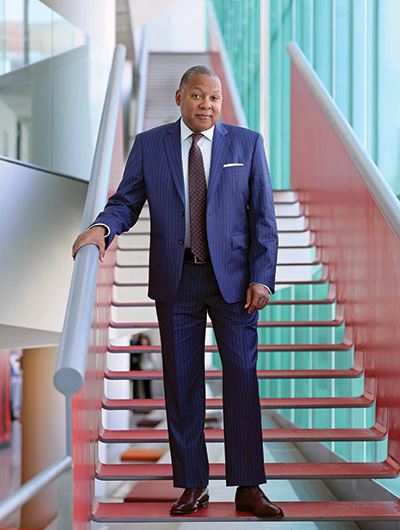
Born: October 18, 1961, New Orleans, Louisiana
Violin Concerto
- Composed: 2015
- Premiere: November 2015 by the London Symphony Orchestra, James Gaffigan conducting; Nicola Benedetti (for whom the concerto was written), violin
- Instrumentation: solo violin, 3 flutes (incl. piccolo), 3 oboes (incl. English horn), 3 clarinets (incl. E-flat clarinet, bass clarinet), 3 bassoons (incl. contrabassoon), 4 horns, 3 trumpets, 3 trombones, tuba (incl. Sousaphone), timpani, African hand drums, bass drums, claves, cowbells, crotale, djembé, field drum, glockenspiel, high hat, marimba, police whistle, sandpaper blocks, sizzle cymbal, snare drum, splash cymbal, suspended cymbals, tam-tam, tambour de Basque, tom-tom, harp, strings
- CSO notable performances: This is the first CSO performance of the Violin Concerto.
- Duration: approx. 43 minutes
This piece was written for Nicola Benedetti. It takes inspiration from her life as a traveling performer and educator who enlightens and delights communities all over the world with the magic of virtuosity. Scored for symphony orchestra, with tremendous respect for the demands of that instrument, it is nonetheless written from the perspective of a jazz musician and New Orleans bluesman. We believe that all human beings are connected in the essential fundamentals of life: birth, death, love and laughter; that our most profound individual experiences are also universal (especially pain); and acknowledging the depth of that pain in the context of a groove is a powerful first step towards healing.
Nicky asked me to “invite a diverse world of people into the experience of this piece.” Because finding and nurturing common musical ground between differing arts and musical styles has been a lifetime fascination of mine, I was already trying to welcome them. It may seem simple enough, but bringing different perspectives together is never easy. The shared vocabulary between the jazz orchestra and the modern orchestra sits largely in the areas of texture and instrumental technique. Form, improvisation, harmony and methods of thematic development are very different. The biggest challenges are: how to orchestrate the nuance and virtuosity in jazz and blues for an ensemble not versed in those styles (a technical issue), and how to create a consistent groove without a rhythm section (a musical/philosophical issue).
Because modern living is an integrated experience, it is never difficult to discover organic connections. Turning those insights into something meaningful and playable, however, is another story. It has to be lived and digested. That’s why I looked for real-life examples in the history of jazz–symphonic collaborations and to the environment and experience that connect Nicky and me. I considered aspects of her Scottish ancestry, the great Afro- American abolitionist Frederick Douglass’ love of legendary Scottish poet Robert Burns, my love and inextinguishable respect for Scottish baritone saxophonist Joe Temperley (and his gleeful recitation of pungent limericks) and the luminous but obscure achievements of Afro-American keyed bugler Francis Johnson, father of the American cornet tradition and one of the first published American composers … who was also a fine fiddler. These sources led me to reconnect with the Anglo-Celtic roots of Afro-American music.
The piece opens with Nicky whispering a solo note before the orchestra enters, as if to say “and so it came to pass” or “once upon a time.” Then we are into a form constructed in fours — as in the four corners of the earth, where her travels take her.
Each of the four movements, Rhapsody, Rondo Burlesque, Blues and Hootenanny, reveals a different aspect of her dream, which becomes reality through the public storytelling that is virtuosic performance.
Movement 1, Rhapsody, is a complex dream that becomes a nightmare, progresses into peacefulness and dissolves into ancestral memory.
Movement 2, Rondo Burlesque, is a syncopated, New Orleans jazz, calliope, circus clown, African gumbo, Mardi Gras party in odd meters.
Movement 3, Blues, is the progression of flirtation, courtship, intimacy, sermonizing, final loss and abject loneliness that is out there to claim us all.
Movement 4, Hootenanny, is a raucous, stomping and whimsical barnyard throw-down. She excites us with all types of virtuosic chicanery and gets us intoxicated with revelry and then … goes on down the Good King’s highway to other places yet to be seen or even foretold.
As in the blues and jazz tradition, our journey ends with the jubilance and uplift of an optimistic conclusion. All of us — Nicky, our conductor Cristi Măcelaru, The Philadelphia Orchestra, our Producer Steve Epstein and I — have come together to make a mutual statement on the common sophistication and soul in our respective and collective art that we hope can be enjoyed by any and all.