Johannes Brahms
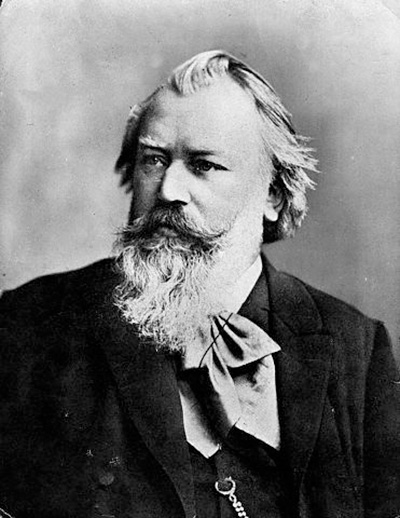
Born: May 7, 1833, Hamburg, Germany
Dead: April 3, 1897, Vienna, Austria
Nänie, Op. 82
- Composed: 1881
- Premiere: December 1882, Zürich, Johannes Brahms conducting
- Instrumentation: SATB chorus, 2 flutes, 2 oboes, 2 clarinets, 2 bassoons, 2 horns, 3 trombones, timpani, harp, strings
- CSO notable performances: First (CSO subscriptions): March 1996, Jahja Ling, May Festival Chorus. Most recent: October 2015, Simone Young conducting, May Festival Chorus. Notable: May 1989 as part of the May Festival, Robert Shaw conducting; May Festival Chorus.
- Duration: approx. 12 minutes
Nänie is one of Johannes Brahms’ most tender, luminous works. With the Schicksalslied (Op. 54) and Gesang der Parzen (Op. 89) it forms a trio of beautifully expressive one-movement choral elegies contemplating the nature of life and death. Nänie is a deeply personal memorial for Brahms’ friend Anselm Feuerbach (1829–80), whose classically inspired paintings Brahms greatly admired. He began work on Nänie in 1880, a few months after Feuerbach’s death, and completed it in August 1881. The work’s poignant reflection on immortality was warmly praised by critics who heard Brahms conduct the premiere in Zürich the following December. This concert, devoted entirely to his compositions, was such a resounding success that the chorus gifted Brahms a specially made silver goblet. The composer treasured the gift so deeply that he kept it on the piano in his Vienna apartment.
Brahms and Feuerbach met in 1865 and quickly bonded over their shared enthusiasm for ancient Greek culture and Renaissance art. Brahms warmly praised Feuerbach’s paintings, recommended them to his friends and acquired photographs of many of the paintings. The art’s wistful, inward-looking atmosphere parallels the atmosphere of Brahms’ choral elegies and many of his instrumental works.
Despite their shared aesthetics, Brahms and Feuerbach became estranged. A few years before his death, Feuerbach distanced himself from Brahms, believing that the composer had insulted him. During 1873–76, Feuerbach taught at the Academy of Fine Arts in Vienna. Brahms was well aware of the city’s prevailing aesthetic tastes, and, upon hearing of Feuerbach’s grand plans to impress the Viennese, attempted— perhaps awkwardly—to protect him from disappointment. But his comments so wounded Feuerbach that their friendship collapsed. Ultimately, Feuerbach resigned his position and left Vienna in 1876, partly because of ill health but also because of the critical reception of his paintings.
When Feuerbach died, Brahms failed to send condolences to the artist’s stepmother, Henriette (1812–92). However, after completing Nänie, he wrote an uncharacteristically compassionate letter to her, acknowledging this mistake, stating that she had frequently been on his mind, and reaffirming his profound admiration for Anselm’s works. Henriette was deeply moved by Brahms’ request to dedicate Nänie to her, and she treasured the work for the rest of her life.
Brahms selected Friedrich Schiller’s (1759–1805) poem Nänie (1799) as the text of his tribute. The word Nänie comes from the Latin nenia, a funeral dirge sung by women. Schiller’s poem opens with a stark description of the inevitability of death: “Even the beautiful must die.” At first glance, Schiller’s words may seem to refer to physical beauty, but in the context of the poem and Brahms’ setting, its meaning is more abstract, either referencing an unattainable ideal or classical Greek culture. Both meanings resonate with Feuerbach’s life and art: he passionately believed in the integrity of his artistic style despite negative responses, and his works feature figures from ancient Greece portrayed in a style influenced by Renaissance painting.
To explore the idea of mortality, Schiller alluded to three well-known Greek myths in which a god or goddess was powerless against the inevitability of human death. Although the poem does not explicitly identify these figures, Brahms named them for the audience at the work’s premiere. Subsequent published editions of the score likewise briefly describe these tragic deaths: Lines 3–4 reference Orpheus, who failed to rescue his beloved wife Eurydice from Hades; lines 5–6 allude to Aphrodite, the goddess of love, who mourned her beloved Adonis, who was killed by a boar; and lines 7–8 refer to Thetis’ failure to shield her son Achilles from being slain by Paris.
Brahms told Henriette that in reading Schiller’s “beautiful words” he couldn’t help thinking of her and Anselm. The poem’s first reference to Orpheus and Eurydice may have resonated with the composer because Feuerbach had painted this famous couple. Similarly, the mother-son relationship in the myth about Thetis may have reminded Brahms of Henriette Feuerbach’s love for her stepson.
After presenting these three myths, in which even gods cannot prevent death, the remainder of Schiller’s poem explores how they grieve their lack of power. The penultimate line, however, introduces a vision of consolation, in that memorializing the dead through the arts grants them a form of immortality: “Even to be a song of lamentation in the mouth of the beloved is glorious.” Brahms lingers on this line, gently repeating it at the end of his composition. A critic who attended the Zürich premiere of the work recognized the significance of this touching passage, writing: “Even the beautiful must die; but as it is brought to life here [in Nänie] in its purest, noblest form, so will it outlive generations.”
Brahms’ score mirrors the poem’s emotional trajectory. This ethereal contemplation of the transience of life and beauty is scored for chorus and orchestra, including harp but excluding the brasher trumpets. In the first section, the orchestra introduces the references to the three myths with a beautiful flowing melody. Played by the plaintive oboe, it evokes a pastoral atmosphere. Just as Schiller’s text recalls earlier stories, Brahms alludes to works by earlier composers. This oboe melody is derived from Beethoven’s Piano Sonata Das Lebewohl (“Farewell”). Beethoven wrote the sonata in 1809 in response to the departure from Vienna of his dear friend and patron Archduke Rudolf. Brahms recalls this motive throughout the work, creating a touching musical farewell to his own friend.
The middle section of Nänie, in which Orpheus and the goddesses grieve their powerlessness, begins with the voices and upper woodwinds moving in unison, while the other instruments provide a rippling accompaniment. Building on the first section’s allusion to Beethoven’s Das Lebewohl, this section references works of lament by multiple composers. Part of the opening melody resembles one of the six songs from Beethoven’s An die ferne Geliebte (“To the Distant Beloved,” Op. 98), a collection about lost love and separation. This melody also appears in Schumann’s Fantasie, Op. 17 (1836), a work by another composer Brahms deeply admired. Perhaps most intriguingly, this section also recalls the fifth movement of Brahms’ A German Requiem, where the text speaks of the comfort of a mother.
The third and final section of Nänie, which sets the last two lines of Schiller’s poem, gently consoles the listener by reminding us that memorials, such as the poem and this composition, ensure a form of eternity. Brahms recapitulates the beautiful opening elegiac melody for this final section, but whereas the first section ends loudly with the death of Achilles, the last ends quietly, with hushed repetitions of Herrlich (“glorious”), transforming lament into quiet transcendence.
—©Heather Platt, Sursa Distinguished Professor of Fine Arts, Ball State University
Schicksalslied ("The Song of Destiny"), Op. 54
- Work Composed: 1868-1871
- Premiere: October 18, 1871 in Karlsruhe, Hermann Levi conducting
- Instrumentation: SATB chorus, 2 flutes, 2 oboes, 2 clarinets, 2 bassoons, 2 horns, 2 trumpets, 3 trombones, timpani, strings
- CSO notable performances: First (CSO subscription): April 1942, Eugene Goossens, University of Cincinnati Oratorio Society Chorus. Most recent: October 2015, Simone Young conducting, May Festival Chorus. Notable: May 1989 as part of the May Festival, Robert Shaw conducting; May Festival Chorus.
- Duration: approx. 16 minutes
Johannes Brahms’ Schicksalslied (“Song of Destiny”) is a highly evocative interpretation of a poem by Friedrich Hölderlin that contrasts the serene existence of the gods with the suffering of humanity. Brahms was drawn to ancient Greek literature and to writers such as Hölderlin who helped inspire a renewed interest in Greek culture. To him the question of human destiny explored by the Greeks was not a mere abstraction, but rather it suffused his daily existence, inspiring many of his works.
In the summer of 1868, while visiting his friend Albert Dietrich, Brahms came across Hölderlin’s two-volume novel Hyperion; oder, Der Eremit in Griechenland (“Hyperion; or, the Hermit in Greece”; 1797 and 1799). The second volume includes Hyperions Schicksalslied (“Hyperion’s Song of Fate”), a poem that Brahms selected as the text for his Schicksalslied. Hölderlin had been a well-respected writer during the early years of his career; later in life, however, mental illness led to his isolation, and many of his works fell into obscurity.
Unlike his contemporaries, Brahms admired Hölderlin and had done so even before discovering Hyperion. In earlier years, he avidly studied the author’s books, copying excerpts into his notebooks alongside writings by other favorite authors. Nevertheless, despite this deep admiration, Schicksalslied is his only setting of a Hölderlin text.
Hölderlin’s Hyperion comprises a series of letters that the character Hyperion wrote toward the end of his life. Through these letters Hölderlin reflected on his spiritual journey of self-discovery and maturation, and he recounted moments of intense joy and profound grief. Brahms chose a poem that appears near the end of the novel, between letters describing Hyperion’s most hopeless moments. (The preceding paragraphs describe how Hyperion was wearied by the pain of parting and loss.) Gazing silently at the sea hour after hour, contemplating his life and future, Hyperion wrote: “I wished to give myself strength; I took out my long-forgotten lute to sing myself a Song of Fate,” a song he had learned from his teacher long ago. Brahms set the words of this song for chorus and orchestra.
The novel’s description of Hyperion’s state of mind resembles elements of Brahms’ personality and the circumstances in which he first envisioned Schicksalslied. The poem’s atmosphere seems to have resonated deeply with Brahms, and, just as Hyperion gazes at the sea, Brahms conceived his work while visiting the port in the North German coastal town of Wilhelmshaven. He was joined there by the Dietrich family and friends, and Albert Dietrich later recalled Brahms being in a more reflective mood than usual, having spent the preceding hours reading Hölderlin. “Later on, when we were sitting resting by the sea, we discovered Brahms a long way off, sitting by himself on the shore writing. It was the first sketch for the Schicksalslied.”
The composition occupied Brahms until 1871, though during that time he was also working on other projects. His principal difficulty centered on how to end the work. While Hölderlin’s first two stanzas are imbued with peaceful yearning and the tranquil clarity of the gods, the final stanza abruptly changes focus, ending with an agonizing image of mortal suffering. Brahms did not wish to conclude with such a grim vision; nevertheless, he struggled to decide upon an alternative that preserved the poem’s tension between serenity and suffering.
Brahms arranged the poem into two sections; the first, which is preceded by an orchestral introduction, comprises stanzas one and two, while the second sets stanza three. Brahms indicated that the orchestral introduction and first two stanzas should be played “slowly and full of longing,” a type of emotional instruction that was quite unusual for him. The slow pace, sustained melodies and quiet dynamics evoke the peacefulness of the gods, while the soft rumbling of the timpani foreshadows what is to come. The sopranos enter with a chorale-like melody, further contributing to the ethereal atmosphere, while the flowing woodwind accompaniment suggests the divine breezes that lightly touch the gods. The quietly rumbling timpani from the introduction returns after the voices conclude the second stanza. After the timpani fades away, soft, dissonant chords in the winds and brass set the stage for a change in mood.
A faster tempo, agitated rhythms and loud dynamics create a turbulent mood for Hölderlin’s agonizing third stanza. It reaches its first climax on the lines describing human beings stumbling blindly, “like water from cliff to cliff, thrown downward for years into uncertainty.” During the repetition of the stanza, Brahms varies the music, making it quieter and less tense. Although the music again surges and the volume increases on the word “blindly,” the final repeated lines are set to longer notes and softer dynamics. These changes soften the sense of terror, transforming uncertainty into something more contemplative and ambiguous.
The question of how to end the work was hotly debated among Brahms and his friends, the most pressing question being whether the conclusion should include voices. He considered ending with a wordless chorus that would sound as though it were humming. He even drafted a short choral conclusion that repeated the poem’s first two lines. But he rejected it, crossing out the music he had written in his score, describing it as a “foolish idea” and an “experiment” created while he was in a “muddle.” (The score with Brahms’ strike-out is now housed at the Library of Congress and can be viewed at its online portal.)
Ultimately, Brahms decided the orchestra should have the last word, and he brought back the luminous music of the orchestral introduction. This ending, however, does not provide complete reassurance and serenity. The return of the restless timpani, rising woodwind lines and a very quiet cadence evoke hopeful longing and distance.
Numerous listeners have debated whether this orchestral conclusion contradicts the meaning of Hölderlin’s poem. While it offers a sense of hope absent from the poem’s last stanza, the music ultimately aligns with the ending of Hölderlin’s novel. Its final page reads: “O soul! Soul! Beauty of the world! Indestructible, ravishing one! … The dissonances of the world are like lovers’ quarrels. Reconciliation lies in the midst of strife, and all things separated come together again.” In this way, Brahms transformed Hölderlin’s tragic vision into something more ambiguous: not consolation, but the possibility of reconciliation beyond suffering.
—©Heather Platt, Sursa Distinguished Professor of Fine Arts, Ball State University