Aram Khachaturian
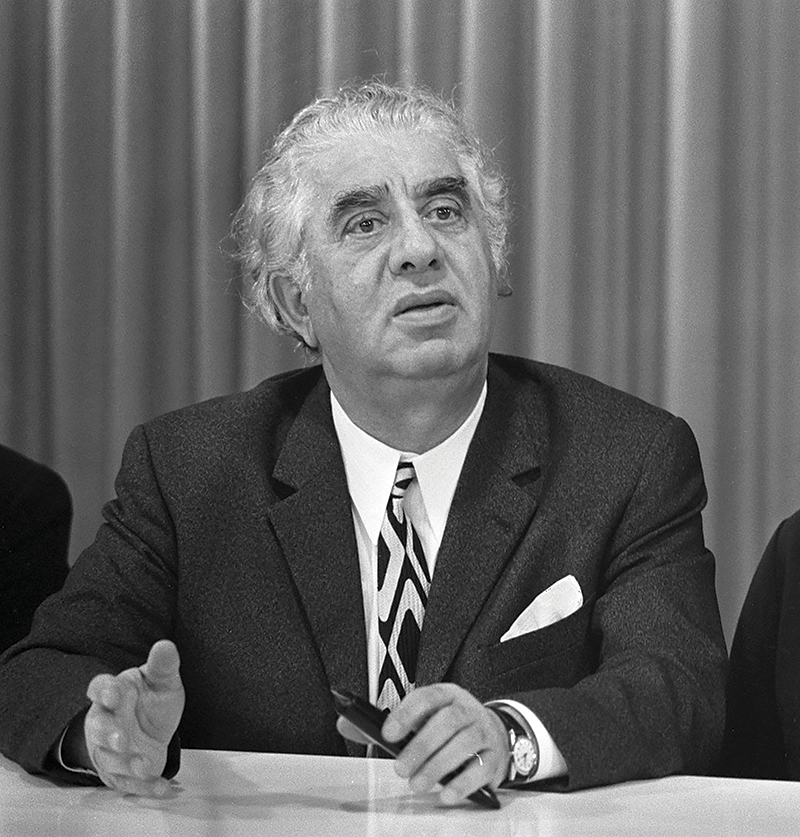
Born: June 6, 1903, Tiflis (now Tbilisi)
Died: May 1, 1978, Moscow
Concerto for Violin and Orchestra
- Work Composed: 1940
- Premiere: November 16, 1940, in Moscow, David Oistrakh, violin
- Instrumentation: solo violin, 2 flutes, piccolo, 2 oboes, English horn, 2 clarinets, 2 bassoons, 4 horns, 3 trumpets, 3 trombones, tuba, timpani, snare drum, suspended cymbals, bass drum, tambour de Basque, crash cymbals, harp, strings
- CSO notable performances: First: March 1978, Sixten Ehrling conducting; Mark Peskanov, violin. Most Recent: November 2011, Kristjan Järvi conducting; Mikhail Simonyan, violin.
- Duration: approx. 35 minutes
Aram Khachaturian was among the leading composers of the Soviet Union and the most celebrated musician of his native state of Armenia. When he arrived in Moscow in 1921 from his home town of Tbilisi, he had virtually no formal training in music, but his talent was soon recognized and he was admitted to the academy of Mikhail Gnessin, a student of Rimsky-Korsakov. Khachaturian’s first published works date from 1926; three years later he entered the Moscow Conservatory. His international reputation was established with the success of the Piano Concerto in 1936, composed at the time he became active in the newly founded Union of Soviet Composers, of which he was elected deputy chairman of the Moscow branch in 1937 and deputy president of the National Organizing Committee two years later. In 1939, he returned to live for six months in Armenia, where he immersed himself in the folk music of his boyhood home in preparation for composing the ballet Happiness.
Russian–American violinist and musicologist Boris Schwarz noted that Khachaturian’s synthesis of vernacular and cultivated musical styles in Happiness “represents the fulfillment of a basic Soviet arts policy: the interpenetration of regional folklorism and the great Russian tradition.” Khachaturian’s compositional colleague Dmitri Kabalevsky added:
The especially attractive features of his music are in its roots in national folk fountainheads. The captivating rhythmic diversity of dances of the peoples of Transcaucasia and the inspired improvisations of the ashugs [Armenia’s native bards] — such are the sources from which have sprung the composer’s creative endeavors. From the interlocking of these two principles grew Khachaturian’s style — vivid and dynamic, with keen contrasts, now enchanting in mellow lyricism, now stirring in tension and drama.
Khachaturian remained a proud and supportive Armenian throughout his life, serving in 1958 as the state’s delegate to the Supreme Soviet of the USSR. “My whole life, everything that I have created, belongs to the Armenian people,” he said, and he imbued the Violin Concerto of 1940 with the spirit and idioms of his homeland.
In 1939, the Union of Soviet Composers established an enclave on the Moscow River near the town of Staraya Ruza for creative work and rest. Khachaturian spent the summer of 1940 there in a cottage in a dense pine forest, where he composed his Violin Concerto for Russian virtuoso David Oistrakh. Khachaturian had largely prepared the formal plan for the piece in advance, and recalled:
I worked without effort. Sometimes my thoughts and imagination outraced the hand that was covering the staff with notes. The themes came to me in such abundance that I had a hard time putting them in some order. … I wanted to create a virtuoso piece employing the symphonic principle of development and yet understandable to the general public.
He succeeded, and the concerto was a great success when Oistrakh premiered it on November 16, 1940, in Moscow, solidifying Khachaturian’s popularity at home and abroad; he was awarded the Stalin Prize for the concerto in 1941.
The concerto’s opening movement is disposed in traditional sonata form, with two contrasting themes and a full development section. After a brief introduction by the orchestra, the soloist presents an animated motif that soon evolves into a bounding, close-interval folk dance. This theme, punctuated by the strong orchestral chords from the introduction, continues before giving way to a nostalgic lyrical strain. The movement then unfolds with one dazzling technical feat after another and culminates in an elaborate cadenza that bridges to the recapitulation. Both of the earlier themes return in elaborated settings to round out the movement. The Andante is a broad three-part design prefaced by a bassoon solo that Grigori Schneerson, in his study of Khachaturian, said imitated the improvisations of the Armenian ashugs, or bards. A melancholy tune occupies the movement’s outer sections while the central portion is more animated and rhapsodic. The finale is an infectious rondo, festive, brilliant and sparklingly virtuosic.
—©Dr. Richard E. Rodda