Dorothy Howell
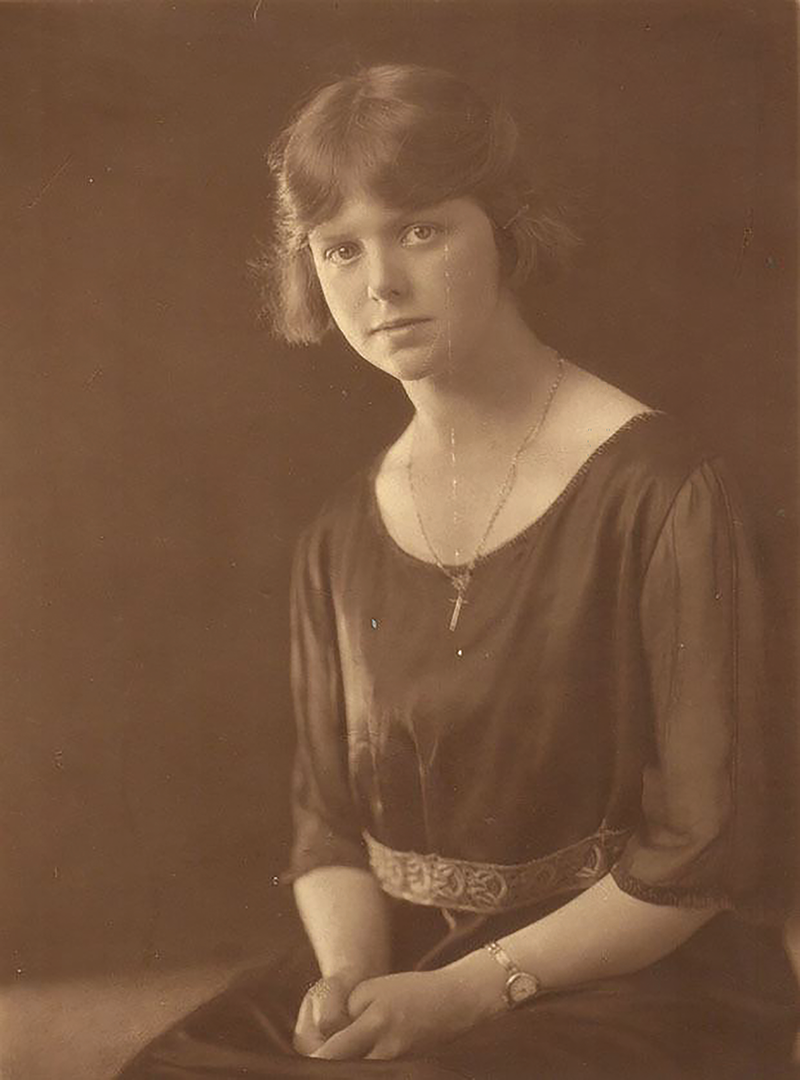
Born: February 25, 1898, Birmingham, England
Died: January 12, 1982, Malvern, England
Lamia
- Composed: 1918 (published 1921)
- Premiere: September 10, 1919, Promenade Concerts, Queen's Hall, London, conducted by Sir Henry Wood
- Instrumentation: 2 flutes, piccolo, 2 oboes, English horn, 2 clarinets, bass clarinet, 2 bassoons, contrabasson, 4 horns, 3 trumpets, 3 trombones, tuba, timpani, triangle, tambour de Basque, crash cymbals, suspended cymbals, harp, strings
- CSO notable performances: These are the first CSO performances of Lamia.
- Duration: approx. 12 minutes
English composer Dorothy Howell demonstrated musical talent at a young age, learning piano and violin from her father, who worked as organist and music director at a local Catholic church. She began taking lessons in composition with Granville Bantock during her holidays from convent schooling; although her faith remained important to her, Howell left convent school to enter the Royal Academy of Music in 1913, when she was just 15 years old. She studied composition with Sir John Blackwood McEwen and piano with Percy Waller and Tobias Matthay, all of whom had great and long-lasting influence on her musical growth. Many of her early compositions were written for piano, and she began to build a reputation as a pianist performing her own works and those of her teachers. Howell also began to compose large-scale orchestral pieces, premiering her symphonic poem Lamia in 1919, followed soon after by a performance of her orchestral Danse Grotesque at Buckingham Palace. In 1921, she received the Cobbett Prize for her Phantasy for Violin and Piano, and she earned acclaim for her composition and performance skills after she played the solo part of her own Piano Concerto in D Minor for its premiere in 1923. Along with her success as composer and pianist, Howell was highly regarded as a teacher. She taught at several schools, and, in 1924, she was appointed professor of harmony and composition at the Royal Academy of Music, where she remained until she retired in 1970. Her final years were marked by illness, and, as she grew older, she performed less frequently, taught only private students and turned to the composition of small-scale works.
First presented in the Queen’s Hall Promenade Concerts (Proms) in London by conductor Sir Henry Wood, Howell’s Lamia launched the young composer into the spotlight. On September 11, 1919, the day after Lamia premiered, The Times published a story on the Promenade Concerts bearing the heading “Miss D. Howell’s Symphonic Poem”:
Last night’s programme at the Queen’s Hall was remarkable, not so much for a new work as for a new composer. Miss Dorothy Howell is apparently quite a young girl, but without taking that fact into account, her symphonic poem “Lamia” would be remarked as a work of singular interest.
The piece met with such positive reception at its premiere that it received a second performance by request just three days later. Sir Henry Wood conducted Lamia twice more in October 1919 and programmed the piece in several later seasons of the Proms, including his farewell season in 1940 — on August 24, months before Queen’s Hall was destroyed by bombs in World War II. Howell dedicated Lamia to Sir Henry Wood when the piece was published in 1921.
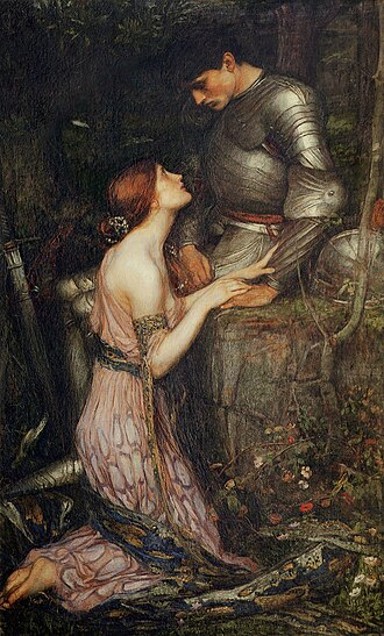
Lamia and the Soldier – John William Waterhouse, 1905
The late Romantic style of Howell’s symphonic poem is similar to that of Richard Strauss’ tone poems, leading the media to dub her the “English Strauss.” The genre of symphonic poem was pioneered by Franz Liszt earlier in the 19th century as a single-movement orchestral work intended to convey a story or express imagery, and many composers, including Strauss and Howell, adopted the approach. Howell’s Lamia tells the story of Lamia, from ancient Greek mythology, as relayed in the narrative poem of the same name written by English poet John Keats in 1819 and published in 1820. A woman transformed into a serpent, Lamia dwells in a forest on the shores of Crete. She longs to become human and to seek out the man she loves, a Corinthian named Lycius. The god Hermes encounters Lamia and grants her human form, and now appearing as a beautiful woman, Lamia finds Lycius and wins his love. They keep their love a happy secret for a time before holding a public marriage feast. The philosopher Apollonius, Lycius’s old teacher, attends the feast and recognizes Lamia’s past as a serpent-woman. As he reveals the truth, his piercing eyes and words cause Lamia to vanish, and Lycius dies of grief.
The structure of Howell’s symphonic poem reflects the structure of the story. It begins with the sound of undulating flutes and a smooth violin melody, setting the scene of the forest of Crete. As the other instruments of the orchestra gradually add layers of color, the intensity builds with a dramatic timpani roll to the climax of Lamia’s transformation. The music fades again as Lamia searches for Lycius, and a harp glissando introduces a gentle love theme between the solo oboe and violins as Lamia and Lycius meet. Their love triumphs as the full orchestra swells again, and then their private romance continues in a moment of tranquility. A chiming triangle begins the marriage feast in the new dancing meter of 3/4 and quick tempo of merry festivities. However, the joyful celebration grows more anxious as the threat of Apollonius looms, and the music breaks suddenly as Lamia vanishes. The somber ending conveys the death of Lycius as the violins mournfully echo the earlier love theme.
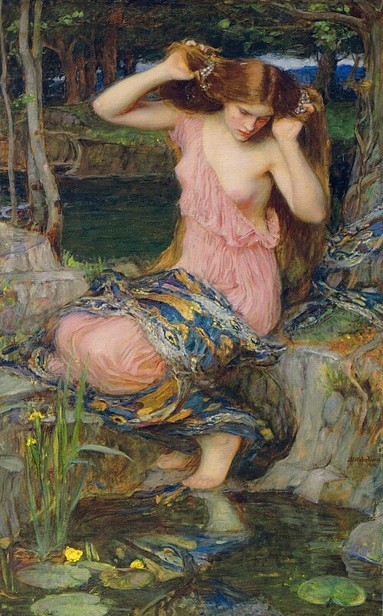
Lamia – John William Waterhouse, 1909
While Howell did not reveal why she chose Lamia as the subject of her symphonic poem, it has been suggested that it may have reflected her grief after losing her elder brother in World War I. Howell was not the only late 19th- early 20th-century artist to be inspired by the Lamia story, however. American composer Edward MacDowell also wrote a symphonic poem based on the story of Keats’ Lamia, composed in 1888 and first performed and published in Boston in 1908. Furthermore, Lamia appeared in Pre-Raphaelite artwork, such as Isobel Lilian Gloag’s The Kiss of the Enchantress (c. 1890), which portrays Lamia as a half-serpent half-woman creature kissing a knight. Two versions by John William Waterhouse (1905 and 1909) and one by Herbert James Draper (1909) depict Lamia as a beautiful young woman draped in snakeskin, as though capturing the moment just after she transforms into a human and sheds the serpent side of herself. It is not known whether Howell encountered any of these works, but her symphonic poem contributed a rich interpretation to the cultural life of the Lamia story. Lamia was one of Howell’s most successful large-scale compositions during her lifetime and remains one of her most performed works.
—©Dr. Rebecca Schreiber