Franz Schubert
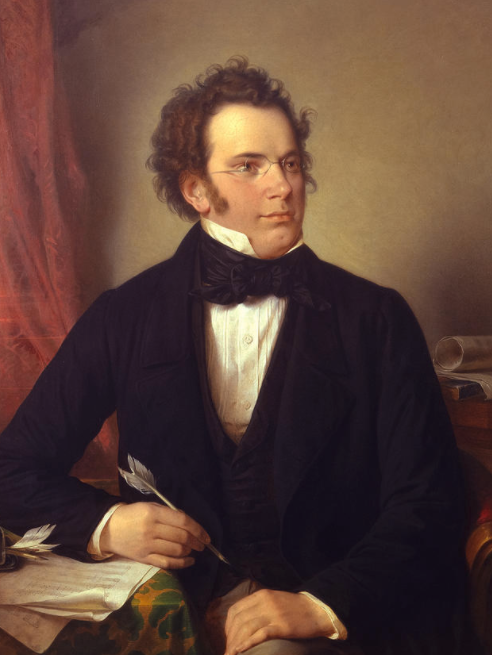
Born: January 31, 1797, Himmelpfortgrund, Austria
Died: November 19, 1828, Vienna
Symphony No. 9, The Great
- Composed: 1825-26
- Premiere: (with cuts) March 21, 1839, Felix Mendelssohn conducting the Gewandhaus Orchestra
- Instrumentation: 2 flutes, 2 oboes, 2 clarinets, 2 bassoons, 2 horns, 2 trumpets, 3 trombones, timpani, strings
- CSO notable performances: Premiere: January 1896, Frank Van der Stucken conducting; Most Recent: NEED
- Duration: approx. 53 minutes
As an orchestral composer, Schubert reached the summit of his art in the gigantic Symphony in C, but the work was not performed during his lifetime. Ten years after Schubert’s death, Robert Schumann visited Vienna and met Schubert’s brother Ferdinand, who showed him the large number of unpublished works the deceased composer had left behind. At Schumann’s suggestion, Ferdinand sent a copy of the symphony to Mendelssohn in Leipzig, who performed it with the Gewandhaus Orchestra shortly afterward. After a repeat performance, Schumann wrote a glowing review—a literary masterpiece in its own right—that established the work’s status as a classic.
A Hard Road to the Great Symphony
Schubert began working on his first symphony in 1811, at the age of 14; this fragment (in D major, D. 2B) is only 30 measures long. Between 1813 and 1818, he completed six symphonies in an idiom rather close to Haydn’s and Mozart’s symphonic style. Yet he grew increasingly dissatisfied with this style and began to think about symphonic composition on a grander scale. He wanted to articulate his response to Beethoven’s symphonies as well as express his own musical personality.
Apparently, Schubert did not find it easy to realize his more advanced ideas right away. He began a symphony in D major in 1818, another one (also in D major) in 1820, and a third one (in E major) in 1821: all three were left in various stages of incompleteness. The B-minor masterpiece of 1822 is therefore not the only “unfinished” symphony from this period of Schubert’s life. In 1824, he composed his Grand Duo for piano duet, D. 812, which also may have been planned as a symphony or is a piano reduction of one. (Joseph Joachim orchestrated this work in 1855, and it has occasionally been performed by orchestras since that time.) All these attempts at writing a grand symphony finally bore fruit in the “Great C-major” symphony. (During the last months of his life, Schubert had plans for another symphony, of which only sketches survive. From these sketches, Peter Gülke and Brian Newbould have each prepared performing editions of a “Symphony No. 10,” and Luciano Berio used the same material to create his orchestral work Rendering.)
For many years, it was thought that the “Great C-major” dated from the final year of Schubert’s life. At the same time, scholars knew all along that Schubert had completed a symphony in 1825 during his stay in the towns of Gmunden and Gastein, but they assumed that this symphony was lost. In the late 1970s, musicologist Robert Winter proved that there was no missing work: the “Great C-major” actually is the symphony written at Gmunden and Gastein in 1825. This re-dating is important because it shows that Schubert reached his highest maturity as a symphonic composer earlier than previously believed. Thus, it was the “Great C-major” that the composer presented to the Austrian Philharmonic Society in October 1826. However, the work was roundly rejected because of its unusual length and its technical difficulty.
What to Listen For
The first movement opens with an Andante introduction that is more substantial than most slow introductions. Its theme, first announced by two unaccompanied horns, undergoes considerable transformations before the gradual transition into the Allegro ma non troppo main section. We hear a lively first theme in C major in the strings (punctuated by the woodwinds), followed by a lyrical second melody played by oboes and bassoons, not in G major as the rules would have it but in the more poignant key of E minor. Then, just as G major has been reached and, according to classical formal expectations, it would be time for the exposition to end, the music takes a sudden detour into the extremely distant A-flat minor and the trombones play a new theme that is one of the movement’s high points. (It is also one of the earliest solo passages for trombones in a symphony.) The development section is relatively short, and the recapitulation mirrors the exposition rather closely. The extended coda ends with the return of the theme from the Andante, as a triumphant hymn played by the entire orchestra.
The second-movement Andante con moto, in A minor, opens with one of Schubert’s great “wandering” melodies, played by the solo oboe. After it has been repeated several times, a second, more soothing melody emerges in the key of F major, as if a second character had entered the stage. This section begins pianissimo, rises to a powerful fortissimo, and then becomes soft again.
The opening melody now returns with the tiny addition of a soft fanfare rhythm played in turn by the first trumpet and the first horn. This detail is so small that it may almost be overlooked at first. Yet, as so often in Schubert, small details may have mighty consequences. Out of this little fanfare motif grows one of the most searing climaxes in the entire symphonic literature, culminating in a dissonant diminished-seventh chord played with maximum intensity by the entire orchestra and followed by sudden silence. It is some time before the music “recovers” from this shock; the string pizzicatos (plucked notes) and the beautifully entwined melodic lines of the cellos and the first oboe “clear the air,” leading back to the second, and eventually to the first, theme of the movement.
The Scherzo is expanded into a short sonata form, with a distinct second theme, development, and recapitulation. Its tone is close to many of Schubert’s German Dances, but the extremely refined orchestration and the innovative sequence of modulations make it quite unique. The Trio is a splendid Viennese waltz whose sophistication is hidden behind the façade of an engaging melody. As always, the Trio is followed by a full repeat of the Scherzo.
The Finale is a real touchstone of the string players’ stamina and rhythmic precision. It is a virtual perpetuum mobile that lasts more than 10 minutes in a single celebration of joy and happiness. The lively triplet notes of the first theme recede into the accompaniment as the second theme begins, and they remain present throughout, except when they are replaced by an equally taxing dotted-note figure. The development section introduces a new theme in the clarinets that bears a striking resemblance to the “Ode to Joy” theme from Beethoven’s Ninth, which was premiered in Vienna the year before Schubert wrote this symphony. The new theme gives rise to a stirring development in which the trombones again play a leading role. The recapitulation contains many new tonal adventures; even after the main tonality has been confirmed, it is called into question several more times—particularly in the Coda, which begins mysteriously and ends with resounding fanfares.
—Program Notes by Peter Laki