Piotr Ilyich Tchaikovsky
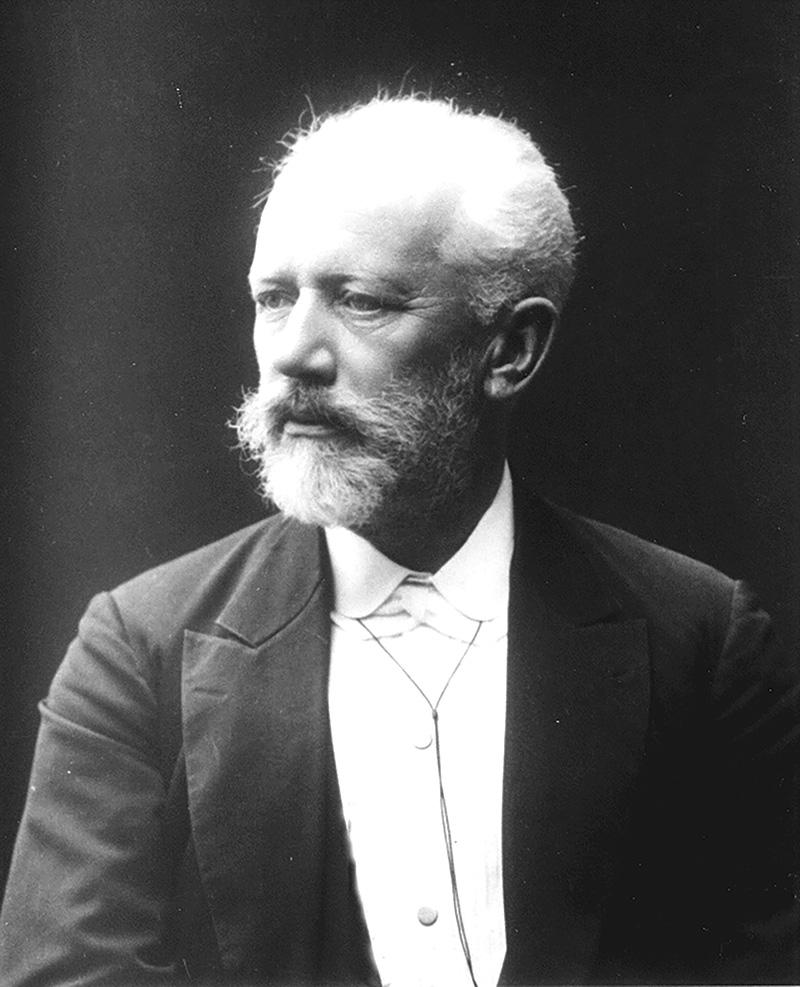
Born: May 7, 1840, Kamsko-Votkinsky, Russia
Dead: November 6, 1893, Saint Petersburg, Russia
Concerto in D Major for Violin and Orchestra, Op. 35
- Composed: 1840-1893
- Premiere: December 4, 1881, conducted by Hans Richter, leading the Vienna Philharmonic
- Instrumentation: Solo violin, two flutes, two oboes, two clarinets in a and Bb, two bassoons, four horns in F, two trumpets in D, optional trombone, timpani, and strings
- Duration: approx. 35 minutes
There is certainly no shortage of great masterpieces that have met with negative criticism at their premiere, but few have fared worse than Tchaikovsky’s Violin Concerto. This may sound surprising, since this work, now one of the most popular of all concertos, has none of the revolutionary spirit of Stravinsky’s Rite of Spring, Wagner’s Ring cycle or Beethoven’s Eroica, to name just three works that generated heated controversies around the time of their premieres. Yet there were some distinct ways in which the Tchaikovsky concerto clashed with the expectations of people who had very strong opinions about what a violin concerto ought to be. The great violinist and teacher, Leopold Auer, for whom the concerto was written, rejected it. And the Viennese critic Eduard Hanslick, a friend of Brahms’ and a fierce opponent of Wagner’s, uttered the immortal phrase after the 1881 premiere that the concerto “stank to the ear.” The harshness and vulgarity of these opinions likely exacerbated Tchaikovsky’s depressive tendencies, tendencies that were never far from the surface. The composer never forgot Hanslick’s diatribe to the end of his days.
Why this unusually strong resistance to a work that did not attempt to challenge the existing world order but wanted “simply” to be what it was: a brilliant and beautiful violin concerto? In Hanslick’s case, the answer may lie in the critic’s inability to accept symphonic music that was not Germanic in spirit. The first great violin concerto to come from Russia, Tchaikovsky’s work certainly struck a chord that was disconcertingly foreign in Vienna. (It is ironic that Hanslick thought of Tchaikovsky as a Russian barbarian, while, in Russia, the composer was considered a “Westernizer” who was not as truly and completely Russian as Balakirev and his circle, known as the “Mighty Five.”) As for Auer, the novel technical demands of the piece may have at first seemed to him insurmountable; yet, to his credit, he soon took a second look and changed his mind. He became a great advocate of the concerto and taught it to many of his star students, among them Mischa Elman, Jascha Heifetz and Efrem Zimbalist.
The concerto was written in the spring of 1878. It was then that, in order to recover from the recent trauma of his ill-fated and short-lived marriage to Antonina Milyukova, Tchaikovsky retreated to the Swiss village of Clarens, on the shores of Lake Geneva, accompanied by his brother Modest and a 22-year-old violinist named Iosif Kotek, who assisted him in matters of violin technique. The composition progressed so effortlessly that Tchaikovsky completed the work in only three weeks, with an extra week taken up by the orchestration. During this time, Tchaikovsky wrote not only the three concerto movements that we know, but a fourth one as well; the initial second movement, Méditation, was rejected at an early run-through and replaced with the present Canzonetta, written in a single day. Due to Auer’s initial unfavorable reaction, for three years no violinist accepted the work for performance, until the young Adolf Brodsky, a Russian-born virtuoso living in Vienna, chose it for his debut with the Vienna Philharmonic — the performance that was so uncharitably described by Hanslick.
One of the things that makes this concerto so great is surely the ease with which Tchaikovsky moves from one mood to the next: lyrical and dramatic, robustly folk-like and tenderly sentimental moments follow one another without the slightest incongruity, similar to the famous Piano Concerto No. 1 he wrote three years earlier. Another remarkable feature is the combination of virtuosity with emotional depth: although the technical difficulties of the solo part are tremendous, every note also expresses something that goes far beyond virtuosic fireworks. All in all, it is one of the greatest violin concertos ever written, and no critic after Hanslick has ever challenged its status again or smelled anything unpleasant in the work!
—©Peter Laki