Carlos Simon
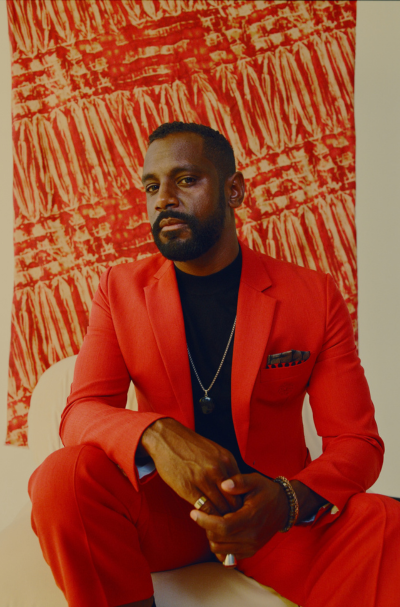
Born: 1986, Washington, D.C.
“My dad, he always gets on me. He wants me to be a preacher, but I always tell him, ‘Music is my pulpit. That’s where I preach,’” Carlos Simon reflected for The Washington Post. Having grown up in Atlanta, with a long lineage of preachers and connections to gospel music to inspire him, the Grammy-nominated Simon proves that a well-composed song can indeed be a sermon. His music ranges from concert music for large and small ensembles to film scores with influences of jazz, gospel and neo-romanticism.
Simon is the current composer-in-residence for the John F. Kennedy Center for the Performing Arts and frequently writes for the National Symphony Orchestra and Washington National Opera. Simon also holds the position of inaugural composer chair of the Boston Symphony Orchestra, the first in the institution’s 143-year history. Starting with the 2026–27 season, Simon is composer-in-residence with Amsterdam’s Concertgebouw.
A highlight of the 2025–26 season was the world premiere of Simon’s Double Concerto for Violin and Cello, featuring Hilary Hahn and Seth Parker Woods with the National Symphony Orchestra; performances by the St. Louis Symphony Ochestra followed, and other co-commissioners will perform the work in future seasons. Additional world premieres include Lamentations for String Orchestra (commissioned by the New World Symphony/Miami City Ballet), a symphonic soundtrack to The Unspoken Elegance of Stillness (directed by Simon Frederick), plus works for the Boston Symphony Chamber Players and Augustin Hadelich, commissioned by the Boston Symphony Orchestra.
The season also featured exciting co-commissioner performances of previously premiered works such as Simon’s acclaimed Good News Mass, a work reimagining the traditional mass with gospel soloists, spoken word and choir, which received performances from the Boston Symphony Orchestra and Chicago Symphony Orchestra at Ravinia Festival, with visual creations from Melina Matsoukas (Beyoncé’s Formation, Queen and Slim). Simon’s new Zodiac: Symphonic Suite was also performed by co-commissioner the New Jersey Symphony.
Simon has been commissioned by the likes of the LA Philharmonic, San Diego Symphony Orchestra, Washington National Opera (in collaboration with Mo Willems), New York Philharmonic and Bravo! Vail, Minnesota Orchestra, American Ballet Theatre, Detroit Symphony Orchestra, Jacksonville Symphony Orchestra, Cincinnati Pops Orchestra, Carnegie Hall for the National Youth Orchestra of the USA, and BBC Symphony Orchestra for the Last Night of the Proms.
As well as his composition work, Simon frequently curates concert programs, which often highlight his own music as well as that of close collaborators. Curation concerts have recently been programmed by the Atlanta Symphony Orchestra, Boston Chamber Players, Tanglewood Festival for Contemporary Music and the Kennedy Center for the Performing Arts. Simon also curated and arranged Coltrane: Legacy for Orchestra, a new project co-commissioned by TO Live (for the Toronto Symphony Orchestra) and the San Francisco Conservatory of Music, in partnership with the Coltrane estate.
August 2024 saw the release of Simon’s first full-length orchestral album, Four Symphonic Works, comprising live concert recordings by the National Symphony Orchestra from the Kennedy Center Concert Hall, conducted by Gianandrea Noseda. Simon also composed the original soundtrack for the PBS documentary Shame of Chicago: Shame of the Nation, which was released as a digital album in April 2024.
In September 2023, Simon released two albums on Decca. Together is a compilation of solo and chamber compositions and arrangements featuring Simon and guests such as J’Nai Bridges, Randall Goosby, Seth Parker Woods and Will Liverman. The work draws on Simon’s personal experience as an artist to highlight the importance of heritage and identity, and the power of collaborative music-making.
Simon also released the live premiere recording of brea(d)th, a landmark work commissioned by the Minnesota Orchestra and written in collaboration with Marc Bamuthi Joseph, conducted by Jonathan Taylor Rush. “Arguably the most important commission of Simon’s career so far” (The New York Times), brea(d)th was written following George Floyd’s murder as a direct response to America’s unfulfilled promises and history of systemic oppression against Black Americans.
Simon was nominated for a 2023 Grammy Award for Best Contemporary Classical Composition for his previous album, Requiem for the Enslaved (Decca, 2022). The requiem is a multi-genre musical tribute to commemorate the stories of the 272 enslaved men, women and children sold in 1838 by Georgetown University. This work sees Simon infuse his original compositions with African American spirituals and familiar Catholic liturgical melodies, and was performed by Hub New Music Ensemble, Marco Pavé and MK Zulu.
Acting as music director and keyboardist for Grammy Award winner Jennifer Holliday, Simon has performed with the Boston Pops, Jackson Symphony and St. Louis Symphony. He has also toured internationally with soul Grammy-nominated artist Angie Stone and performed throughout Europe, Africa and Asia.
Simon earned his doctorate at the University of Michigan, where he studied with Michael Daugherty and Evan Chambers. He has also received degrees from Georgia State University and Morehouse College. He is an honorary member of Phi Mu Alpha Sinfonia Music Fraternity and a member of the National Association of Negro Musicians, Society of Composers International and Pi Kappa Lambda Music Honor Society. He has served as a member of the music faculty at Spelman College and Morehouse College in Atlanta, Georgia, and now serves as associate professor at Georgetown University. Simon was also a recipient of the 2021 Sphinx Medal of Excellence, the highest honor bestowed by the Sphinx Organization to recognize extraordinary classical Black and Latinx musicians, and was named a Sundance/Time Warner Composer Fellow for his work for film and moving image.
Fate Now Conquers
- Composed: 2020
- Premiere: Philadelphia’s Kimmel Center, Yannick Nézet-Séguin conducting The Philadelphia Orchestra
- Instrumentation: flute, piccolo, 2 oboes, 2 clarinets, 2 bassoons, 2 horns, 2 trumpets, timpani, strings
- Duration: approx. 5 minutes
Carlos Simon’s music ranges from concert works for large and small ensembles to film scores with influences of jazz, gospel and neo-romanticism.
He is the current composer-in-residence for the John F. Kennedy Center for the Performing Arts and frequently writes for the National Symphony Orchestra and Washington National Opera. Simon also is the inaugural composer chair of the Boston Symphony Orchestra and, starting with the 2026–27 season, is composer-in-residence for Amsterdam’s Concertgebouw.
Recent premiere performances of his music have been given by the National Symphony Orchestra, Boston Symphony Orchestra, BBC Symphony Orchestra for the Last Night of the Proms (his BBC Proms commissioning debut), Jacksonville Symphony Orchestra, Cincinnati Pops Orchestra, Carnegie Hall for the National Youth Orchestra of the USA and the LA Philharmonic.
Simon was nominated for a 2023 Grammy for Best Contemporary Classical Composition for Requiem for the Enslaved, a multi-genre musical tribute to commemorate the stories of the 272 enslaved men, women and children sold in 1838 by Georgetown University.
The composer earned his doctorate at the University of Michigan, where he studied with Michael Daugherty and Evan Chambers, and he has received degrees from Georgia State University and Morehouse College. He has served as a member of the music faculty at Spelman College and Morehouse College in Atlanta and now serves as associate professor at Georgetown University. carlossimonmusic.com
Here is Carlos Simon’s synopsis of Fate Now Conquers:
This piece was inspired by a journal entry from Ludvig van Beethoven’s notebook written in 1815:
Iliad. The Twenty-Second Book
But Fate now conquers; I am hers; and yet not she shall share in my renown; that life is left to every noble spirit and that some great deed shall beget that all lives shall inherit.
Using the beautifully fluid harmonic structure of the 2nd movement of Beethoven’s Seventh Symphony, I have composed musical gestures that are representative of the unpredictable ways of fate. Jolting stabs, coupled with an agitated groove with every persona. Frenzied arpeggios in the strings that morph into an ambiguous cloud of free-flowing running passages depicts the uncertainty of life that hovers over us.
We know that Beethoven strived to overcome many obstacles in his life and documented his aspirations to prevail, despite his ailments. Whatever the specific reason for including this particularly profound passage from the Iliad, in the end, it seems that Beethoven relinquished to fate. Fate now conquers.