Maurice Ravel
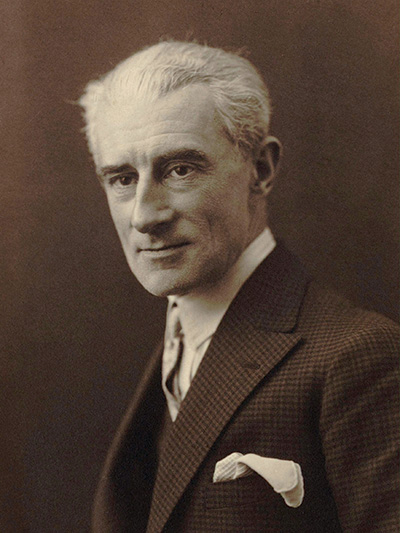
Born: March 7, 1875, Ciboure, France
Died: December 28, 1937, Paris, France
Ma mère l’oye (“Mother Goose”), complete ballet
- Work Composed: 1908–1910 (piano duet), 1912 (complete ballet)
- Premiere: (complete ballet) January 29, 1912, Théâtre des Arts, Paris, GabrielGrovlez conducting
- Instrumentation: 2 flutes (incl. piccolo), 2 oboes (incl. English horn), 2 clarinets,2 bassoons (incl. contrabassoon), 2 horns, timpani, bass drum, crash cymbals, snare drum, tam-tam, triangle, xylophone, harp, celeste, jeu de timbres, strings
- CSO notable performances: (Complete ballet) First/most recent: October 1997,Alan Gilbert conducting. (Suite) First: January 1924, Fritz Reiner conducting; most recent subscription: March 2017, Louis Langrée conducting; most recent other: December 2020 as part of a livestream, Louis Langrée conducting.
- Duration: approx. 29 minutes
Maurice Ravel was known as moody and aloof by his peers, but his playful nature and pleasure in the simple joys of childhood were evident in his close friendships. He often visited his friends Ida and Cipa Godebski and their two children, Mimi and Jean, at their house in the country outside Paris, where he liked to relax. According to a memoir written by Mimi, Ravel often engaged with the children in practical jokes and storytelling; they adored him. Many of their favorite stories came from French author Charles Perrault, whose 1697 publication, known as Tales of Mother Goose, is the source of timeless characters such as Cinderella, Puss in Boots and Little Red Riding Hood.
Between 1908 and 1910, Ravel composed a piano duet called Ma mère l’Oye (“Mother Goose”), based on these fairy tales, and dedicated them to Mimi and Jean. He asked the children if they would like to play the premiere performance, but they declined. Mimi later wrote that she and her brother were too young to appreciate the gesture and instead “regarded it rather as something that involved hard work.” The duets were instead premiered by two piano students that Ravel was acquainted with, Jeanne Leleu and Geneviève Durony, aged 6 and 10, in April of 1910.
Ravel often orchestrated his own piano pieces, and Ma mère l’Oye was no exception. The musicologist Arbie Orenstein wrote of Ravel’s predilection as an “attempt to draw out every ounce of its inherent possibilities.” In 1911, he completed the five-movement orchestral suite that is widely performed to this day. In 1912, he went a step further and created a ballet by adding a prelude, scene and interludes for a full narrative arc. The ballet was premiered that same year to much acclaim at the Théâtre des Arts in Paris. During rehearsals, the conductor Gabriel Grovlez complained to the director about the state of the orchestral parts, saying it was almost “impossible not to slip up.” In addition to being squeezed into the very narrow pit of the theater, the musicians were contending with parts taken from the suite; the pages were re-ordered and rife with tricky page turns and handwritten add-ons.
Part of Ravel’s brilliance as a composer was his knack for innovative instrumental color, which is on full display in this work. He also aimed to evoke an idyllic childhood by simplifying his style. To reflect the innocent nature of these fairytales, he chose a delicate, transparent orchestration. He omits the brassy trumpets and trombones and augments the percussion with a gong, xylophone and glockenspiel, creating a magical sound world inhabited by the likes of the Beauty and the Beast and Tom Thumb.
Ravel conceived a simple plot for the staging of the ballet. Princess Florine accidently pricks her finger on a spinning wheel and is cursed by the Evil Fairy who declares that she must die. The Good Fairy intervenes and turns the Princess’ death into a sleep of 100 years, from which she can only awaken by the kiss of true love. While the princess sleeps, the Good Fairy comforts her by filling the girl’s dreams with fairy tales. Finally, Prince Charming arrives to break the spell, and the prince and princess joyfully unite while surrounded by the characters from the fairy tales.
The ballet opens with a muted fanfare. Rustling strings and fluttering woodwinds transport the listener to a faraway land. Languid solos are heard in the flute, oboe, cello and violin. Horns begin an increasingly active call and response, and percussion joins in for a grand crescendo that flows directly into the next movement, the Spinning-wheel Dance. The perpetual motion of the wheel can be heard in the strings, harp and celeste. Quick, chromatic figures in the flute and oboe pierce through the texture. The mood is anxious throughout; even a moment of silence amid the flurry is loaded with anticipation.
A serene pavane follows as servants prepare the princess for sleep. The melody, a somber lullaby, is passed along in the woodwinds and concludes with muted strings and harp. As the Good Fairy leaves the princess, she whistles with a flash of vibrant color in the piccolo. This summons guards to keep watch over the princess while she dreams, and the music slowly transitions into the first fairy tale, a conversation between the Beauty and the Beast.
The Beauty is represented by the warm tone of the clarinet, and the Beast is the low growl of the contrabassoon. After a lively exchange between these characters, a harp glissando signals the transformation of the Beast into a prince and a solo violin brings the scene to a peaceful end.
After a short interlude, the tale of Tom Thumb begins. Seven little boys are abandoned in the woods by their father, but the youngest, Tom Thumb, leaves a trail of breadcrumbs to lead them back home. This scene features the oboe as the lost boy whose path of crumbs gets eaten by the birds. As the strings wander aimlessly through snippets of scales, gathering momentum then fading away, the flutes trill somewhat innocently, imitating the birds as they pick up the morsels.
An interlude for harp and celeste signals the entrance of the Empress of the Pagodas, who is cursed with ugliness. Her lover, once a handsome man, has been changed into a serpent. When they bathe in magical waters, they are both transformed into their true selves. Piccolo and xylophone add vibrant texture to this picturesque dance.
Birdsong in the flutes and muted horns break the spell of the dream world, bringing the story back to the sleeping princess and the entrance of the prince. The final scene, The Fairy Garden, begins with hushed strings in a beautifully simple melody that slowly rises in register. A solo violin enters with the harp and celeste as the day breaks and the princess awakens. A chorale-like melody slowly builds and bursts into a brilliant display of lush orchestration as the Good Fairy appears again to bless the happy couple.
—©Catherine Case