Johannes Brahms
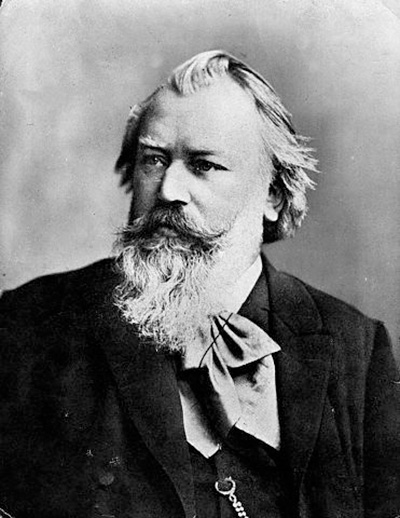
Born: May 7, 1833, Hamburg, Germany
Died: April 3, 1897, Vienna, Austria
String Sextet No. 1 in B-flat Major, Op. 18
- Composed: 1860
- Premiere: October 20, 1860 in Hanover by an ensemble led by Joseph Joachim
- Duration: approx. 37 minutes
The Principality of Lippe-Detmold, midway between Frankfurt and Hamburg, was one of the leading centers of 19th-century German music. The reigning Prince, Leopold III, had a taste for music, which he was able to gratify by employing a permanent orchestra of 45 players that presented a broad spectrum of works from Mozart through Wagner. A great deal of chamber music was played by the principals of the orchestra, a choir was formed from members of the household and townsfolk, and guest artists were often asked to visit the court to perform with the resident forces. One such visitor was Clara Schumann, who not only performed but also gave piano lessons to one of the Prince’s sisters and to the sister of the Court Chamberlain. When Clara moved from Düsseldorf to Berlin in 1857, a year after her husband’s death, she recommended that her young friend, the composer Johannes Brahms, continue the ladies’ lessons. So taken were they with their 24-year-old teacher that they wrangled for him a position at court that included conducting the chorus and orchestra, participating in chamber music and, of course, continuing their instruction. The post was only for the three months of October through December, but the salary was sufficient to sustain Brahms in his modest lifestyle in Hamburg for a full year. He returned again in 1858 and 1859.
Brahms found much to like at Detmold. The rich musical atmosphere was an inspiration to his study of the Classical masters, aided by the performances of Mozart and Haydn that the Prince required from the orchestra. The financial reward left him much free time to compose. Perhaps equally important to him were the lovely parks and forests surrounding the palace, where he took long walks to calm himself and ponder his future and his art. In those painful years after Robert Schumann’s death, Brahms was not only confronting his grief at the loss of his dear friend and mentor but was also sorting out his strong personal feelings for Clara. At Detmold, as throughout his life, he found the antidote to his feelings for her in music. When he returned there in autumn 1859 he wrote to his Aunt Auguste, “I am quite ecstatic: I think of nothing but music, and of other things only when they make music more beautiful to me. If things go on like this, I am perfectly capable of evaporating into a musical chord and floating away in the air.” It was under this halcyon spell that Brahms created his first chamber work for string ensemble, the Sextet in B-flat major.
The Sextet was conceived at Detmold in 1859, but largely composed between March and September of the following year. The work was first heard in Hanover in October 1860, played by a group under the direction of the composer’s friend and champion, the violinist Joseph Joachim. Composer and music critic Daniel Gregory Mason (1873–1953) noted that the work marked an important artistic and stylistic passage for Brahms, “unmistakably the moment of his musical adolescence. ... It is the first piece of chamber music in which, freeing himself once and for all from the subjectivity and turgidity of romanticism, he starts to explore the road of classical universality in beauty, in which he was to discover such unprecedented treasures.” Mason then went on to point out the Sextet’s indebtedness to the clear Classical formal models of Mozart and Beethoven. In a later study of Brahms, however, Burnett James (writer of Brahms: A Critical Study), while allowing the dominant vein of neo-Classicism in the Sextet, added, “Yet underneath there is the firm, irresistible, romantic spirit moving.” In noting the apparently antithetical qualities in this music, these two writers have summarized the essential characteristic of Brahms: effulgent Romantic emotional expression absolutely disciplined by impeccable Classical form. The B-flat Sextet is among the earliest indisputable evidences of Brahms, the master.
Brahms was absolutely profligate with fine melodies in the opening, sonata-form movement. The first-theme group comprises the lyrical cello strain given immediately at the beginning and a Ländler-like tune (with a dotted rhythm) played in close harmony; a wide-ranging cello melody and another dotted-rhythm motive provide contrast. The development section is concerned just with the first-theme group motives, but all of the thematic material is returned in the recapitulation in heightened settings. The second movement is a theme with variations of which Brahms was so fond that he made a two-piano version (now lost) to play at parties with friends, as well as a transcription for solo piano (Theme and Variations in D Minor, which he presented to Clara as a birthday gift in 1860). The Scherzo is both vivacious and sly, filled with deceptive but delightful rhythmic cross-accents that fuddle the toe-tapping proclivities of many a listener. The closing Rondo, in its form and thematic material, if not in its somewhat long-winded working-out of an homage to Mozart, confirms Brahms biographer Walter Niemann’s words about this Sextet: “In it, Brahms’ grave face wears an almost Apollo-like brightness and breathes a strong, healthy spirit of almost exuberant vitality.”
—©Dr. Richard E. Rodda