Keeril Makan
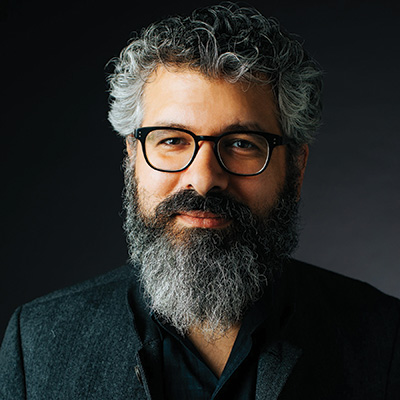
Born: March 14, 1972, New Jersey
2 for Violin and Percussion
- Composed: 1998
- Premiere: unknown
- Duration: approx. 18 minutes
The first thing you will hear in this work is a single note 37 times, at fortissississimo. Not "a lot of times,” not "many times," but 37, and then leave six-and-a-half beats of silence. Then the same note, 29 times. Then 25. Keeril Makan wrote 2 for violin and percussion in 1998, and from that opening bar he tells us, with cruel exactness, what kind of 18 minutes lies ahead. The marking above it reads simply: Unrelenting, violent.
Makan’s music comes from a lineage that doesn't develop so much as investigate; this is music that sets a single process in motion and follows it, without flinching, all the way to its end. Alvin Lucier's Silver Streetcar for the Orchestra asks a player to strike one triangle for 19 minutes, varying only speed and force so that our brains play tricks on us and hear things that are perhaps more grand than a triangle (an “orchestra,” maybe). 2 belongs to that family. Makan's music has been described as "a fascinating wedding of intellect and expressivity," and that's the bargain of this work: this music pushes your mind and your nervous system. For 18 minutes, Makan is going to deny your brain its desire for logic, its hunger for comprehension, its appetite for comfort.
The opening repeated hammers do not relent, but erode. New pitches creep into the pounding, the rhythmic twists, and just as you locate solid ground you catch a glimpse (30, 40 seconds worth) of something almost singable. It's gone before you can hold it, pulled back under the current that Makan once likened to an inexorable stream, where ideas surface only to be swept away for good. Then, from nowhere, there’s space: pitches left to ring and sing and the storm seems to pass, which delivers us into a transition to the second section, where a single note repeats 16 times, now marked despondent and much softer, almost like a painful memory.
Throughout the work, we never play the same pitch, not once. The percussion sits just above or just below the violin the entire way, a halo around Rose's line rather than a counterpoint to it.
Rather than a dialogue or duet in any comfortable sense, this piece has two players locked in near-unison, each wholly dependent on the other for the idea to cohere. Either of us alone would be skydiving without a parachute. Together, this nightmarish corn maze gets only marginally easier to navigate … marginally ….
The long central section, marked anxious, unrelenting, is the heart of the piece and some of the most frightening music we’ve ever played: a torrent of twisting two- and three-note cells, roughly 1,908 notes with no rest, at breakneck speed, white-knuckle music. The instant you settle into a pattern, Makan flicks the smallest curveball and locks you back into the dread.
The third section, then, is earned: distant, lyrical but estranged. Lyrical, after what we've just survived, for sure feels estranged. Here, Makan sharpens the halo — the percussion now plays both the note above and the note below the violin's melody, and plays them a beat behind, "like a shadow." It looks like peace, it may even sound like peace, but it doesn’t necessarily feel like peace. This is the Makan one critic called "hard-driving and visceral, but not without moments of quiet, beautiful repose.”
Finally, the piece undoes itself. In the coda, pitch and rhythm fall away entirely. Rose drives extreme bow pressure into the string until it collapses into subtones — sounds below the violin's nominal range — while a bow drawn across a thundersheet — a sheet of metal built to evoke distant thunder — makes the instrument cry out rather than rumble. The critic Chris McGovern compared the effect to "a metallic building collapsing on top of a den of lions inside the Grand Canyon if Arizona was the Sistine Chapel.” That is where Makan leaves us, both as performer and listener, in the aftermath of what he's put all of us through.
So: is 2 a beautiful piece? A comfortable one? I can’t answer these questions for you. To me, the risk of this music is real, and it is shared: ours onstage without a net, yours out there as the physical, psychological impact of sound works directly on you. That sharing, to us, is the point.
—Joseph Bricker