Maurice Ravel
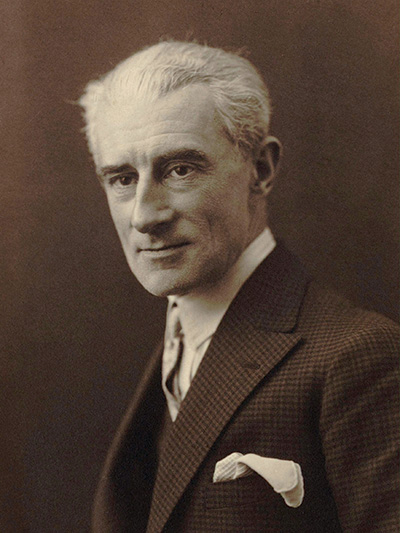
Born: March 7, 1875, Ciboure, France
Died: December 28, 1937, Paris, France
Boléro
- Work Composed: 1928
- Premiere: November 22, 1928, at the Paris Opéra, Walther Straramconducting
- Instrumentation: 2 flutes, piccolo, 2 oboes (incl. oboe d’amore), English horn,2 clarinets, E-flat clarinet, bass clarinet, 2 bassoons, contrabassoon, soprano saxophone, tenor saxophone, 4 horns, 4 trumpets, 3 trombones, tuba, timpani, bass drum, castanets, triangle, crash cymbals, snare drums, tam-tam, harp, celeste, strings
- CSO notable performances: First: January 1930, Fritz Reiner conducting. Most recent: October 2019, Louis Langrée conducting.
- Duration: approx. 13 minutes
“One was immediately taken captive, transported by an art which partakes of magic. Ravel has certainly written works with a greater musical richness; he has done nothing more successful.” So wrote the critic Henry Prunières after the 1928 premiere of Boléro. His verdict has been echoed countless times in the decades since. Yet, as often happens with great works of art, the circumstances of that first performance — as a daring new ballet at the Paris Opéra — differ markedly from the way it is usually encountered today, as a concert-hall showpiece and orchestral blockbuster.
Despite Ravel’s insistence that Boléro is “a masterpiece … without any music in it,” two musical ideas dominate. A solo flute introduces the first, which unfolds over 16 bars and divides neatly into four-bar segments. After a solo clarinet responds with an exact copy, now at the dynamic of piano rather than pianissimo, a solo bassoon presents the second musical idea. Whereas the first theme stays in rhythmic lockstep with the pizzicato strings and snare drum accompaniment, the second theme quickly charts a rhythmic and harmonic profile that is part exotic Spanish dance, part blue-note American jazz. The harp, newly added to the ensemble, seems to mediate between these worlds, setting off the theme with luminous, gently dissonant chords that hazily allude to the flamenco tradition to which the boléro is closely associated.
The AABB structure created by these two musical ideas persists for the remainder of the work. Although this formal arrangement is not especially unusual in the history of music, the other two traditional parameters that typically provide direction — rhythm and harmony — are effectively rendered inert. The resulting absence of appreciable melodic, rhythmic and harmonic change lends credence to Ravel’s disarming remark that “unfortunately [Boléro] is only orchestration,” but it also demands that the listener perceive how Ravel’s many precise adjustments to the orchestra’s timbral profile power the work’s gradual accumulation of tension. For example, the appearance of a new instrument becomes a structurally defining moment — the entrance of the celeste (paired with piccolos and a solo horn), the solo tenor saxophone’s sultry appoggiaturas, the over-the-top trombone glissando or the mid-melody handoff from one soprano saxophone to another. Likewise, the fortissimo tutti that announces the final statement of Ravel’s two musical ideas — now presented in full orchestral force and seemingly accelerated by an abbreviated AB (rather than AABB) presentation — marks the culmination of this timbrally driven progression.
The orchestra, having reached its sonic breaking point, finally makes a decisive harmonic move. Up to this point, Boléro has subsisted essentially on two chords, C and G, which Ravel now abruptly replaces with E and B. For a composer writing in the late 1920s, such a swap was hardly audacious: examples abound in Beethoven and Schubert, Wagner and Brahms. But listeners, having been sonically conditioned to such a restricted melodic and harmonic range for almost 15 minutes (Ravel demanded that conductors keep an absolutely steady tempo from start to finish), are caught off guard. And while the “off-key” passage only lasts for a single eight-bar phrase, it is enough to disrupt the delicate machinery of the piece. Indeed, within seconds, Boléro comes to a swift, confused close.
The subtleties of Ravel’s orchestration and the slow buildup and sudden release of kinetic energy serve as powerful reminders that Boléro was conceived not as a freestanding orchestral showpiece, but as a ballet score. In 1928, the patron and dancer Ida Rubinstein commissioned Ravel to orchestrate six piano pieces from Isaac Albéniz’s piano suite Iberia for her ballet troupe. Ravel set to work on the commission, only to learn that another musician, Spanish conductor Enrique Arbós, had already carried out such a task independently. Ravel considered fulfilling the commission by orchestrating one of his own earlier piano pieces instead, but that plan gave way when he happened upon an original theme that he described as “insistent.”
Five months later, Boléro was complete, and, on November 22, 1928, Rubinstein and her troupe presented it at the Paris Opéra. While she donned the role of a flamenco dancer who slowly arouses the senses of a throng of ogling male spectators, Prunières asserted that “Mme. Rubinstein understood that the strength of the score was such that the dance must appear as a kind of projection on the visual plane of this radiant music.” Indeed, Boléro would almost immediately transcend the dance stage, finding favor among concertgoers and solidifying Ravel’s reputation as, per a New York Times review of the American premiere on November 14, 1929, “one of the most finished and subtle masters of the craft of composition and orchestration in the world today.”
Thanks to its enduring popularity and Ravel’s ambivalent — and sometimes even contradictory — statements about its meaning, Boléro has become one of his most discussed works. On the one hand, elements of Ravel’s fascination with “everything that was mechanical, from simple tin toys to the most intricate machine tools,” as his brother Edouard recalled, appear in L’heure espagnole, the toccata from Le tombeau de Couperin, the finale to the Sonata for Violin and Piano, and other works. With its transparent design, inflexible tempo and methodical sonic expansion, Boléro might arguably be yet another way in which Ravel — like Honegger in Pacific 231 or Antheil in Ballet Mécanique earlier in the decade — let his art imitate modern life.
And yet, Ravel’s description of Boléro is extraordinarily lifeless: “It constitutes an experiment in a very special and limited direction. … There are no contrasts, and there is practically no invention except the plan and the manner of the execution. The themes are altogether impersonal.” Rather than celebrating the mechanization of the modern world, Ravel may have been plugging into a stream of critique that was playing out around him: with the Dadaist and Surrealist movements in France, Neue Sachlichkeit (“New Objectivity”) in Germany, or the writings of Sinclair Lewis and, later, films of Charlie Chaplin in the United States. If Boléro does channel such pessimism, then it assumes an even bleaker and, unfortunately, prophetic worldview when heard alongside Ravel’s other great ballet scores, Daphnis et Chloé and La valse. Together, these three works invert the usual “darkness to light” narrative arc, tracing a self-induced descent from heavenly creation to human ruination.
—©Jonathan Kregor, University of Cincinnati College-Conservatory of Music