Maurice Ravel
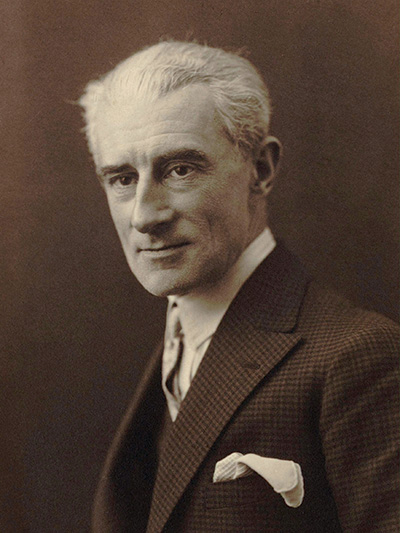
Born: March 7, 1875, Ciboure, France
Died: December 28, 1937, Paris, France
La valse
- Work Composed: 1919–1920
- Premiere: December 12, 1920, Camille Chevillard conducting the Orchestrades Concerts Lamoureux
- Instrumentation: 3 flutes (incl. piccolo), 3 oboes (incl. English horn), 2 clarinets, bass clarinet, 2 bassoons, contrabassoon, 4 horns, 3 trumpets, 3 trombones, tuba, timpani, bass drum, bells, castanets, crotale, cymbals, glockenspiel, snare drum, suspended cymbals, tam-tam, tambourine, triangle, 2 harps, strings
- CSO notable performances: First: November 1927, Victor de Sabataconducting. Most recent: January 2022, François López-Ferrer conducting.
- Duration: approx. 13 minutes
While remembered today for his elegance, refinement and craftsmanship (Igor Stravinsky praised him as “the most perfect of Swiss clockmakers”), Maurice Ravel spent his entire career negotiating the undefined boundaries between the refined and the banal. Born to a Basque mother and a Swiss father in the border town of Ciboure, but raised in Paris, Ravel grew up amid a blend of regional and cosmopolitan influences. After uneven success at the Paris Conservatoire, where his originality often put him at odds with the establishment, he emerged as a central figure in Parisian musical life, eventually co‑founding the Société musicale indépendante to promote new music outside official channels. Early compositional successes like the Menuet antique, the Pavane pour une infante défunte. (“Pavane for a Dead Princess”), and the Sonatine reference archaic courtly dances and amateur genres, while Jeux d’eau (“Water Games”), Miroirs (“Reflections”), and Gaspard de la nuit (“Gaspard of the Night”) extend the Impressionism of Debussy and virtuosity of Liszt nearly to their breaking points.
Given this context, it is not surprising to read, in 1906, of a new composition occupying Ravel’s attention: “It is not particularly sophisticated,” he wrote to a friend, “the matter occupying me at present: a grand waltz, an homage of kinds to the memory of the great — not Richard, but Johann.” Over the next 15 years, the work changed identities several times. Ravel initially envisioned it as a “symphonic poem” titled Wien (“Vienna”), thus continuing a tradition of characteristic or programmatic orchestral composition that had shaped Emmanuel Chabrier’s España (1883), Debussy’s Prélude à l'après-midi d'un faune (“Prelude to the Afternoon of a Faun”; 1894), Paul Dukas’ L'Apprenti sorcier (“The Sorcerer’s Apprentice”; 1897) and Ravel’s soon-to-be-composed Rapsodie espagnole (“Spanish Rhapsody”). However, the war that pitted France and the Austro-Hungarian Empire against each other made the title untenable, such that by early 1919 Ravel referred to his ongoing composition as La valse.
Decoupling La valse from any specific location was as politically expedient as it was practically justified, since Serge Diaghilev had recently commissioned Ravel for a work that his famous Ballets Russes could program. Prior to the First World War, Ravel had successfully adapted another set of waltzes, the Schubert-inspired Valses nobles et sentimentales (“Noble and Sentimental Waltzes”), into a ballet score titled Adélaïde, ou le langage des fleurs (“Adelaide, or, The Language of Flowers”); his “symphonie chorégraphique” Daphnis et Chloé, commissioned by Diaghilev, would premiere two months later in June 1912 and soon take on a life of its own as independent orchestral suites. When Ravel played through a piano version of La valse to Diaghilev in April 1920, however, the famed impresario judged it inappropriate for the dance floor: “A masterpiece,” he reportedly concluded, “but it’s not a ballet. … It’s the portrait of a ballet … the painting of a ballet.”
Despite this setback, Ravel completed the orchestration of La valse over the next two months. By the end of the year, his “poème chorégraphique” had been published in versions for solo piano, piano four hands and two pianos. By the time the full orchestral score appeared in print in March 1921, the work had already enjoyed a promising premiere in Paris on December 12, 1920, under the baton of Camille Chevillard and the Orchestra des Concerts Lamoureux. Thanks to the support of conductors like Serge Koussevitzky and Ravel himself, who would conduct the work over 30 times, the press was soon describing the orchestral piece as “world famous.” (Notably, a choreographed version would not take place until the later 1920s.)
All published versions of La valse contained Ravel’s prefatory scenario:
Through swirling mist, occasional glimpses of dancing couples can be seen. The swathes of cloud dissipate, revealing [at letter A in the score] a vast hall filled with a whirling crowd. The scene gradually grows brighter. The light of the chandeliers bursts forth fortissimo [at letter B]. An imperial court, around 1855.
Such a “painterly” scenario led listeners toward interpretations that, according to Ravel, were categorically false:
Some saw in my waltz the expression of a tragic event; others said it represented the end of the Second Empire [in 1870]; others yet again thought it was post-war Vienna. This is all mistaken. Of course the waltz is tragic, but in the Greek sense: it is a fateful swirling, it is an expression of the dizziness and sensuality of dancing driven to paroxysm.
Ravel’s focus on passionate, frenzied movement belies a straightforward musical structure indebted to Viennese predecessors like Franz Schubert and especially Johann Strauss, Jr. La valse essentially consists of an introduction, a series of waltzes of varying character and an extended coda. Beginning with nearly inaudible tremolo dyads in divided contrabasses, the introduction gradually hints at the Viennese waltz: bassoons parade a characteristic rhythm that the clarinets subsequently extend, while heavily divided strings create an ethereal ground from which a decisive accompaniment materializes in the cellos. The rest of the winds, then the brass, slowly come to life, and before long the orchestra is awash in motivic, timbral and rhythmic counterpoint, primed for the attentive dancers who have come onto the floor.
These elements finally stabilize as the lower strings and clarinets settle into an undulating motive over which the first waltz melody appears in the violas and bassoons. About halfway through, the aural center of gravity shifts to the upper strings — the typical melodic locus of the Straussian waltz — around which the orchestra offers radiant arpeggios that unabashedly reinforce a home key of D major and culminate in the lighting of Ravel’s metaphorical chandeliers. In the second waltz, Ravel entrusts a slightly tipsy melody to the oboe, which it soon cedes to the violins. Lest listeners lose themselves to the quiet reverie, an explosive B-flat signals the start of the third waltz, a truculent, circus-like affair that provides some memorable moments for the percussion battery.
The waltzes that follow alternate between insouciant emulation and outright defiance of the Viennese waltz tradition. A bubbly chromatic line snakes throughout the fourth waltz, a textbook example of eight-bar phrase construction. Yet that same motive takes on a far more modern profile when it reappears in the sixth waltz, a harmonically unstable essay whose trio section seems to wink at the famous opening of the Scherzo of Beethoven’s Ninth Symphony. The seventh waltz, with its characteristic accompaniment and off-beat leaps, is arguably the most indebted to Strauss Junior (Ravel emphasized in 1920 that “the themes are, of course, entirely original”), while the two waltzes that follow increasingly overshadow any overt references to Ravel’s predecessors.
After this extraordinary and uniquely personal display of historicist reinvention, Ravel effectively restarts the piece. Snippets of earlier waltzes appear but never linger for long. In contrast to the work’s first half, in this extended coda phrases are cut short, harmonies destabilize, and one surprising jolt after another propels the music forward, as the orchestra itself emerges as the work’s true protagonist — enacting what Ravel, in his own words, conceived as “a kind of apotheosis of the Viennese waltz.”
—©Jonathan Kregor, University of Cincinnati College-Conservatory of Music