Richard Strauss
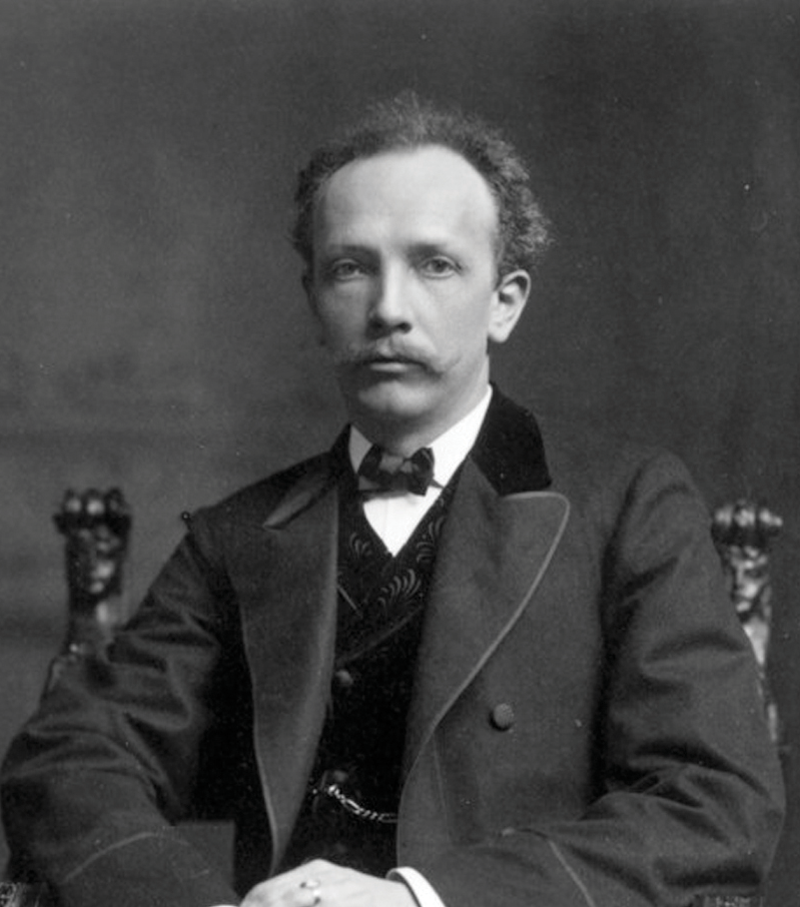
Born: June 11, 1864, Munich, Germany
Died: September 8, 1949, Garmisch-Partenkirchen, Germany
Also sprach Zarathustra (“Thus Spake Zarathustra”), Op. 30
- Work Composed: 1896
- Premiere: November 27, 1896 in Frankfurt with the composer conducting
- Instrumentation: 3 flutes (incl. piccolo), piccolo, 3 oboes, English horn, 2 clarinets, E-flat clarinet, bass clarinet, 3 bassoons, contrabassoon, 6 horns, 4 trumpets, 3 trombones, 2 tubas, timpani, bass drum, chimes, crash cymbals, glockenspiel, suspended cymbals, triangle, 2 harps, organ, strings
- CSO notable performances: First: November 1926, Fritz Reiner conducting. Most recent: October 2022, Maurice Cohn conducting.
- Duration: approx. 35 minutes
Although each of Richard Strauss’ tone poems — Macbeth, Death and Transfiguration, Don Juan, Don Quixote, Till Eulenspiegel, Ein Heldenleben, Also sprach Zarathustra — was inspired by what he called “a poetical idea,” he never described the programmatic elements, plot or “meaning” of these works in any detail, preferring to let critics and scholars contend over such matters. (Of Till Eulenspiegel, he once said, “Let them guess at the musical joke that the Rogue has offered them.”) Strauss approved almost all of these efforts (they were, after all, good publicity, and Strauss — and his very large income — thrived on publicity), so the latter-day reader is left with often contradictory evidence.
Such is the case with Also sprach Zarathustra, which was derived, in some manner at least, from the universal vision of Friedrich Nietzsche’s poem (left unfinished at his removal to a mental hospital in 1889). Strauss provided titles for the nine continuous sections of the piece, but attempts to equate them with specific passages from the poem have been largely unconvincing. Some of the music even goes against the meaning of the text. "Of the Inhabitants of the Unseen World" deals in Nietzsche’s belief in the folly of religion. Strauss’ analogous music, which was originally titled “Of the Divine” and quotes a Credo from the ancient Catholic liturgy, is marked “with devotion” and creates a prayerful mood. Strauss’ "Dance-Song" is not some vision of gods on Mount Olympus hymning the beauties of life, but a lilting Viennese waltz. The sensuality of Strauss’ interpretation of "Joys and Passions" has nothing to do with the self-abnegation professed by the poet. The truth of the matter seems to be that Strauss’ music and Nietzsche’s poem share little more than a title and a few pretentious ideas. Strauss’ Also sprach Zarathustra is a musical composition and not a philosophical tract.
One possible way to view Also sprach Zarathustra was given by Strauss himself in a letter to his friend Otto Floersheim at the time of the work’s Berlin premiere. He wrote:
I did not intend to write philosophical music or to portray in music Nietzsche’s great work. I meant to convey by means of music an idea of the development of the human race from its origin, through the various phases of its development, religious and scientific, up to Nietzsche’s idea of the Superman. The whole symphonic poem is intended as my homage to Nietzsche’s genius, which found its greatest exemplification in his book Thus spake Zarathustra.
These objectives are, in themselves, more than enough to ask of any piece of music. To go further and “attempt to reveal [in sound] a specific philosophical system or detailed philosophical teaching,” wrote George R. Marek in his biography of Strauss, “must end in failure.” Against this background, it seems probable that Nietzsche’s book was little more than the source of generating Strauss’ “poetical idea,” a literary hook upon which to hang a piece of music. In his exhaustive study of the composer, Norman Del Mar brought out the most salient point about Strauss’ magnificent tone poem: “Ultimately it is the sheer quality of the musical material and its organization that counts, while the greater or lesser degree to which it succeeds in the misty philosophizing which conjured it into being is wholly immaterial.”
Although the work’s philosophical intentions are correctly questioned, there has never been any doubt about the expressive powers of this music. (It was the Budapest premiere of Also sprach Zarathustra that inspired the young Béla Bartók to devote his life to composition.) The sections of Strauss’ tone poem mirror several strong emotional states, as indicated by the following program note that appeared at the work’s premiere, conducted by the composer in Frankfurt on November 27, 1896:
First movement: Sunrise, Man feels the power of God. Andante religioso. But still man longs. He plunges into passion (second movement) and finds no peace. He turns toward science, and tries in vain to solve life’s problems in a fugue (third movement). Then agreeable dance tunes sound and he becomes an individual, and his soul soars upward while the world sinks far below him.”
There is a progression inherent in the work, a sort of a-religious Pilgrim’s Progress, toward some transcendent state. One German writer, Rudolf Kloiber, viewed Also sprach Zarathustra as “a colorfully formed music-drama without words. ... Strauss chose from the poem the speeches of Zarathustra to create a kind of scenario for the content and form of the work.”
There are three overtly programmatic elements that unify the work. The first is heard at the outset. It is the theme of Nature, the unison call by four trumpets based on the most fundamental pitches in the musical spectrum: C–G–C (inextricably wedged in the public consciousness by Kubrick’s 2001: A Space Odyssey). The second is a sinister theme, perhaps depicting Fate, introduced by the trombones in the section “Of Joys and Passions.” The third is the conflict between the C tonality — representing Nature — and that of B, the latter standing for Man’s aspirations. The unsettled struggle between these two (the technical term is bi-tonality) is most clearly discerned at the very end of the work, but it occurs many times throughout the piece.
©Dr. Richard E. Rodda