GUESTS
Oona Borovicka | Narrator
Ava Weber | Understudy
The narrator appears special thanks
to Abacus Planning Group
Laura Nicholas | Director
Dicey Langston Artistic Partners
Kristin LaRoy, lead Lydia Coggins, Molly Coggins, Sage Criss, Lucy DeWease, Ella Kalliainen, Isabel LaRoy, Addelyn Rodgers, Ava Speer, Fiona Smith, Kalina Strong
Peter Kay (b. 1973)
Original narration by Mark Waldrop
Daring Dicey: Hero of the Revolution
As a tale gets told and retold on its way to becoming a legend, certain conflicting facts and embellishments inevitably emerge. And this local legend is no exception. Here’s what cannot be disputed: Dicey Langston was a real person, and her daring midnight adventure really did change the course of South Carolina history.
Aaron Copland (1900 - 1990)
Appalachian Spring: Suite
First half 50 minutes
This commission is funded in part by:
The South Carolina Arts Commission, which receives support from the
National Endowment for the Arts; South Carolina American Revolution
Sestercentennial Commission (SC250); The Rose Ball;
and The National Endowment for the Arts.
Special thanks to:
Mayor Brandy Amidon and the City of Travelers Rest, Upcountry History
Museum, South Carolina Historical Society, Centre Stage, and Furman University
Dicey Langston (World premiere)
Peter B. Kay and Mark Waldrop
Dicey Langston, a work for chamber orchestra and narrator, was inspired by the true story of a South Carolina teenager who risked her life during the Revolutionary War to protect her family and disrupt Loyalist attacks.
The 20-minute piece, presented here in its world premiere, focuses on one of the most famous episodes in Dicey’s life: an arduous journey on foot and horseback to warn Patriot forces of an impending Loyalist assault. Thanks to her courage, the attack was thwarted.
The work was composed by Peter B. Kay, general manager and composer-in-residence with the Spartanburg Philharmonic.
The piece’s text was written by Broadway director and writer Mark Waldrop, who previously penned a new version of “Peter and the Wolf” and an original story, “The Adventures of RaeLynn and Luke,” both for the Greenville Symphony.
For Dicey Langston, the Greenville Symphony Orchestra partnered with the Upcountry History Museum and SC250, an agency commissioned by state lawmakers to commemorate the 250th anniversary of the American Revolution in South Carolina.
Through its website (southcarolina250.com), SC250 relates the history of South Carolina’s pivotal role in the Revolution. Following are excerpts of Dicey Langston’s story from the SC250 website:
“Laodicea ‘Dicey’ Langston was born in 1766 in South Carolina’s Ninety Six District, which is now Laurens County.
“Dicey grew up along an important colonial road, in an area that brought frequent Loyalist activity near her family’s home. Her father, Solomon Langston, was a Patriot supporter, and her brothers served as Patriot soldiers. Because of the family’s close proximity to troops, Dicey started overhearing plans made by Loyalists.
“Dicey understood the danger but also knew it was important to pass along the information she was learning to help protect her brothers and other Patriot forces. When Loyalists discovered her actions, she was warned to stop or face deadly consequences. Her father’s life and property were directly threatened.
“Dicey paused briefly, but when she learned that a group of Loyalists known as the ‘Bloody Scouts,’ led by William ‘Bloody Bill’ Cunningham, planned to attack the Eden settlement where her brother and others were camped, she knew she could not stay quiet. In 1781, she traveled miles through the night by foot and horseback, crossing rivers and nearly losing her life. She reached the Patriot camp in time to warn the soldiers, who then alerted nearby residents and prevented the attack.”
A separate but equally fascinating story tells of Dicey protecting her father:
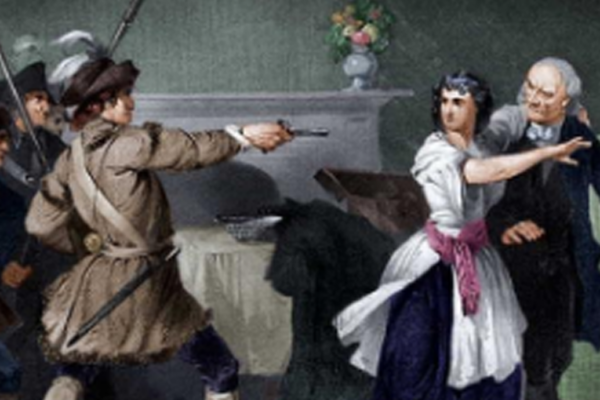
“Another time, Loyalists arrived at the Langston home and threatened to kill any supporters of the Patriot cause. When they pointed a gun at her father, Dicey stepped directly in front of him, daring them to shoot. The Loyalists left, shaken by her courage.
“Dicey continued to support the Patriot cause throughout the war. After independence was secured, she married Thomas Springfield and later moved to Travelers Rest, where she spent much of her adult life raising 22 children.”
Appalachian Spring
Aaron Copland (1900-1990)
Aaron Copland’s Appalachian Spring stands as one of the defining works of 20th-century American music, celebrated for its clarity, optimism, and evocation of the American landscape.
Composed in 1944 as a ballet score for choreographer Martha Graham, the work was originally commissioned by the Elizabeth Sprague Coolidge Foundation for performance at the Library of Congress. Copland later arranged the music into an orchestral suite, which has become one of his most frequently performed and beloved compositions.
The ballet is set in rural Pennsylvania in the early 19th century and depicts the simple joys and quiet challenges of frontier life. Rather than telling a literal story, Appalachian Spring unfolds as a series of scenes centered on a young pioneer couple preparing to build a life together, watched over by a revivalist preacher and a small community.
Copland’s music mirrors this gentle narrative through transparent textures, open harmonies, and a sense of spaciousness that listeners often associate with wide American landscapes.
Musically, Appalachian Spring exemplifies Copland’s mature style, sometimes described as “Americanist.” He favors clear melodic lines, steady rhythms, and harmonies built on fourths and fifths, which create a feeling of openness and restraint. The score moves fluidly between moments of quiet reflection and passages of lively, folk-like energy. Although the title suggests the Appalachian Mountains, Copland famously chose it after the music was completed; the work’s sense of place comes more from mood than geography.
The most recognizable moment in Appalachian Spring is Copland’s use of the Shaker hymn “Simple Gifts.” Introduced quietly and then developed through a set of increasingly animated variations, the tune becomes the emotional centerpiece of the work.
Copland treats the melody with restraint and reverence, allowing its simplicity to resonate as a symbol of humility, community, and hope. Rather than sounding nostalgic or sentimental, the variations feel purposeful and forward-looking, reinforcing the ballet’s theme of building a new life.
Since its premiere, Appalachian Spring has become a cultural touchstone, frequently performed in concert halls and widely used in film, television, and public celebrations. Its blend of folk influence, modernist clarity, and emotional directness captures a powerful vision of American identity.
More than a pastoral portrait, Copland’s Appalachian Spring expresses enduring ideals of optimism, cooperation, and faith in the future, qualities that continue to resonate with audiences decades after its creation.
© 2025 Paul Hyde
Paul Hyde, a longtime arts journalist, is an English instructor at Tri-County Technical College. He writes regularly for the Greenville Journal, the S.C. Daily Gazette, EarRelevant, ArtsATL, and the Atlanta Journal-Constitution. Readers may write to him at paulhydeus@yahoo.com.
Concert Hall Series
Saturday performances at 7:30
Sunday at 3:00 pm
Opening Night: Mozart Requiem
September 26 & 27
Beethoven’s Violin Concerto
November 21 & 22
Tchivzhel Conducts Mendelssohn and Tchaikovsky
February 6 & 7
Bartók Concerto for Orchestra
March 13 & 14
Beethoven 7 + Jacqueline Tso Plays Butterfly Lovers’ Concerto
April 10 & 111
Ravel’s Bolero + Maxim Lando
May 15 & 16
Gunter Theatre Series
Saturday performances at 7:30
Sunday at 3:00 pm
Mozart Among Friends
October 31 & November 1
Carmen in Concert
February 20 & 21
Rhythm Rising: A Percussion Celebration
March 20 & 21
Haydn Symphony 102 + Stravinsky’s Pulcinella
April 24 & 25
Special Concerts
How to Train Your Dragon in Concert
November 7 at 2:00 pm & 7:00 pm
Holiday at Peace
December 4 at 7:00 pm
December 5 at 7:00 pm
December 6 at 2:00 pm
Harry Potter and the Goblet of Fire™ in Concert
January 9 at 1:00 pm and 7:00 pm
January 10 at 2:00
Chamber Music Series
Principal Winds of the Greenville Symphony
September 15 at 5:30 pm, Poe Mill Music
September 16 at 7:00 pm, Cascades Verdae
Principal Strings of the Greenville Symphony
March 16 at 5:30 pm, Centre Stage
March 17 at 7:00 pm, Hotel Hartness
Details and tickets available at greenvillesymphony.org