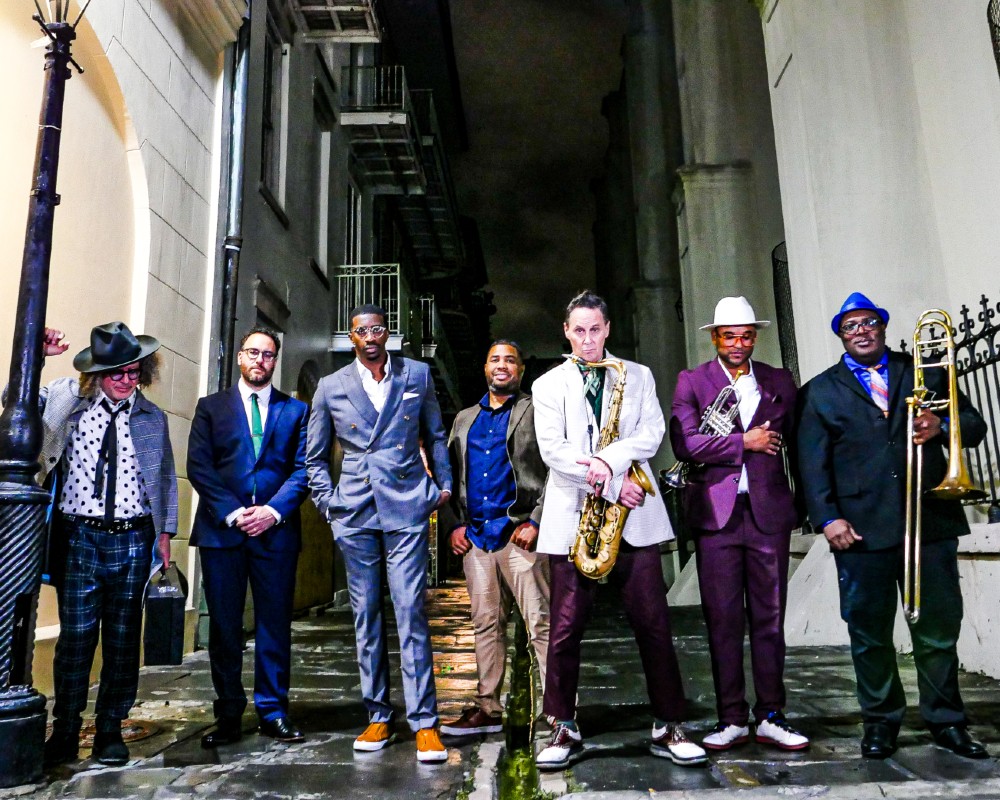
Preservation Hall Jazz Band
Sunday, February 22, 2026 at 5pm
Performance Sponsor
Haskell & White LLP
This performance will include a 15-minute intermission.
Ben Jaffe: Bass/Tuba
Branden Lewis: Trumpet
Clint Maedgen: Saxophone
Kyle Roussel: Piano
Revon Andrews: Trombone
Jafet Perez: Drums
At a moment when musical streams are crossing with unprecedented frequency, it’s crucial to remember that throughout its history, New Orleans has been the point at which sounds and cultures from around the world converge, mingle, and resurface, transformed by the Crescent City’s inimitable spirit and joie de vivre. Nowhere is that idea more vividly embodied than in the Preservation Hall Jazz Band, which has held the torch of New Orleans music aloft for more than 65 years, all the while carrying it enthusiastically forward as a reminder that the history they were founded to preserve is a vibrantly living history.
Preservation Hall Jazz Band marches that tradition forward once again on So It Is. The album redefines what New Orleans music means today by tapping into a sonic continuum that stretches back to the city’s Afro-Cuban roots, through its common ancestry with the Afrobeat of Fela Kuti and the Fire Music of Pharoah Sanders and John Coltrane, and forward to cutting-edge artists with whom the PHJB have shared festival stages from Coachella to Newport, including legends like Stevie Wonder, Elvis Costello and the Grateful Dead and modern giants like Beck, The Foo Fighters, My Morning Jacket, and the Black Keys.
Situated in the heart of the French Quarter on St. Peter Street, the Preservation Hall venue presents intimate, acoustic New Orleans jazz concerts over 350 nights a year featuring ensembles from a current collective of 50+ local master practitioners. On any given night, audiences bear joyful witness to the evolution of this venerable and living tradition.
The story of Preservation Hall dates back to the 1950s at Associated Artists, a small art gallery at 726 St. Peter Street in New Orleans’ French Quarter. Upon opening the gallery, the proprietor Larry Borenstein found that it curtailed his ability to attend the few remaining local jazz concerts, and began inviting these musicians to perform “rehearsal sessions” in the gallery itself. These sessions featured living legends of New Orleans jazz – George Lewis, Punch Miller, Sweet Emma Barrett, Billie and De De Pierce, The Humphrey Brothers, and dozens more.
During this period, traditional jazz had taken a backseat in popularity to rock 'n' roll and bebop, leaving many of these players to work odd jobs. Although concerted efforts by aficionados such as William “Bill” Russell succeeded in recording and documenting this fading artform during the New Orleans Jazz Revival of the 1940s, venues that offered live New Orleans jazz were few and far between. Before long, Borenstein’s sessions took on a life of their own; enthusiasts of the music gravitated toward the gallery, including a young couple from Pennsylvania named Allan and Sandra Jaffe.
The Jaffes arrived in New Orleans in 1960, on an extended honeymoon from Mexico City. During their visit, they conversed with a few jazz musicians in Jackson Square who were on their way to “Mr. Larry’s Gallery.” As avid fans of New Orleans jazz, the honeymooners followed the musicians and were introduced to Borenstein along with a number of living jazz greats that had gathered that evening for a jam session. Needless to say, they were enraptured by what they saw and heard. The music was pure and unaffected by the swaying of popular music. Most of these musicians were elderly, many of whom were contemporaries of Buddy Bolden and other early jazz practitioners. The Jaffes knew they happened upon something special and soon after moved to New Orleans permanently.
The jam sessions at 726 St. Peter became much more frequent, so much that Borenstein moved his gallery to the building next door. Performances were held nightly for donations and were organized by a short-lived, not-for-profit organization, The New Orleans Society for The Preservation of Traditional Jazz. Shortly after the Jaffes returned to New Orleans, Borenstein passed the nightly operations of the hall to Allan Jaffe on a profit-or-loss basis, and Preservation Hall was born.
Operating as a family business, Preservation Hall supported the unique culture of traditional jazz in New Orleans, which developed in the local melting pot of African, Caribbean, and European musical traditions at the turn of the 20th century. Preservation Hall was a rare space in the South where racially integrated bands and audiences shared music together during the Jim Crow era. At the center of that family business, the Jaffes became involved in the southern civil rights movement (and were even persecuted) as heads of an integrated venue in a time of cruelly-policed racial segregation.
The nightly jazz concerts at Preservation Hall gathered a significant amount of press interest from its inception, first from local media, then a year later from national outlets, such as The New York Times and The Brinkley News Hour. As time went on, Allan believed the success of both the Hall and its mission of preservation would require these bands to tour, and in 1963, he organized the newly minted Preservation Hall Jazz Band for a string of performances in the Midwest.
True to Jaffe’s estimation, the tour was a success and interest in the band and the rediscovery of New Orleans music stretched as far as Japan. The following decades found the band traveling and featured on a wide array of performances, from The Fillmore West with the Grateful Dead to the palace of the King of Thailand (who sat in on alto sax). Following Allan Jaffe’s untimely passing in 1987, Preservation Hall and The Preservation Hall Jazz Band now operate under the leadership of the Jaffe’s second son, Benjamin.