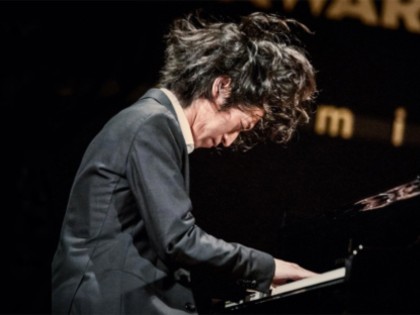
Hayato Sumino
Saturday, April 4, 2026 at 8pm
Global View Series Sponsor
Worah Family Foundation
This performance will include a 15-minte intermission.
JOHANN SEBASTIAN BACH (1685–1750)
Chromatic Fantasia and Fugue in D minor, BWV 903
HAYATO SUMINO (b. 1995)
New Birth (2022)
Recollection (2022)
Three Nocturnes - Pre Rain / After Dawn / Once in a Blue Moon (2023/2024)
FRÉDÉRIC CHOPIN (1810–1849)
Nocturne in C minor, Op. 48 No. 1 (1841)
Scherzo No. 1 in B minor, Op. 20 (c. 1835)
-INTERMISSION-
HAYATO SUMINO (b. 1995)
Big Cat Waltz (2020)
GEORGE GERSHWIN (1898–1937)
An American in Paris (1928)
[arr. Hayato Sumino]
MAURICE RAVEL (1875–1937)
Boléro, M. 81 (1928–29)
[arr. Hayato Sumino]
JOHANN SEBASTIAN BACH (1685–1750)
Chromatic Fantasia and Fugue in D minor, BWV 903
Few keyboard works by Bach so vividly suggest the presence of the improviser as the Chromatic Fantasia and Fugue in D minor, composed before 1717. The Fantasia unfolds with extraordinary freedom: volatile in gesture, harmonically daring, and resistant to the symmetrical habits of high Baroque writing. At moments, it seems almost to speak, turning aside from figuration into passages that resemble heightened declamation or operatic recitative.
The Fugue, by contrast, channels that expressive instability into discipline and propulsion. Cast in three voices and firmly grounded in D minor, it is built on a long chromatic subject whose force gathers steadily as the work proceeds. The result is music of mounting gravity and inevitability. Revered already in the 18th century, the piece circulated so widely in manuscript that more copies of it survive than of any other individual work by Bach.
HAYATO SUMINO (b. 1995)
New Birth (2022)
For Hayato Sumino, Frédéric Chopin is not merely a composer to interpret, but an artistic ideal: a musician whose craftsmanship is exacting, yet whose phrases seem to arise in the moment, as if improvised. Sumino has spoken of wanting not only to play Chopin well, but to learn from his aesthetic itself—its refinement, spontaneity, and sense of inevitability. It was with Chopin’s music still vivid in his imagination after the 2021 International Chopin Competition that Sumino composed New Birth and Recollection, two original works shaped by that encounter.
New Birth takes as one of its points of departure the streaming, arpeggiated world of Chopin’s Étude in C major, Op. 10, No. 1. But this is not transcription or paraphrase in any ordinary sense. Rather, Sumino uses Chopin’s keyboard language as a generative impulse—as a way of releasing his own virtuosic and imaginative response. The title suggests emergence, renewal, and transformation: music born from inheritance, yet not bound by it. What begins in homage becomes something newly made, with Chopin’s brilliance refracted through Sumino’s own fluent, contemporary voice.
Recollection (2022)
If New Birth turns outward in brilliance and motion, Recollection inhabits a more inward space: reflective, lyrical, and memory-charged. Sumino has described the piece as incorporating a melody from Chopin’s Ballade No. 2 in F major, preserved as a kind of souvenir from a journey to Warsaw, where he followed in the composer’s footsteps. As with New Birth, Chopin is not treated here as a distant monument, but as a living presence—something remembered, absorbed, and quietly reimagined.
The title is exact. Recollection does not simply quote the past; it listens back to it. Memory, in this piece, is neither fixed nor documentary. It returns in fragments, in atmosphere, in melodic traces that seem to hover between recognition and reinvention. The result is music of intimate retrospection: a personal response to place, lineage, and artistic kinship, where Chopin’s shadow remains visible, but the speaking voice is unmistakably Sumino’s own.
Three Nocturnes: Pre Rain / After Dawn / Once in a Blue Moon (2023/2024)
For Hayato Sumino, composition begins not with abstraction but with touch: at the keyboard, through improvisation. As he has described it, a piece often grows from spontaneous ideas recorded in the moment, later shaped by selecting, connecting, and refining the most compelling material.
His Three Nocturnes—Pre Rain, After Dawn, and Once in a Blue Moon—were first released on his debut album Human Universe (2024). Together, they form a kind of nocturnal triptych, each rooted in a particular place, atmosphere, and passing hour encountered in travel. Pre Rain arose in South Korea in winter, in weather suspended between snowfall and rain. After Dawn was inspired by sunrise in his hometown in Japan, glimpsed while jet-lagged and awake at an unusual hour. Once in a Blue Moon was improvised in the rural south of France.
Each piece preserves something of its original landscape: temperature, light, solitude, and mood. The result is music that feels both personal and cinematic, translating fleeting impressions into sound, suspended between memory and story.
FRÉDÉRIC CHOPIN (1810–1849)
Nocturne in C minor, Op. 48 No. 1 (1841)
Chopin’s nocturnes reveal perhaps the most inward and singing side of his art. Yet within their often intimate scale lies an astonishing breadth of expression. The late Nocturne in C minor, Op. 48, No. 1 is among the most powerful of the set: a work of concentrated drama, noble rhetoric, and deep emotional layering.
Its opening is grave and arresting, and from that stillness the music rises gradually toward one of the darkest and most commanding climaxes in the entire nocturne repertory—almost orchestral in its scope. What follows is equally striking: not a triumphant release, but a retreat into a coda of unusual inwardness. The piece becomes, in miniature, a study in contrast, restraint, and the eloquence of afterthought.
Scherzo No. 1 in B minor, Op. 20 (c. 1835)
Chopin’s four scherzos take a genre once associated with wit and lightness and transform it into something far more turbulent and grand. The Scherzo No. 1 in B minor, written some four years after his arrival in Paris, is among the boldest of them—compressed in form, yet immense in gesture and emotional range.
It begins almost in provocation, with commanding chords and rushing passagework that seem to announce themselves as a challenge. Yet Chopin places within this storm a moment of striking tenderness: a gently unfolding melody drawn from the Polish Christmas carol Lulajże Jezuniu. Heard in this context, the quotation becomes more than contrast; it is a remembrance of home—intimate and deeply affecting—set against the work’s larger drama.
-INTERMISSION-
HAYATO SUMINO (b. 1995)
Big Cat Waltz (2020)
Sumino’s Big Cat Waltz is at once affectionate, elegant, and mischievous—a miniature portrait gallery in motion. Written, as he shared, for his beloved cats, the piece was sparked in particular by one resident feline: outwardly placid, somewhat stout, yet unexpectedly agile.
Known online as “Cateen,” Sumino nods here both to Chopin and to the Viennese waltz tradition, though always with a sly smile. The buoyant triple meter, quicksilver changes of direction, and springing melodic leaps all suggest the cat’s peculiar blend of poise, unpredictability, and athletic grace. Beneath its charm lies a deftly stylized musical joke—a valse-scherzo in spirit, if not in title.
GEORGE GERSHWIN (1898–1937)
An American in Paris (1928)
[arr. Hayato Sumino]
Gershwin described An American in Paris as the impression of an American visitor wandering the city, hearing its street sounds, and absorbing its atmosphere. He spoke of it after returning from Europe in 1928, by which time he was already firmly established on both Broadway and the London stage through works such as Funny Face, Rosalie, and Oh, Kay! Yet for all his success, he continued to pursue artistic expansion, seeking out major European composers including Milhaud, Poulenc, Prokofiev, Stravinsky, and Ravel—who famously declined to teach him, asking why Gershwin should risk becoming a second-rate Ravel when he was already a first-rate Gershwin.
It was during this visit that Gershwin began An American in Paris, which he characterized as “really a rhapsodic ballet,” freely written and among the most modern music he had yet attempted. Like his earlier orchestral works, it resists a fixed storyline. Its program is atmospheric rather than literal: a sequence of impressions, urban energies, and passing moods.
Gershwin’s rhythmic vitality, improvisatory instinct, and synthesis of musical languages have been especially meaningful to Hayato Sumino, who has arranged An American in Paris, I Got Rhythm, and Rhapsody in Blue. In an interview with NHK Radio, Sumino reflected on Gershwin’s influence in bringing genres together—a creative impulse he recognizes in his own work as well.
MAURICE RAVEL (1875–1937)
Boléro, M. 81 (1928–29)
[arr. Hayato Sumino]
Ravel’s famously dry verdict on Boléro was that it was his only masterpiece—and that, unfortunately, it contained no music. The remark was characteristic: witty, provocative, and not entirely untrue to the work’s premise. Originally conceived as a ballet for Ida Rubinstein, Boléro is built from radically limited means: one rhythmic pattern, one melody, and two alternating sections, sustained across a vast crescendo driven not by thematic development but by changes in instrumental color.
In 1929, Ravel made a version for two pianos, and it is from that lineage that Hayato Sumino’s reimagining proceeds. Here, he further alters the instrument’s resonance by incorporating felt, dampening the strings in a manner that recalls aspects of John Cage’s prepared-piano practice.
Ravel himself cautioned early listeners not to search the piece for conventional expressive argument. He called it an experiment in an extremely narrow and deliberate direction, its themes impersonal and its character tied to a staged vision of urban modernity—a street scene, with a factory visible in the background. In that sense, Boléro belongs to the mechanized pulse of the early 20th century, not unlike Honegger’s Pacific 231. Its repetitions generate tension without transformation, fascination without release. That very quality has made it one of the most recognizable—and most argued-over—works in the orchestral canon.
“Something truly unforgettable was created by Hayato Sumino when he made his debut on the piano world’s biggest stage” (Classic FM).
Taking the concert world by storm, pianist and composer Hayato Sumino breathes new life into the term virtuoso. His dynamism and creativity are the building blocks of his astonishing online presence—boasting over 1.5 million YouTube followers and 240 million views, and still growing—and his passion and spontaneity draw fans to the concert hall, where he regularly sells out shows and captivates audiences across North America, Europe, and Asia, with lines out the door for his autograph.
Sumino’s unique style blends classical virtuoso tradition with an arranger’s ear and breathtaking improvisational skills, allowing him to share classical masterworks, jazz, and his original works with audiences around the globe. His global appeal is evidenced by his recent history-making wins of top honors in two categories in Germany’s most important classical music awards, the Opus Klassik Awards: Live Performance of the Year (Soloist) and Young Talent of the Year for his debut album on the Sony Classical label, Human Universe.
Released last fall, the record includes repertoire by Bach, Fauré, Purcell, Sakamoto, and Hans Zimmer, as well as Sumino’s own compositions and arrangements. His second Sony Classical album, Chopin Orbit, was released in January 2026 and reached No. 1 on the Apple Classical Top 100 chart.
The 2025–26 season marks Sumino’s busiest yet in North America and began with sold-out recitals at his Carnegie Hall debut, as well as appearances in Chicago; Stanford and Fresno, California; and with Canada’s National Arts Centre Orchestra in Ottawa. Spring 2026 sees a return to Carnegie Hall as soloist with The Philadelphia Orchestra, along with recitals throughout California, Massachusetts, and Vancouver. He made his Hollywood Bowl debut last summer to great acclaim, performing his signature version of Gershwin’s Rhapsody in Blue with the Los Angeles Philharmonic.
Overseas, he recently toured Japan with the Polish National Radio Symphony Orchestra under the baton of Marin Alsop and will soon give recitals in Italy, Austria, Germany, Switzerland, and Japan. Throughout the season, he performs on some of the world’s most prestigious stages, including the Elbphilharmonie Hamburg, the Berlin Philharmonie, and the Vienna Konzerthaus.
Continuing a long series of accolades for his fresh and innovative approach to music, Sumino was awarded the 2025 Schleswig-Holstein Music Festival Leonard Bernstein Award. He was also featured on Forbes Japan’s “30 Under 30” list in 2023, which recognizes “young entrepreneurs, leaders, and trailblazers” who are spearheading “the transformation of industries and finding innovative ways to navigate new business realities.” In 2018, he won the Grand Prix at the PTNA Piano Competition, and in 2020, while completing his master of engineering degree, he received the University of Tokyo’s President’s Award for exceptional achievements in both music and academics.
Recent seasons have seen Sumino collaborating with the Vienna Radio Symphony Orchestra on an 11-concert sold-out tour of Japan conducted by Marin Alsop; appearing at the Ravinia Festival with Alsop and the Chicago Symphony Orchestra; and debuting in many of Europe’s renowned concert halls, including the Berlin Philharmonie and Munich’s Prinzregententheater. An extensive sold-out 24-recital tour of Japan culminated in a celebration of his July 14 birthday at Budokan in Tokyo, where he performed for more than 13,000 fans. His 2024 Royal Albert Hall debut of Gershwin’s Rhapsody in Blue with the Royal Scottish National Orchestra created a media frenzy. In November 2025, his performance at K-Arena in Japan achieved a Guinness World Record for the most tickets sold for an indoor piano recital, with more than 18,000 in attendance.
Hayato Sumino is an exclusive Sony Classical recording artist, an Artist Ambassador for Apple Music Classical, a Steinway Artist, and a CASIO Ambassador, and he continues to forge his own path in the arts, equally comfortable across a wide range of genres and repertoire.