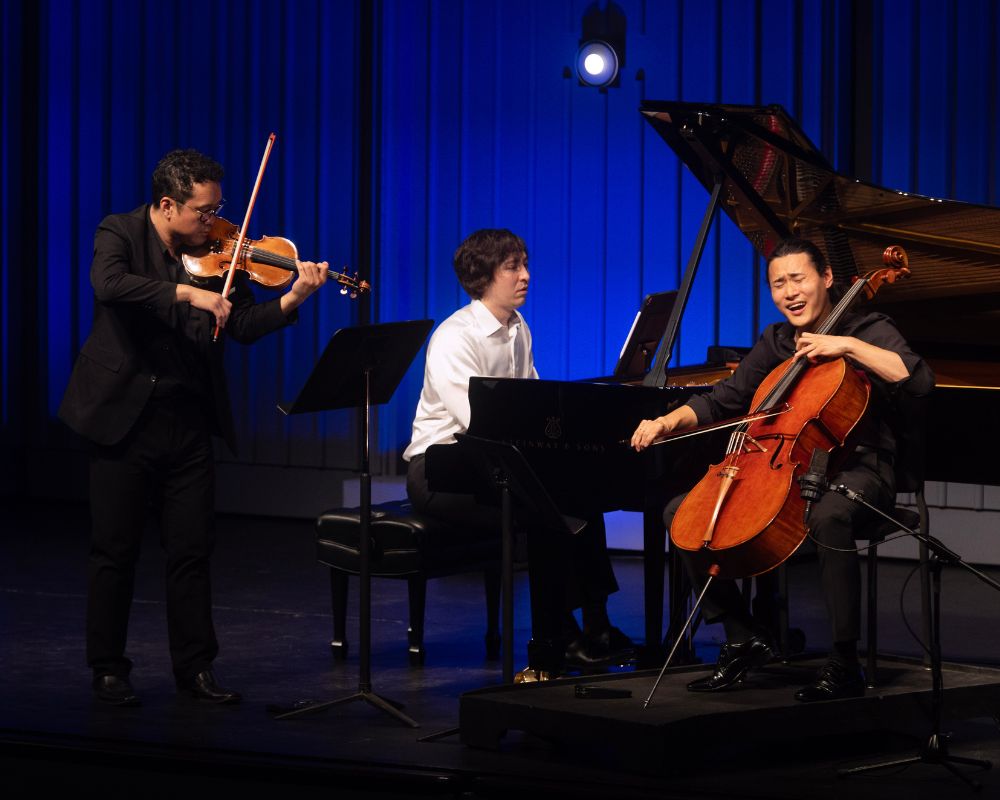
Trio Barclay®
Brahms' Piano Quartet No. 1
Sunday, May 3, 2026 at 5pm
Performance Sponsors
Eugene and Carol Choi
Mike Gordon
Terry and Judy Jones
Karen Kuo-Limb and Jong C. Limb
Goran Matijasevic
Dot and Rick Nelson
Al Spector and Tatjana Soli
Artist Sponsor
Gerrit and Amy Cole Foundation
Wes and Judy Whitmore
This performance will include a 15-minute intermission.
TRIO BARCLAY
Dennis Kim: Violin
Jonah Kim: Cello
Sean Kennard: Piano
WITH SPECIAL GUESTS
Jessica Chang: Viola
EcoEcho Ensemble
Antonín Dvořák: Song to the Moon
Trio Barclay
Johannes Brahms: Piano Quartet No. 1 in G minor, Op. 25
I. Allegro
II. Intermezzo: Allegro ma non troppo — Trio: Animato
III. Andante con moto
IV. Rondo alla Zingarese: Presto
Trio Barclay with Jessica Chang, viola
-INTERMISSION-
Special Collaboration (TBA)
Trio Barclay and EcoEcho Ensemble
Sheridan Seyfried: Piano Trio No. 4 (World Premiere)
I. Lento; Energico
II. Adagio espressivo
III. Con spirito
Trio Barclay
I. Allegro
II. Intermezzo: Allegro ma non troppo — Trio: Animato
III. Andante con moto
IV. Rondo alla Zingarese: Presto
Johannes Brahms’s Piano Quartet in G minor, Op. 25, composed between 1856 and 1861, stands as one of the most powerful and expansive works in the chamber music repertoire. Written during a turbulent period in Brahms’s life—marked by his deep emotional connection to Clara Schumann and the lingering shadow of Robert Schumann’s death—the quartet reflects both intensity and introspection.
The opening movement (Allegro) bursts forth with restless energy, driven by a dramatic, sweeping theme in the strings against a richly textured piano part. Brahms develops this material with remarkable structural command, balancing lyricism with stormy agitation. The movement’s emotional breadth sets the tone for the entire work.
The second movement, Intermezzo (Allegro ma non troppo), replaces the traditional scherzo with something more shadowy and elusive. Its muted, almost ghostly character contrasts sharply with the outer movements. The central section offers a brief moment of warmth, but the unsettled mood soon returns, leaving an air of mystery.
In the Andante con moto, Brahms provides a lyrical respite. This movement unfolds as a set of variations on a tender, song-like theme introduced by the cello. Each variation reveals new colors and textures, showcasing Brahms’s gift for melodic transformation and intimate dialogue among the instruments.
The finale, Rondo alla zingarese (Presto), is a fiery tour de force inspired by Hungarian folk music. With dazzling rhythms, rapid passagework, and sudden shifts in mood, the movement demands virtuosic brilliance from all four players. Its exuberant energy and dramatic flair bring the quartet to a thrilling conclusion.
Brahms’s Piano Quartet in G minor is a work of profound contrasts—lyrical and turbulent, intimate and explosive—revealing a composer at once deeply reflective and boldly expressive.
I. Lento; Energico
II. Adagio espressivo
III. Con spirito
This work is not only the fourth trio I composed, but also the fourth I composed specifically for Sean, Dennis, and Jonah. This ongoing collaboration among friends has been a composer's dream - multiple commissions have allowed me to experiment and grow. I think of how 18th century composer Joseph Haydn had nearly unlimited opportunity to write symphonies, thanks to the support of his princely patron, and regular access to the stellar band at the prince's estate. "Papa" Haydn ultimately wrote a whopping 104 symphonies, and changed the course of musical history in the process. Though I lay no claim to being compared with one of my musical heroes, nor do I profess to change the course of history, what I certainly do hope is to provide our wonderful Irvine audience with a special and memorable musical experience.
This piece is in three movements - the first and third movements (fast in speed) are about 6 minutes each, and the middle (slow) movement is about 9. The first movement begins with a slow introduction that sets the tone for what's to come. Notes of yearning or nostalgia, however, quickly give way to much faster, livelier music: we are plunged into a headlong dance of sorts: rhythmic, driven, and by turns dark-hued and playful. The movement eventually reaches a frenetic conclusion.
The second movement is a lyrical meditation - after the solo piano sets the mood, a violin melody is introduced, built on a repeated pattern of descending notes. The music ebbs and flows in this melancholy mood — an overcast sky, or maybe a quiet rainfall. Soon, however, the mood changes — the piano again introduces a new idea, but this time, the character is unmistakably yearning and quietly impassioned. The strings take up the idea, and the music grows to a climax. Settling down eventually, we hear the sad song return again, as if reality is intruding on a pleasant dream. However, the music quickly takes on a greater restlessness than before, as if wishing to find its way out. At a peak of intensity, there is an epiphany — a revelation, or maybe a decision of the will — the hopeful tune is suddenly reclaimed in a full-throated acclamation. Joyfully, the ensemble strives toward an even greater peak of passion. In the final denouement, tenderness and love prevail.
The finale begins in quiet jubilation, as if carrying a happy secret. The tenor of the music is unmistakably joyous and optimistic. After a few minutes, a contrasting idea emerges in the cello: a driving, rhythmic sort of dance in the minor mode. This mood reflects other things earlier in the piece, and brings into question whether the light-hearted joy is meant to stay. The music settles down and softly the cello, then the piano, offer reflection on the movement's opening theme. The violin joins, and together the instruments crescendo to a return of the former jubilation. A final section ("coda") rounds out the piece, slowly building to an ultimate peak of joy and exuberance.
- Program notes by the composer
EcoEcho Foundation is a youth-led nonprofit dedicated to advancing inclusion, healing, and equity through music. Comprised of passionate middle school, high school, and college students, EcoEcho believes that access to music is a right, not a privilege—especially for children with disabilities and those from under-resourced communities. Through accessible music education, inclusive performances, and global partnerships, the organization empowers young people to build creativity, compassion, and a stronger sense of community.