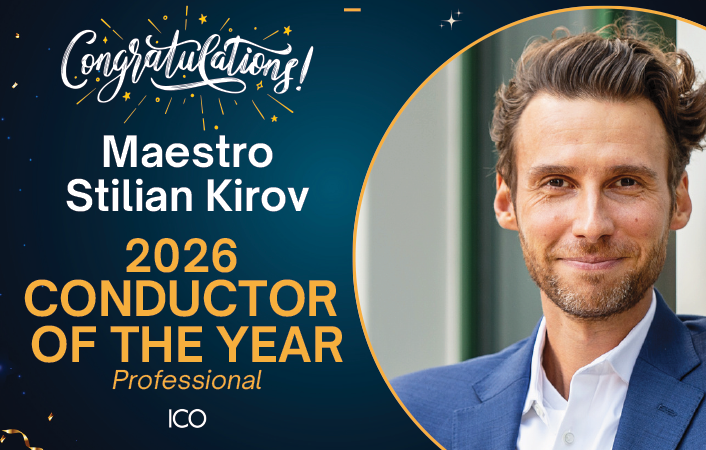

Stilian Kirov, Conductor
Matthew Lipman, Viola
LaRob. K. Rafael, Narrator
Fanfare for the Uncommon Woman | Joan Tower | |
Coincident Dances | Jessie Montgomery | |
The Liberty Bell | John Philip Sousa | |
Washington Post | John Philip Sousa | |
The Stars and Stripes Forever | John Philip Sousa | |
| INTERMISSION | ||
| Presentation of Davee Award to Music Institute of Chicago | ||
Billy the Kid: Suite | Aaron Copland | |
Theme from Schindler’s List for Solo Viola and Orchestra | John Williams (b. 1932) | |
Lincoln Portrait | Aaron Copland | |
OPENING ACT LOBBY PERFORMERS
Hinsdale Middle School Harp Ensemble
Contact: Meghann Talbot and Mary Mandel
mmandel@d181.org
First Violin
Azusa Tashiro, Concertmaster
Lois and Stanley Birer
Elizabeth Huffman,
Assistant Concertmaster
Ebedit Fonseca
Lilian Chou
Stephane Collopy
Hobart Shi
Brian Ostrega
Steve Winkler
Matt Musachio
Jacob Murphy
Amanda Beaune
Second Violin
Linda Veleckis, Principal
Linda D. and Craig C. Grannon
Kamen Vatchev,
Assistant Principal
Anna Carlson
Caroline Slack
Matthew Weinberg
Munire Mierxiati
Kate Lano
Linda Lager
Samantha May
Carmen Abelson
Viola
Oana Tatu, Acting Principal
Gerhard Haigis
Matthew Barwegan
Acting Assistant Principal
Scott Gordon-Dowd
Nicholas Munagian
Jay Pike
Adam Davidowitz
Monic Reilly
Cello
Jacob Hanegan, Principal
Brian and Carolee Samuels
Lisa Bressler,
Assistant Principal
Emily Lewis Mantell
Ingrid Krizan
Karena Fox
Margaret Daly
Bass
Phillip Serna, Acting Principal
Billie and Henry Hauser
Alison Gaines
Acting Assistant Principal
Lindsey Orcutt
Jason Neihoff
FLUTE
Cythina Fudala, Principal
Dr. Jerri E. Greer
Isabel Evernham
Dominic Dagostino
OBOE
Naomi Bensdorf Frisch, Principal
Steve and Joey Buck
Christine Janzow Phillips, also English Horn
CLARINET
Trevor O'Riordan, Principal
Leonard Achtenberg and Steven Livesey
William Olsen, also bass clarinet
BASSOON
Erin Kozakis, Principal
Dr. Mel and Janet Muchnik
Matthew Hogan
HORN
John Schreckengost, Acting Principal
Barbara Sturges
Brian Goodwin
Elizabeth Mazur-Johnson
TRUMPET
Greg Fudala, Acting Principal
Richard and Andrea Gibb
Sarah Carrillo
Ross Beacraft
TROMBONE
Thomas Stark, Acting Principal
Adam Moen
Andrew Rozsa
TUBA
Sean Whitaker, Principal
Dr. Michael Rogers
TIMPANI
Sarah Christianson, Acting Principal
HARP
Michael Maganuco
PERCUSSION
Richard Janicki, Principal
Kathleen Field Orr
Andy Cierny
Christian Hughes
Paul Ross
PIANO / CELESTE
Louise Chan
* indicates on leave
Chair Sponsor indicated in blue text
2026 | Ruth D. and Ken M. Davee Excellence in the Arts Award
honoring the Music Institute of Chicago
 Tonight, IPO will honor the Music Institute of Chicago with the Ruth D. and Ken M. Davee Excellence in the Arts Award, an honor bestowed periodically to honor an individual, group, or organization whose exceptional commitment, vision, leadership, and achievements have resulted in major contributions to the arts and music. This is the most prestigious award given by the orchestra.
The Music Institute of Chicago fosters lifelong engagement with music for people of all ages, backgrounds, and abilities. Serving students from early childhood through pre-professional training and adult studies, MIC combines exceptional teaching, outstanding performance opportunities, and community programming. By harnessing the power of music, MIC educates and inspires while ensuring broad access to high-quality music education.
MIC envisions a community where music education and performance are accessible to everyone, regardless of age, background, or ability to pay. We believe strongly that the arts contribute to vibrant, resilient communities and strive to reach individuals with music education where such opportunities are limited. Music education is an investment in helping young students develop into strong, creative, and productive citizens. Music students at MIC grow into creative and engaged citizens, making the world a better place.
Founded in 1931 by David and Dorothy Dushkin, the Music Institute of Chicago (MIC) makes high-quality music education accessible to all. MIC is recognized as a cornerstone of Chicago’s musical ecosystem, contributing generations of artists to institutions such as Chicago Symphony Orchestra and Lyric Opera of Chicago with alumni performing on major stages such as Carnegie Hall, the Kennedy Center, The Hollywood Bowl, as well as other prestigious venues around the world.
IPO is honored to bestow this award to the incomparable Music Institute of Chicago.
Ruth Davee was a long-time benefactor of the IPO who enjoyed a wonderfully close relationship with the orchestra over the years. The IPO is pleased to honor other dedicated arts supporters with the Ruth D. and Ken M. Davee Excellence in the
Arts Award.
Since its founding in 1931, the Music Institute of Chicago has served as an important community resource, engaging in innovative teaching, inspiring performances, and a fundamental drive to ensure access to music for everyone. The practice of studying music prepares MIC alumni for success across every conceivable industry from Grammy Award winners to zoologists. Illinois Philharmonic Orchestra has had a long relationship with MIC alumni Matthew Lipman and Rachel Barton Pine whose Foundation was awarded the Ruth D. and Ken M. Davee Excellence in the Arts Award in 2022.
– Artistic Committee Chair, Charles Amenta, M.D.
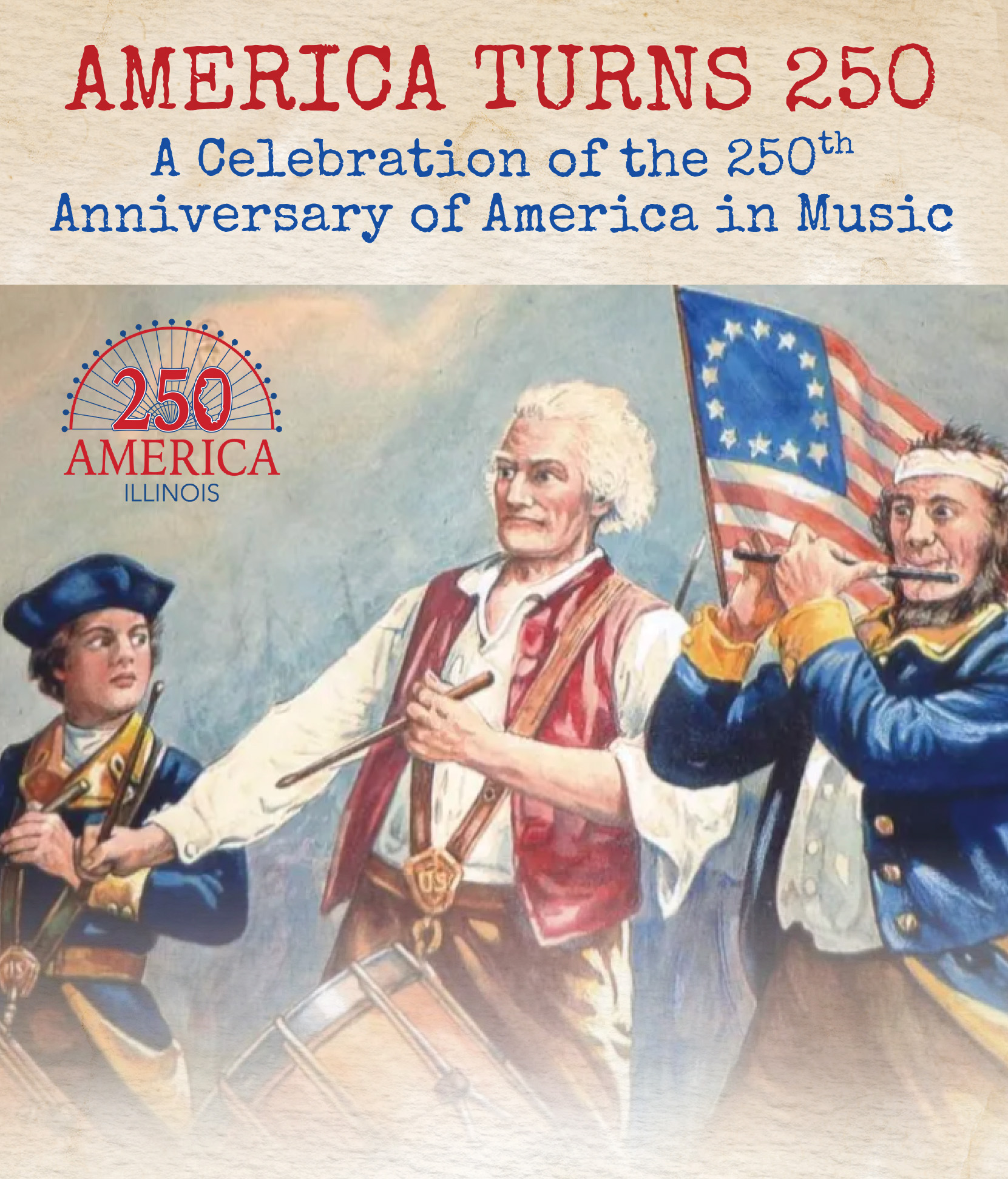
Happy 250th Birthday to the United States of America! “Three cheers for the Red, White, and Blue!” You may be surprised that John Philip Sousa did not set those words in his great march, The Stars and Stripes (the official title is sans “Forever”). But as that text certainly fits the famous melody, you can think those words (please, no singing) as the Illinois Philharmonic Orchestra performs that most American of compositions. Appropriately, this is a concert consisting solely of “American Music.” As Illinois Philharmonic Orchestra regular attendees will remember, whenever we program the Dvořák Symphony No. 9 “From the New World,” we are compelled to discuss his theory about the future of American classical music – namely that the elements of the traditional music of Blacks and indigenous people should form the basis of American classical music the same way that the folk songs of the Czech lands informed his music, or as a 20th-century example, the various folk musics of central Europe and North Africa formed the basis and inspiration of Bartok’s music. Dvořák’s proclamation was very controversial at the time.
Fortunately, most people accept the maxim of Virgil Thomson, a mid-twentieth-century American composer and critic, who famously described the essence of American music with characteristic perception and concision: "The way to write American music is simple. All you have to do is be an American and then write any kind of music you wish." (Thompson was taught by the same Parisian superstar composition teacher, Nadia Boulanger, who guided a myriad of American composers from Aaron Copland to Quincy Jones and Philip Glass.) In that Thompsonian sense, even the later music of Igor Stravinsky, Erich Wolfgang Korngold, and Mario Castelnuovo-Tedesco (all performed by the IPO) could also be considered “American” because all were naturalized American citizens. That inclusiveness is a glory of The United States of America. Unfortunately, there is no such adjective, “U.S. of A.’an” so we must use “American” though, as the Puerto Rican megastar Bad Bunny demonstrated in this year’s Super Bowl half-time show, there are more than 20 “American” countries in the Western Hemisphere including Mexico whose official name is Estados Unidos Mexicanos. So, “God Bless America!” God Bless all these United States! It’s great to be an American and have American music to play and listen to however it is defined.
Joan Tower (born 1938) is a Grammy-winning contemporary American composer, concert pianist, and conductor. Tower first gained worldwide recognition for her very first orchestral composition, Sequoia (1981), a tone poem that structurally depicts a giant tree from trunk to needles. Tower has written a variety of instrumental works, including the Island Prelude, five string quartets, an assortment of other tone poems and Fanfare for the Uncommon Woman —something of a response to Aaron Copland's Fanfare for the Common Man. Born in New Rochelle, New York, Tower moved to Bolivia when she was nine years old, an experience she credits for making rhythm an integral part of her work. She discovered this love for rhythm in the local saints’ day celebrations. There, she learned how to play percussion which started her musical journey. For the next decade Tower's talent for music, particularly the piano, grew rapidly due to her father's insistence that she benefit from consistent musical training. Tower was the pianist and a founding member of the Naumburg Award-winning Da Capo Chamber Players, which commissioned and premiered many of her early works, including the popular Petroushskates.
Among her most famous works is the six-part Fanfare for the Uncommon Woman, dedicated to "women who are adventurous and take risks". Four of the six parts are scored for 3 trumpets, 4 horns, 3 trombones, tuba and percussion. The Fanfare No. 1, which the IPO plays tonight, debuted in 1987 and was subsequently dedicated specifically to the female conductor Marin Alsop who is the Chief Conductor of the Ravinia Festival.
Jessie Montgomery was born in 1981 in New York City. Since 1999, Montgomery has been affiliated with The Sphinx Organization, which supports the accomplishments of young Black and Latino string players. In 2014, Montgomery, of African American heritage, was awarded Sphinx’s generous MPower grant toward her acclaimed debut album, “Strum: Music for Strings.” Montgomery holds a Bachelor of Music degree from the Juilliard School and completed her graduate degree in 2012 in Composition for Film and Multimedia at New York University. Since 2012, she has been a member, as first violin, of the highly acclaimed Catalyst Quartet, touring regularly in the United States and abroad. In addition to composing, Jessie could also be heard performing regularly with Silkroad, The Knights, and the Orpheus Chamber Orchestra. Riccardo Muti, Music Director of the Chicago Symphony Orchestra, appointed Jessie Montgomery as the ensemble’s Mead Composer-in-Residence, 2021-2024. Montgomery won the Grammy for Best Contemporary Classical Composition for the recording of her work, Rounds. (David Diamond whose Symphony No. 2 was memorably performed by the IPO under Stilian Kirov in 2024, composed his most famous work titled Rounds for String Orchestra in 1944.)
The IPO performed Montgomery’s Strum (2006; rev. 2012), at the moving Matt Mantell memorial concert in 2023. Many organizations this US anniversary season are performing Montgomery’s Banner (2014) her meditation on the 200th anniversary of the “Star Spangled Banner;” appropriately, Stilian Kirov has chosen the lively Coincident Dances (2017 premiered by the Chicago Sinfonietta). Coincident Dances is inspired by the sounds found in New York’s various cultures, capturing the frenetic energy and multicultural aural palette one hears even in a short walk through a New York City neighborhood. The work is a fusion of several different sound-worlds: English consort, samba, mbira dance music from Ghana, swing, and techno. According to Montgomery, some of the pairings started as experiments. Working in this mode, the orchestra takes on the role of a DJ of a multicultural dance track.
John Philip Sousa (1854-1932) was born on November 6, 1854, in Washington, D.C., to João António de Sousa (John Anthony Sousa), who was born in Spain to Portugese parents. The elder Sousa was a musician in the U.S. Marine Band. The young John Philip, who had taken music lessons to learn the violin, piano, flute, and several brass instruments, entered the Marines as an apprentice bandmate at age 13. (The Marines gave him the rank of “boy.”) This employment was arranged by his father to prevent him from joining a circus band! After leaving the Marines in 1875, he began performing on the violin and joined a theatrical pit orchestra where he learned to conduct. Sousa rejoined the Marines in 1880 to lead the Marine Band, “The President’s Own.” With his leadership (1880-1892) and compositions, he brought the Marine Band to a high level of performance and renown. His compositions of that period include The Gladiator (1886) Semper Fidelis (1888) – the official Marine March --, and the Washington Post (1889). After leaving the Marine Band, he formed his own 70-piece “Sousa Band” that toured nationally and internationally. Major works of “The March King.” [or “The American March King” to distinguish him from his British counterpart, Kenneth J. Alford] include Liberty Bell (1893), Stars and Stripes (1896) and El Capitan (1896). The latter was derived from its namesake operetta, one of the fifteen (!) operettas that he composed. Sousa wrote 136 Marches, Five overtures, and 11 Suites.
There is a Chicago connection. The Belle of Chicago (1892) a Sousa march which Chicago males of the time criticized as far too vigorous to represent the local fair sex. Sousa’s A Century of Progress (1932) was the official march for the Chicago World’s Fair of 1933, which Sousa did not live to see. The Navy can also claim Sousa because he patriotically enlisted in 1917 to train bands at the Great Lakes Naval Station in Illinois where he took charge of the Great Lakes Naval Band.
Sousa had achievements beyond music. He was ranked as one of the all-time great trapshooters and was enshrined in the Trapshooting Hall of Fame. He also wrote novels and novellas. In Sousa's 1902 novella The Fifth String, a virtuoso violinist makes a deal with the Devil for a magic violin with five strings. The first four strings excite the emotions of Pity, Hope, Love, and Joy but the fifth string, made from the hair of Eve, will cause the player's death once played. The violinist wins the love of the woman he desires but out of jealous suspicion, she commands him to play the death string, which he does.
Over many years, Sousa refined his march forms with which, solely using musical means, he was able to tell a story with a dramatic build to an exciting conclusion. The Washington Post has been described by march experts as a “concert” march (i.e., for the concert hall, not on the field to march to). The Liberty Bell was made infamous as used in the Monty Python introduction music. While there are parody lyrics (e.g., with “web-footed friends”) set to the Stars and Stripes, Sousa actually penned a text. The famous refrain goes per Sousa:
Hurrah for the flag of the free!
May it wave as our standard forever,
The gem of the land and the sea,
The banner of the right.
Let despots remember the day
When our fathers with mighty endeavor
Proclaimed as they marched to the fray
That by their might and by their right it waves forever.
Leonard Bernstein famously said of American composer Aaron Copland, “he’s the best we have.” Another American composer, David Del Tredici, called Copland, “our Bach.” While Copland might have winced at such a hyperbolic accolade if he had been alive to hear it, he certainly was and perhaps is still the formidable presence in American musical composition, known in his lifetime as “The Dean of American Composers.” This may be because he was the first composer to write music of great quality which seemed to say “American” in every bar, not just in a few passages which were ensconced in an otherwise European sound world.
The Copland sound is spacious, like America, often with chords voiced over several octaves across the whole orchestra. The Copland voice is eloquent, but not fussy, thick, or bombastic. A frequent expression marking in Copland’s scores is “with simplicity.” There is emotion, but not hand-wringing--more a bit of moisture in the eye and a subtle yearning for a time that might have been a bit more wholesome, honest, and natural. There is a famous video of Copland rehearsing an orchestra in one of his pieces instructing the players, “Watch out, you’re making it sound…a little pathetic—keep away from the Tchaikovsky side. Make it a little cooler.”
Copland was born in 1900 in New York City to a Jewish immigrant family with no particularly musical background. He left the US in 1920 to study composition in Paris with Nadia Boulanger. Paris, because that’s where the newest things in music were happening, and Boulanger because she knew intimately what these exciting sounds and ideas meant and had empathy for the individual creative spirit that few teachers in any field ever communicated. Copland, with his projecting nasal dorsum and overbite, did not have the glamorous composer presence that someone like a Bernstein inhabited, but Boulanger would state, “without any sense of irony” that she thought that Copland had a “beautiful face.”
Copland, on his return to the US in 1924, was able to get a few performances of his works, most notably by his life-long champion, Serge Koussevitsky, with his Boston Symphony Orchestra. The early critical reception was seldom positive. His jazz-inflected Music for the Theater (1925) was branded as music suitable for a whore house. His Piano Concerto (1927) has several entries in Slonimsky’s Lexicon of Musical Invective including: “…a harrowing horror from beginning to end. There is nothing in it that resembles music except as it contains noise...” and “…shows a shocking lack of taste, of proportion…”
One notable Copland piece of that period that the Illinois Philharmonic Orchestra performed was the Symphony for Organ and Orchestra (1924) at Stilian Kirov’s first concert as Music Director in 2017. Tonight, however, we must pivot to the later, “populist” Copland of the tuneful even “folksy” pieces that have also been performed previously on our concert series. These include Billy the Kid (1938), Appalachian Spring (1944) which the IPO performed in 2021 in the original chamber version – in new choreography performed by the School of the Joffrey Ballet, Fanfare for the Common Man (1942), Lincoln Portrait (1942), Rodeo (1942) The Clarinet Concerto (1948), and the Old American Songs (1950, 1952).
Billy the Kid (1938) was a ballet commissioned by Lincoln Kirstein, then the director of the Ballet Caravan. He wanted a “cowboy ballet” telling the story of William Bonney (Billy the Kid). Copland was reluctant as a New Yorker to be writing music about cowboys – he didn’t even like the cowboy tunes he knew. But Kirstein was persistent, noting that Bonney, himself was originally born in NYC before moving to New Mexico. Kirstein gave Copland a collection of cowboy tunes, and he used several – “Great Granddad” “Git Along Little Dogies,” “The Old Chisholm Trail,” “Goodbye Old Paint,” “Bury Me Not on the Lone Prairie,” and “The Dying Cowboy” – in the ballet. These were fully Coplanized with zesty rhythmic dislocations and spicy dissonances to form material for an original composition, not mere arrangements or pastiche. Copland had already mastered the use of folk/vernacular melodies in a sophisticated classical composition in his El Salón Mexico (1936) which incidentally, since we have touched on Pan Americanism, helped to reinforce the nationalist possibilities of this technique with Mexican composers like Carlos Chavez and José Pablo Moncayo.
Another local connection, Billy the Kid was premiered at The Civic Opera House in Chicago on October 16, 1938, in a two-piano version since Ballet Caravan could not afford a full orchestra on its tour. The Billy the Kid Suite is in one continuous movement with the seven dramatic scenes well marked but flowing from one to the other. I The Open Prairie “Lento maestoso” (Very slow, masterfully) conveys the setting in the most characteristically Copland style with broad expanses of tonal space between low-lying and high-pitched instruments as well as open spaces in the chords which sometimes lack “middles” in their perfect, open 4ths and 5ths (harmonies that we have already heard in our Joan Tower opener). II Street in a Frontier Town “Moderato” a poly-rhythmic layering of folksongs conveys bustling activity. III Mexican Dance and Finale “Allegro” (fast). The solo trumpet, a feature of Mexican music, carries the melody here. IV Prairie Night (Card Game at Night) “Molto Moderato” More solo trumpet in the quiet, sparse instrumentation. V Gun Battle “Allegro” Unsurprisingly, loud, percussive effects predominate here. VI Celebration (after Billy’s Capture): ”Allegro” With a vigorous dancing version of “The Old Chisholm Trail.” VII The Open Prairie “Lento Maestoso” A return to the opening themes and textures. Copland wanted this rounding out for the concert suite rather than ending on Billy’s death.
Lincoln Portrait (1942) was commissioned by conductor Andre Kostelanetz, who sought, shortly after we entered the war, "to mirror the magnificent spirit of our country" in music. There is an Introduction in two parts and then the words of Lincoln, spoken by a narrator, are lovingly mounted, like the verbal jewels they are, by Copland’s music. As Copland described his intentions and methods:
…a portrait in which the sitter himself might speak. [I had] the voice of Lincoln to help me when I was ready to risk the impossible…The letters and speeches of Lincoln supplied the text. It was comparatively a simple matter to choose a few excerpts that seemed particularly apposite to our own situation today. I avoided the temptation to use only well-known passages, permitting myself the luxury of quoting only once from a world-famous speech ...I worked with musical materials of my own, with the exception of two songs of the period: the famous “Camptown Races” and a ballad that was first published in 1840 under the title “The Pesky Sarpent” but is better known today as “Springfield Mountain.” In neither case is the treatment a literal one. The tunes are used freely, in the manner of my use of cowboy songs in Billy the Kid. The composition is roughly divided into three sections. In the opening section I wanted to suggest something of the mysterious sense of fatality that surrounds Lincoln's personality. Also, near the end of that section, something of his gentleness and simplicity of spirit. The quick middle section briefly sketches in the background of the times he lived in. This merges into the concluding section where my sole purpose was to draw a simple but impressive frame about the words of Lincoln himself.
Lincoln Portrait was taken off the January 1953 National Symphony program to celebrate the inauguration of Dwight Eisenhauer when an Illinois congressman objected to Copland’s “Un-American” sympathies. He was subsequently called to testify before Congress. The US has survived many challenges. As Copland quotes Lincoln: “The occasion is piled high with difficulty, and we must rise with the occasion. As our case is new, so we must think anew and act anew. We must disenthrall ourselves, and then we shall save our country."
Program Note by IPO Board Member,
Charles Amenta, M.D.