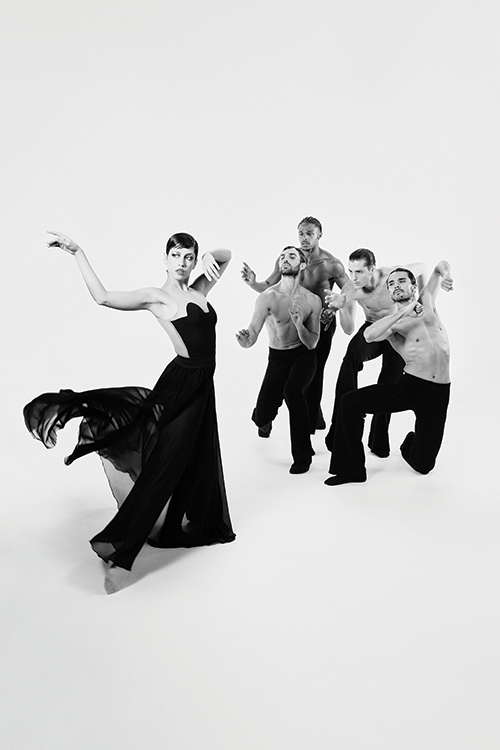

CARMEN.maquia
October 30, 2026
Company Premiere: 2014, Ballet Hispánico New York
World Premiere: 2012, Luna Negra Dance Theater
Choreography by Gustavo Ramírez Sansano
Music from Various works by Georges Bizet, performed by the Slovak Philharmonic, Praha Philharmonic, and the Arte Ensemble. Carmen Fantasy, by Pablo de Sarasate, performed by the Apollo Symphony Orchestra
Set Design and Construction by Luis Crespo
Costume Design by David Delfín
Lighting Design by Emilio Lavarías
Casting
Carmen: Amanda Ostuni
Don José: Dylan Dias McIntyre
Escamillo: Thierry Blannchard
Micaela: Francesca Levita
The Company
Artistic Director & CEO
Eduardo Vilaro
Founder
Tina Ramirez
Company Artistic Associate
Rodney Hamilton
Ballet Mistress
Nicole Duffy
Chief Managing Director
Patrick Muhlen
The Company
Amanda Bacallao, Amir J. Baldwin, Mia Bermudez, Thierry Blannchard, Maya Canestaro, Antonio Cangiano, Madison Carrion, Francesca Levita, Matthew Mancuso, Dylan Dias McIntyre, Andrea Mish, Kevin Ortiz Lemus, and Amanda Ostuni.
Company General Manager
Karl Rader Watson
Wardrobe Director
Natalie Shoch
Lighting Supervisor
Dominick Riches
Stage Manager
Chloe Marie Lupini
Major funding for Ballet Hispánico New York is provided by the Arnhold Foundation, Jerome L. Greene Foundation, Mellon Foundation, Thompson Family Foundation, Frances Lear Foundation, Howard Gilman Foundation, and Shubert Foundation.
MetLife Foundation is the Official Tour Sponsor of Ballet Hispánico New York.
Ballet Hispánico New York is grateful to Artistic Sponsor Andrew Martin Weber for generously supporting the restaging of CARMEN.maquia.
Public support Ballet Hispánico New York is provided by the New York State Council on the Arts with the support of Governor Kathy Hochul and the New York State Legislature, the New York City Council under the leadership of Speaker Julie Menin.
Prelude
A solitary figure emerges in silence. It’s Don José. Imprisoned in both body and soul, he relives the aftermath of a fatal passion. As he paces the dim cell of his conscience, Carmen appears—not in flesh, but in memory, in ache. The past is inescapable.
Act I
The Factory Floor
Outside the cigarette factory, the Cigarreras spill into the light, their chatter mixing with the haze of tobacco and fatigue. Guards linger, dozing and joking. Don José arrives, a figure of rigid order, shattering their ease. A soldier among dancers.
The Habanera
A changing of the guard—and the air shifts. Carmen, irresistible and indifferent, catches sight of Don José. She dances. What begins as flirtation becomes doctrine: her creed of freedom, love without chains. The onlookers are caught in her gravity. So is he.
The Letter
Micaela arrives—prim, dutiful, and bearing a letter from Don José’s mother. The contents call him home, to honor, to marriage, to a quieter fate. He reads, torn between the woman he was promised and the woman he cannot forget.
The Fracture
Tensions boil over within the factory walls. A violent altercation erupts—Carmen at its center. Though the fault is unclear, she is blamed. Don José, following protocol, arrests her. But on the road to jail, seduction triumphs over duty. She escapes. He is punished.
The Cell
Now incarcerated, Don José slips into visions. Carmen multiplies around him, dancing through his fevered imagination.
The Streets
Carmen and her friends stroll through town, trailed by desire. Soldiers vie for her attention, she creates a tornado of arguments, gossip and debauchery. But her mind drifts to Don José and the handkerchief she stole from him. She fingers his handkerchief and admits—perhaps, against instinct—that she may have loved him.
The Arrival
Escamillo, the celebrated toreador, makes a triumphant entrance. The crowd swells with admiration—Carmen included. Their flirtation is theatrical but layered with curiosity. He leaves; confident she will follow. She stays, uncertain if she already belongs to someone else.
The Return
Don José is freed. Carmen runs to him. For a moment, all is bliss. But when military orders intrude, Don José hesitates. Carmen is incensed. She demands devotion without question. He abandons duty—for her.
Act II
The Mountains
Micaela ventures into the mountains in search of Don José. She finds him amidst a band of gypsies—Carmen among them. Escamillo returns and resumes his courtship. Carmen yields, if only for a moment. Don José watches. Something breaks.
The Cards
The Cigarerras sit in a loose circle, giggling as they pull cards and tell one another’s fortunes. Then Carmen arrives. She says nothing—only lets out a sharp, serpentine hiss. The sound cuts through the air. In an instant, the group scatters. Alone now, Carmen claims the deck. She draws death. Separation. Finality. She shudders but shrugs it off. Her freedom remains a louder voice than fear.
The Duel
Escamillo and Don José cross paths. Tensions rise. Words are thrown like knives. Blows follow. Carmen is the ghost that haunts them both. No victor emerges—only wounded pride.
The Revelation
Micaela finds Don José again. She pleads for a return to the life they planned. But Don José is haunted—by Carmen, his choices, and his undoing. Micaela reveals the final blow: Carmen has chosen Escamillo. The truth ignites something fatal.
The Wedding
Escamillo calls everyone to gather and celebrate his triumphant wedding to Carmen. Joy hums through the crowd. Then, Don José appears. The celebration stills and the atmosphere tightens. Don Jose confronts Carmen. “You are mine,” he says. Carmen stands her ground. “I’ve moved on.” What follows is not a quarrel, but a reckoning. He lunges. She resists. And then—it happens. Carmen falls fatally struck.
What he could not possess, he has destroyed. Love has turned to violence, and desire to ruin.