Trio Barclay®
SCHUBERT’S PIANO TRIO NO. 1
Sunday, January 25, 2026 at 5pm
Performance Sponsors
Eugene and Carol Choi
Terry and Judy Jones
Karen Kuo-Limb and Jong C. Limb
Goran Matijasevic
Dot and Rick Nelson
Joel and Judy Slutzky in Honor of Ellie Gordon
Al Spector and Tatjana Soli
Artist Sponsor
Wes and Judy Whitmore
This performance will include a 15-minute intermission.
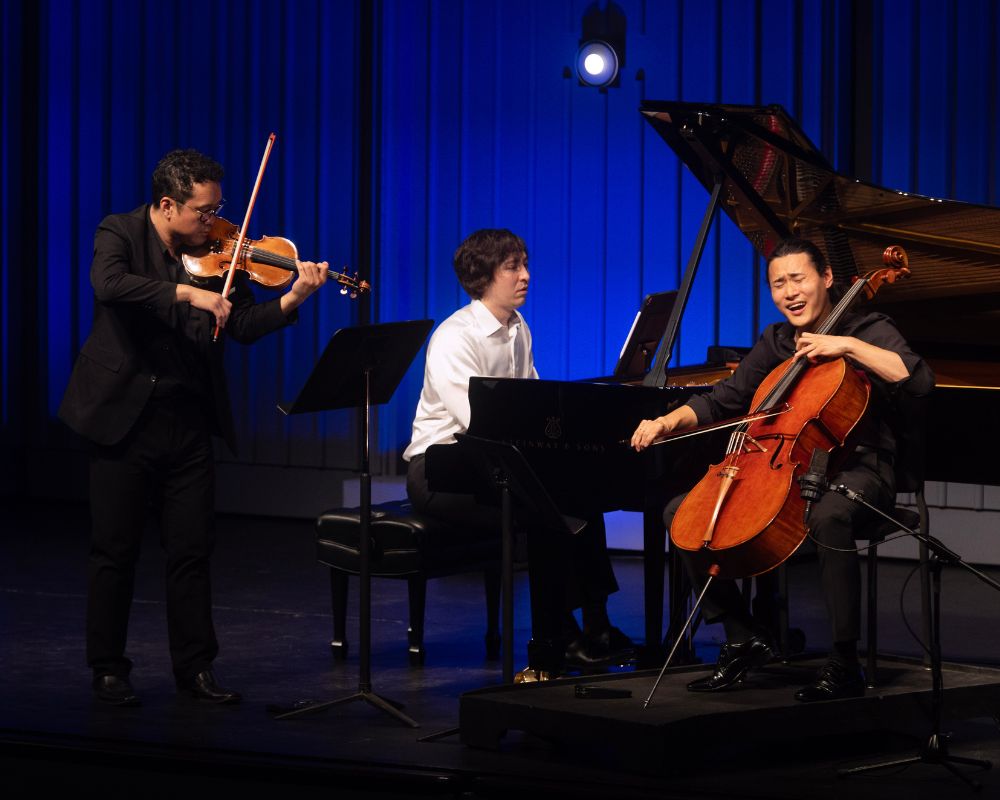
Dennis Kim: Violin
Jonah Kim: Cello
Sean Kennard: Piano
Schubert: Piano Trio No. 1 in B-flat major, Op. 99, D. 898
I. Allegro moderato
II. Andante un poco mosso
III. Scherzo. Allegro - Trio
IV. Rondo. Allegro vivace - Presto
-INTERMISSION-
Kyle Yeung: "Convergence" For Piano Trio (World Premiere)
Beethoven: Piano Trio No. 1 in E-flat major, Op. 1, No. 1
I. Allegro
II. Adagio cantabile
III. Scherzo. Allegro assai
IV. Finale. Presto
Schubert
Piano Trio No. 1 in B-Flat Major, Op. 99, D. 898
I. Allegro moderato
II. Andante un poco mosso
III. Scherzo. Allegro - Trio
IV. Rondo. Allegro vivace - Presto
When Schubert turned 30 in January 1827, his native Vienna was in the thrall of what might then have been called the "Age of Beethoven and Rossini." Schubert had achieved some renown for his work, but he was still publically regarded as a gifted "song and dance man", a notch or two below the pantheon. Schubert was warmly admired for his Lieder (German songs), dances and piano duets including a few genuine hits. But he was not (yet) held in the same esteem as Beethoven, Mozart or Haydn largely because Schubert had not written (to the public's knowledge) a "serious" concert work. He knew this, and his scant correspondence finds him yearning to compose a long-form instrumental work, to enter the great foray.
In March of that year, Beethoven died. Schubert was deeply moved and literally carried a torch in the funeral procession. Although we don't know if they actually met, Schubert was intimately aware of Beethoven's music including the final works - the piano sonatas, symphonies and quartets – and held him in the highest esteem. Schubert himself was a ticking time bomb: he knew he was battling a fatal but unpredictable illness. Beset with fragile, volatile health, his mortality quite real. With no time to lose and a vacancy now left by Beethoven, Schubert entered his "last year", one of the most astonishing in the history of classical music. Although his unparalleled creative surge would not be fully appreciated for decades, between the winters of 1827 and 1828 just before he died, Schubert produced a torrent of long-form instrumental masterpieces including the three late piano sonatas, two towering piano trios, the transcendent string quintet and drafts of a 10th symphony. If only he could have known that, today, we look back upon these magnificent years as the "Age of Beethoven and Schubert."
Schubert's two completed piano trios were likely composed between November 1827 and January 1828 although precise dating is impossible. The second trio in E-flat enjoyed a public premiere and was published one month before his death (it is unlikely that Schubert saw it in print). The first trio in B-flat lay fallow until it was published in 1836, nearly a decade later. Years later, Schumann would famously write about this pair of epic trios in the "grand sonata style" regarding the first as feminine (lyrical, sensuous, bright and nuanced), the second as masculine (strong, dark, an angry comet streaking across the sky). Today they are both keystones of the canon, Schubert, light and dark.
The radiant Piano Trio No. 1 in B Flat luxuriates across some forty minutes with the requisite four-movement program writ large in Schubert's "late" romantic style. The sprawling first movement is an epic two-themed sonata form that begins grandly with signing octaves and dotted rhythmic lilt that propels the music throughout. A lyrically winning second theme introduced by the cello establishes the signature polarity between which Schubert will lavishly oscillate until, towards the end, both themes briefly join in counterpoint. The trio textures are rich and colorful, yet transparent and perfectly balanced in a fluid dialog that always redresses the return of familiar themes with new clothes. As throughout the trio, Schubert uses his "magical" modulations (surprising chord and key changes) to articulate and extend his passages with indescribable emotion nuance.
The slow movement finds Schubert in his finest lyrical hour, a "song without words" in the deepest sense. An amorous duet of intimately entwined strings sings over a gentle triple-meter piano accompaniment that will eventually join in sparkling three-part textures. It follows a "simple" three-part form with a more rousing, dramatic interlude briefly interrupting the serenity. Graceful, yet deeply expressive, it is all the more mesmerizing for its constantly changing instrumental color. This was Schubert's second version of the slow movement for this trio; his first, quite different in character, is now published separately as the Notturro, D. 897.
With well over half the trio spent on the first two epic movements, Schubert completes this masterpiece with the classically familiar scherzo and rondo finale. The equally large-scale scherzo features a lively dance full of three-part imitations, humorous digressions, playful dynamics, rhythms, and silences, all based essentially on simple scales. The trio is more posed, a Ländler for violin and cello.
Though Schubert titles his last movement "Rondo", many have commented that the musical form is more complex than that. The primary themes serve as a rondo refrain and episode, but they are subjected to variation and development in the manner of a sonata and a theme and variations combined so the iterations are less obvious.. Yet again, beautiful long-limbed themes, colorful, spacious scoring, feints, modulations and counterpoints create an epic tapestry that ends with big, extended cadences. As Schubert was loved and recognized in his time, this music is full of "song and dance" but, as yet unbeknownst to his contemporaries, here is a masterpiece of "serious" instrumental music, one of many that last year for the pantheon.
- Program Notes by Kai Christiansen
This piano trio tells the story of three instruments that start out completely lost, each in its own world. From the very beginning, the violin, cello, and piano are all in different time signatures, which makes it feel like they’re not listening to one another. Nothing lines up exactly, and it’s meant to sound a little disorienting or unsettled—almost like three people talking past each other instead of having a conversation.
Throughout the piece, one thing keeps returning: the 6/4 chord harmony. It doesn’t always stay for long, but it acts as a landmark in the music. Every time the trio hits the harmony introduced at the beginning, it feels like they’re trying to grab onto something familiar in the middle of the chaos. I wanted these chords to give the listener a sense of direction, even when the rhythms are all over the place.
The first section paints a picture of being lost, like a child wandering alone in the woods. The instruments sound unsure, and there are sudden outbursts that represent fear or confusion—like running into wild animals. But there are also moments of imitation between the instruments where it feels like they’re trying to find each other and make sense of the world around them.
The middle section is much calmer. Here, the instruments finally begin to connect. They take turns playing lines that respond to one another more clearly, like an actual conversation. There’s less tension and more space to breathe. Instead of pushing against each other, the piano, violin, and cello start working together. It’s not totally smooth yet, but it feels like they’re finally listening and trying to understand one another.
As the piece moves toward the final section, the 6/4 chords return, but this time they’re more grounded and intentional. The violin and cello begin playing in counterpoint—two separate but connected voices weaving together. This builds toward a short, expressive cadenza where the instruments finally stop searching and settle into something stable. The piece ends with a cadence moving from F-sharp to G major, bringing a clear sense of resolution.
In the end, this trio is about the journey from confusion to convergence. The instruments begin disconnected and rhythmically scattered, but over time they learn to listen, respond, and find common ground. It’s not just a return to the beginning; it’s a transformation. They don’t go back to where they started—they move forward together, ending in a place of unity.
Beethoven Piano Trio No. 1 in E-Flat Major, Op. 1, No. 1
I. Allegro
II. Adagio cantabile
III. Scherzo. Allegro assai
IV. Finale. Presto
Beethoven's first published works comprise a set of three piano trios that went to press in 1795 was he was in his mid-twenties. Saving the string quartet and the symphony until the time was right, Beethoven's choice of the piano trio ensemble was practical and circumspect. Trios were popular and provided a vehicle for Beethoven the pianist, and, the genre at that time was largely a domain for amateur domestic music making, not necessarily a proving ground with extant masterworks as measurable standards. Indeed, it was Beethoven himself who elevated the trio into the central sphere of "significant" chamber music by expanding the form with these very trios. With Op. 1, Beethoven was the first to add a modern "scherzo" creating longer four-movement works less like the piano sonata and more like the string quartet. The first movement sonata forms explore a greater breadth and depth of expression and, famously, with the intense third trio in C-minor, broach a dark-side of unprecedented intensity and complexity. There is a new independence of the string parts that both play primary thematic roles along with the pianist. Already with his first publication, Beethoven stakes out new territory in a genre still waiting to be explored. The three trios of Op. 1 each strongly stake their own ground in terms of mood and character. The first is warm and witty, possibly Haydnesque, the second, more sensuous and lyrical, in the manner of Mozart, and the third is dark and smoldering, unmistakably Beethoven.
The first trio in E-flat is a perfect debut, ample, bright and public. A strong chord followed by a lively uprising arpeggio quickly establishes an exuberant vivacity that pervades the mood of this first essay for piano trio. A generous classical sonata, form with two clear themes, development and coda places the weight of drama and virtuosity on the first movement, a grand opening showcase. The second, slow movement introduces Beethoven's first singing adagio that gracefully navigates a three-part song form demonstrating his fine touch with gentle, radiant beauty. There are moments that recall the limpid serenity of Mozart's piano concerti where the piano first found its first great singing voice. The textures are clear and spacious recalling the modest but rarefied classical balance of Mozart's trios from a now almost bygone era.
The newly added third movement is a full-bore scherzo, far more of a robust peasant dance than a French minuet, leaping from strong downbeats into the drone of bucolic bagpipes with a more poised trio for contrast. There is a brusque, impatient eagerness to the music that matches the first and last movement, a kind of brash insouciance that nearly chafes in its restraints, soon to push the envelope.
The mirth prevails, overflowing right into the finale, which is a presto rondo with all the cartoon-like hijinks of a great Haydn romp including a touch of Gypsy fire. The wide upward leap in the first motive almost directly mirrors the "uplifting" theme in the first movement, this time abbreviated, and in the manner of much Beethoven, reduced, abstracted and "distilled." The potential energy of the climb is released through equal parts of downward free fall in the consequent answers of the phrase. When Beethoven moves the rondo refrain into a minor key, its vivacity takes on an urgent spice, a Hungarian groove that is found through the music of Beethoven, Haydn and Brahms, a deeply ingrained vernacular of Viennese musical rhetoric. Another is wit. Humor and musical playfulness become a chief hallmark of the new classical style, a marked departure from the predominant Baroque manner. Genial, vivacious and virtuosic, Beethoven's first published appearance makes a great splash just as Mozart had once literally predicted years prior.
- Program Notes by Kai Christiansen