BPO Classics Series
JOANN’S CLASSICAL CHRISTMAS
Friday, December 12 at 10:30 AM
Saturday, December 13 at 7:30 PM
JoAnn Falletta, conductor
Sirgourney Cook, soprano
Buffalo Philharmonic Chorus
Hamburg High School Chamber Choir
RIMSKY-KORSAKOV | Polonaise from Christmas Eve | |
HERMAN / arr. Robert Wendel | We Need a Little Christmas | |
TCHAIKOVSKY | Pas de Deux from The Nutcracker, Op. 71 | |
HANDEL | Let the Bright Seraphim from Samson | |
DARIN KELLY | Of Nights and Lights | |
JOHN WILLIAMS | Somewhere in My Memory from Home Alone | |
J. S. BACH | Jauchzet, frohlocket! (Rejoice, exult!) from Christmas Oratorio | |
| INTERMISSION | ||
RANDOL BASS | Fanfare: Joy to the World | |
BIZET | Farandole from L'Arlésienne Suite No. 2 | |
KORNGOLD | Prelude and Serenade from Der Schneemann (The Snowman) | |
NILES / | I Wonder as I Wander | |
YON / | Gesu Bambino (Baby Jesus) | |
HANDEL | Hallelujah Chorus from Messiah | |
ANDERSON | A Christmas Festival | |
BPO Holiday Concerts are presented by 
The Classics Series is presented by the
The Coffee Concert Series is presented by 
Patrons are asked to silence all electronic devices.
The use of cameras and recording devices is strictly prohibited.
By JoAnn Falletta, Music Director
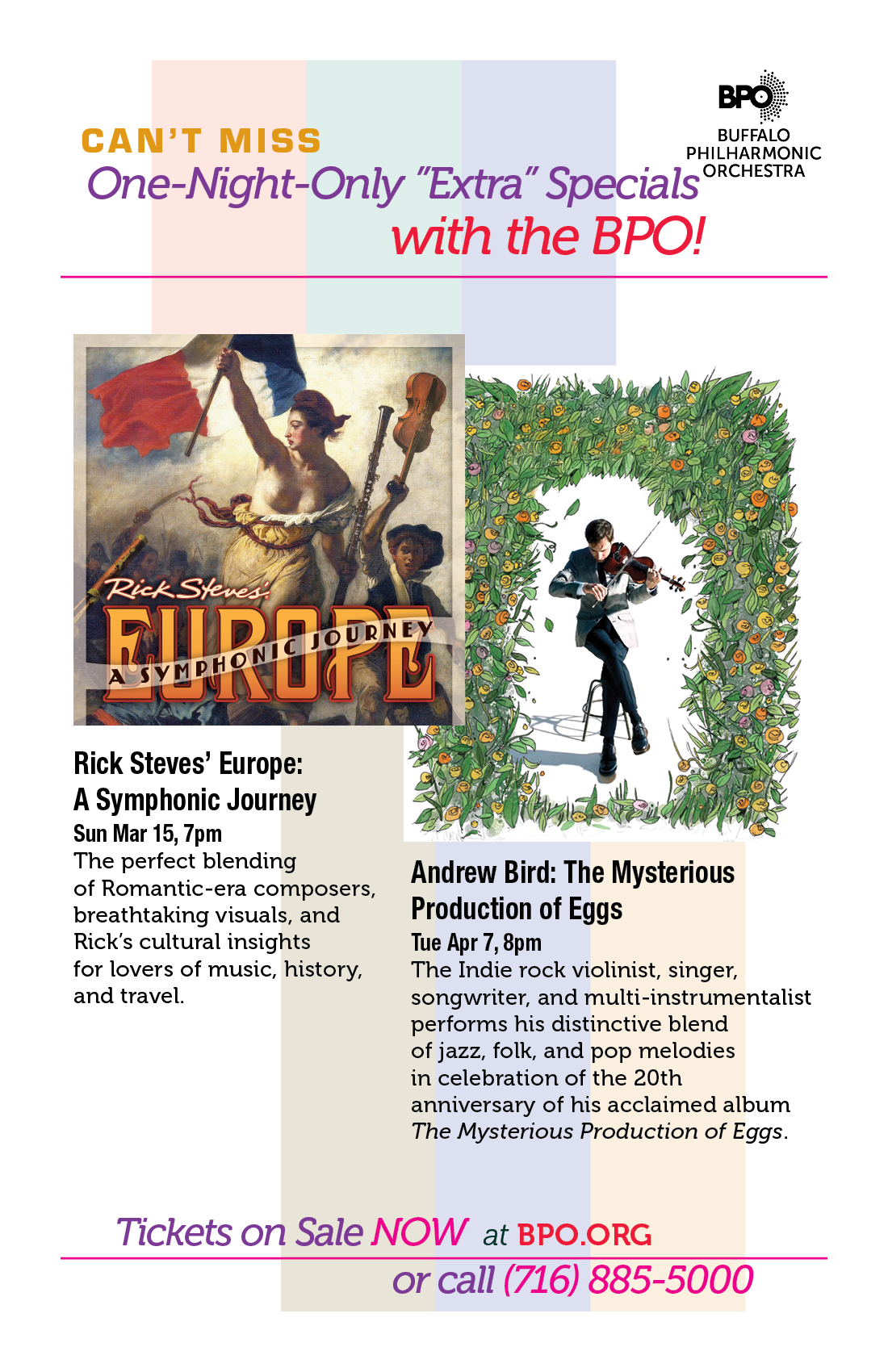
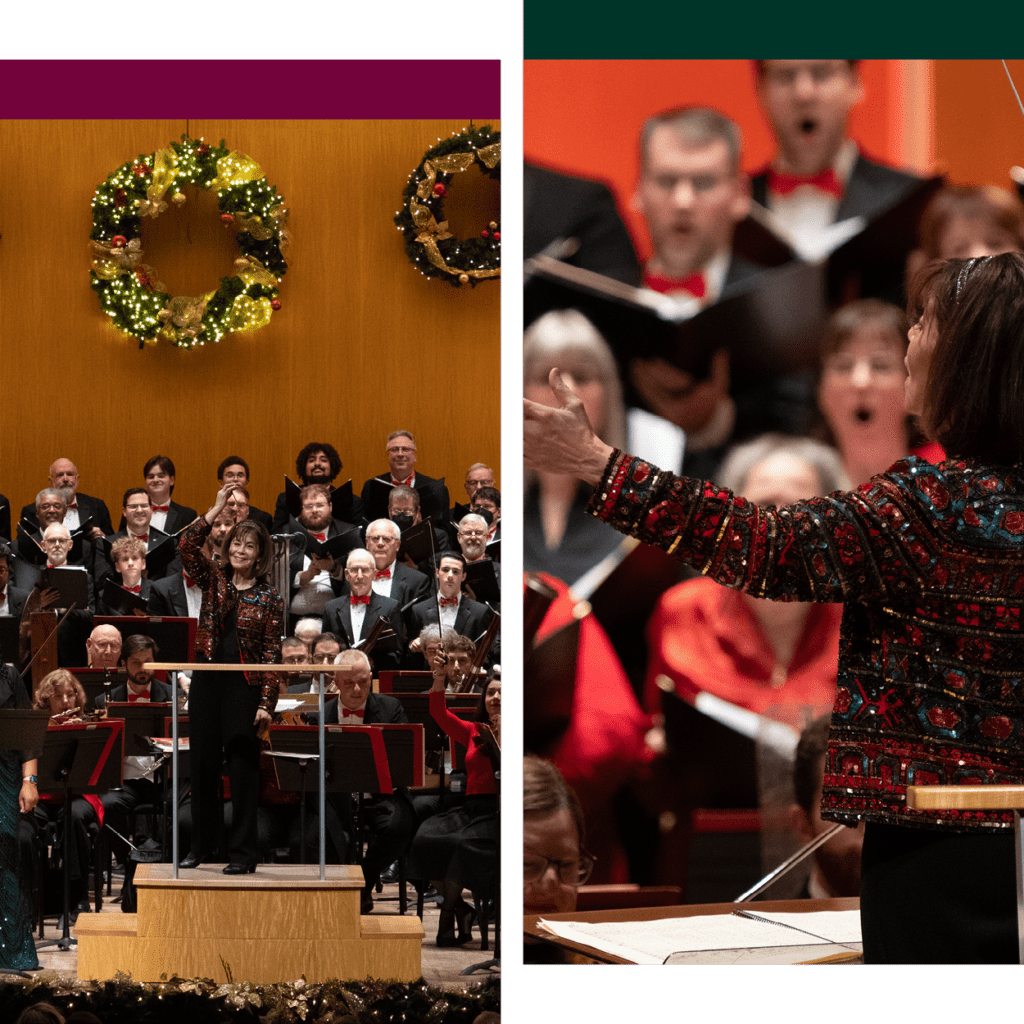
It is that wonderful time of the year, our very favorite season when we have the opportunity to celebrate Christmas and Hanukkah and the coming of the New Year with our beloved audiences. This is a time of year when traditions bring us all together, and we play the music that is close to your hearts and in your memories. We welcome extraordinary soprano Sirgourney Cook and our superb Buffalo Philharmonic Chorus, and feature some of our musicians in solo roles, like Alex Jokipii and Nikki Chooi.
The BPO musicians are deeply thankful to all of you for inspiring us all year, and we wish you a merry Christmas, a happy Hanukkah, and a New Year filled with joy and love!
By Edward Yadzinski and Chaz Stuart
Nikolai Rimsky-Korsakov (Russian; 1844-1908)
Polonaise from Christmas Eve (1895)
Rimsky-Korsakov’s opera, Christmas Eve, subtitled “A Carol Brought to Life,” is based on a short story by Nikolai Gogol from his collection titled Evenings on a Farm near Dikanka, published in 1832. The story takes place in a small village in Ukraine, and concerns a young blacksmith Vakula, whose heart is set for the lovely Oxana. But Vakula’s mother is a witch, Solokha, who plots with the devil to make trouble for the young lovers. Oxana’s vanity for a luxuriant pair of shoes turns into a quest for Vakula, who deals with the devil to achieve his goal. When he fails, false rumors of his death reach Oxana, but a Tsarina looks kindly on Vakula and gives him the slippers for his future bride and a new winter coat for her father. When Vakula suddenly appears on Christmas Eve, all is joyfully understood when he explains his fantastic journey.
In Act III, the stars reveal brilliant constellations above as the townsfolk dance mazurkas and a czardas, capped off with a rousing polonaise, the national dance of Poland.
Jerry Herman (American; 1931-2019)
arr. Robert Wendel
We Need a Little Christmas (1966)
Tony Lifetime Award recipient Jerry Herman is among the great mid-century Broadway songwriters, known for an optimistic voice in his hit works Hello, Dolly! (1964), Mame (1966), and La Cage aux Folles (1984). The beloved holiday hit “We Need a Little Christmas” was composed for the first act of Mame, and was first performed by Angela Lansbury. In the show, Mame has lost her fortune in the Wall Street crash and decided that the household needed cheering up with Christmas spirit, even though it was only one week after Thanksgiving. It would have been peculiar at the time to begin the holiday season so early, but the song acknowledges the uplifting power of Christmas celebration, which can be seen in a number of chart-making recordings over the decades.
Pyotr Ilyich Tchaikovsky (Russian; 1840-1893)
Pas de Deux from The Nutcracker, Op. 71 (1892)
Among Tchaikovsky’s final works was his 1892 two-act ballet, The Nutcracker, which would become a Christmastime staple. With a libretto adapted from an E. T. A. Hoffmann story, it begins at a grand and festive Christmas Eve party at the Stahlbaums’ home. Daughter Clara falls asleep with her nutcracker and fantastic dreams ensue with many famous scenes, from the Nutcracker fighting the Mouse King, to his transformation into a prince and their journey to the Land of Snow, to their arrival in the Land of Sweets, where they encounter the Sugar Plum Fairy.
Clara’s time in the Land of Sweets concludes with the unforgettable Pas de Deux, in which the Sugar Plum Fairy and her Cavalier perform a series of dances. The economic Tchaikovsky spins a yearning melody from a simple descending scale. Sweetly intimate at first, the Pas de Deux overflows with climactic energy.
George Frideric Handel (German-British; 1685-1759)
Let the Bright Seraphim from Samson (1743)
German-born composer George Frideric Handel studied opera in Italy, and brought his continental tastes to England in 1712. In addition to his success in the field of opera, he is credited with inventing the English oratorio. The oratorio shares many musical characteristics with opera, but is not presented theatrically, allowing for sacred subject matter and its performance in church. Handel also made good use of England’s vibrant choir culture by placing it at the center of the action.
The most famous example was his 1741 Messiah, but the ink wasn’t even dry when he set out on a new Old Testament project. The dramatic three-act Samson premiered in London in 1743 and was so popular it received seven repeat performances in its inaugural season. Prior to the final chorus, an “Israelitish Woman” performs the celebrated aria, “Let the Bright Seraphim,” which calls upon the angelic seraphim to celebrate the deceased hero.
Darin Kelly (American; b. 1968)
Of Nights and Lights (2005)
Darin Kelly writes, “Of Nights and Lights was originally composed in 2005 for symphonic brass, commissioned and premiered by the Virginia Symphony Brass. This celebration of the mysticism, traditions and revelry of the Hanukkah season is dedicated to people of all faiths—whatever and however they celebrate—but most especially to my friends Rodney and Helen Martell, without whom this piece would have never seen the light of day—or night!”
John Williams (American; b. 1932)
Somewhere in My Memory from Home Alone (1990)
From Star Wars to Harry Potter (and many more), John Williams has shaped the film industry through memorable melodies and classically informed scores for films that capture the imagination and wonder of childhood and nostalgia. His most lasting contribution to the yuletide season was his score for the iconic movie, Home Alone.
Amidst the chaos of an extended family’s overseas Christmas trip, eight-year-old Kevin McCallister (Macaulay Culkin) is mistakenly left in Chicago at the family’s large suburban home. The house, presumed empty, is the target for two local bandits who were unprepared for Kevin’s wily booby traps. As Kevin’s mother desperately tries to return to him, he makes an unexpected friend in the elderly neighbor.
A top-grossing film in 1990, Home Alone remains a beloved Christmas classic with a score to match, especially the unforgettable earworm melody “Somewhere in My Memory,” featuring lyrics by Leslie Bricusse.
Johann Sebastian Bach (German; 1685-1750)
Jauchzet, frohlocket! from Christmas Oratorio (1734)
Bach’s Christmas Oratorio was composed in Leipzig in 1734. In sum, the full work comprises six cantatas for which the text was derived from two biblical narratives: St. Luke 2:1-21 for cantatas 1 through 4; and St. Matthew 2:1-12 for cantatas 5 and 6. In reality, Bach had intended the work to be performed in a sequence of parts spread out over a period of 13 consecutive days. Among Bach’s most brilliant instrumental and choral statements is “Jauchzet, frohlocket!” (“Rejoice, exult!”), which resounds in glorious tone at the very beginning of the oratorio.
Randol Bass (American; b. 1953)
Fanfare: Joy to the World (2007)
As a composer and arranger, Randol Bass has received commissions by leading choruses and orchestras throughout the U.S. and Europe. For the Buffalo Philharmonic Chorus’ 70th anniversary, he composed Passage Into Spirit, a tuneful, five-movement suite based on the lyrics of American poet Walt Whitman. Bass’ bright setting of the traditional Christmas carol Joy to the World offers a splendid concert opener. The work was scored for the Dallas Symphony and Chorus in 2007.
Georges Bizet (French; 1838-1875)
Farandole from L’Arlésienne Suite No. 2 (1879)
In his play L’Arlésienne of 1872, French writer Alphonse Daudet captured the romance of the Arles region in a poignant melodrama. Dedicated to Georges Bizet, who wrote incidental music to the play, the storyline concerns the ultimately tragic love of a young farmer, Frédéri, for a beautiful but altogether capricious and unattainable woman who lives in the neighboring town of Arles. Although she is a principal character in the drama, we never learn her name and she never appears onstage, referred to only as L’Arlésienne.
The music was received so warmly that Bizet quickly extracted several highlights into Suite No. 1. After Bizet’s premature death in 1875, his friend and fellow composer Ernest Guiraud assembled Suite No. 2, which ends with the now-famous Farandole. The main theme is based on a folk tune from the Christmas season known as “March of the Three Kings.”
Erich Wolfgang Korngold (Austrian; 1897-1957)
Prelude and Serenade from Der Schneemann (1910)
Recognized as one of the greatest child prodigies of all time, Erich Wolfgang Korngold is best-known today for his film scores, the opera Die tote Stadt (“The Dead City”), and his Violin Concerto, Op. 35. The stories from his youth are astonishing, the first of which concerns the current work, Der Schneemann (The Snowman), a ballet pantomime which Korngold scored at age 11 (orchestrated by his teacher, Alexander Zemlinsky), and which caused a sensation when it was premiered at the Vienna Court Opera in 1910.
Der Schneemann is set in two acts and six scenes. No less remarkable than Korngold’s youthful score is the fabled story itself, also written by the boy-wonder. In sum: it is winter in an old Alpine village, where Pierrot, a young, vagabond violinist, tries to woo the lovely Columbine over the objections of her old step-uncle. The melodic and harmonic scene-painting of the music is perfectly picturesque and evocative of a young love story in winter.
John Jacob Niles (American; 1892-1980)
arr. Robert Sadin
I Wonder as I Wander (1934)
Kentucky-born composer John Jacob Niles had an affinity for Appalachian music paired with an academic skillset, studying music in Paris following his service in the First World War. In performing and collecting folksongs, his numerous recordings and publications had an enormous impact on the American folksong revival. His original compositions were influenced by this work, causing confusion as to the origination of some songs—especially his enduring Christmas piece, “I Wonder as I Wander.”
According to his own account, while visiting Appalachian North Carolina in 1933, Niles witnessed a young girl repeatedly sing a brief refrain of a song. He expanded this into four verses appropriate for the Nativity season, and its haunting melody has since found a place among the carol canon for hymnals, folksingers, and pop artists alike.
Pietro Yon (Italian; 1886-1943)
arr. William Ryden
Gesu Bambino (1917)
Pietro Yon studied at the renowned Accademia di Santa Cecilia in Rome, after which he served as an organist at St. Peter’s Cathedral in the Vatican. After moving to the United States, he held a similar post at St. Patrick’s Cathedral in New York. Yon’s best-known work is his setting of Gesu Bambino (Baby Jesus) in 1917, based on an old but traditional Italian Christmas carol. The piece has been widely recorded by many of the world’s greatest voices.
George Frideric Handel (German-British; 1685-1759)
Hallelujah Chorus from Messiah (1741)
Without question, Handel’s greatest contribution to the form known as the English Oratorio is Messiah. The now-famous story accounts that the work was completed in just 24 days—August 22 through September 14, 1741. About the creative process, Handel noted, “I had the impression that our all-powerful God had opened all of heaven’s skies before my eyes.” The full score includes several magnificent choruses, including the glorious Hallelujah Chorus.
Leroy Anderson (American; 1908-1975)
A Christmas Festival (1942)
American composer Leroy Anderson is renowned for writing a small wealth of popular orchestral miniatures. Among his best-known characteristic pieces is A Christmas Festival, a score charged with glistening timbres, tantalizing rhythms, and color-bright harmonies. The work offers a dashing suite of favorite Christmas carols, including Joy to the World, Deck the Halls, Good King Wenceslas, Hark! The Herald Angels Sing, Silent Night, Jingle Bells, and Adeste Fidelis (O Come, All Ye Faithful). But for all the easy allure of the famous melodies, it required the hand of a keen symphonist to make it all sound cheery and mint-green at every hearing. Masterful!