HARTFORD SYMPHONY ORCHESTRA
Carolyn Kuan, music director
Romeo & Juliet:
A Theatrical Concert
Friday, February 13, 2026 / 8 PM
Saturday, February 14, 2026 / 8 PM
Sunday, February 15, 2026 / 3 PM
Belding Theater, The Bushnell Center for the Performing Arts
CAROLYN KUAN, conductor
CONCERT THEATRE WORKS, BILL BARCLAY, director
JASON BOWEN (Romeo)
Nigel Gore (Capulet)
Carman Lacivita (Tybalt)
Caleb Mayo (Mercutio)
JULIANA SASS(Juliet)
Robert Walsh (Friar and Nurse)
Music by Sergei Prokofiev
Libretto by Sergei Radlov, Adrian Piotrovsky, Leonid Lavrovsky, and Sergei Prokofiev
Text by Shakespeare
Adapted and Directed by Bill Barclay
Produced by Concert Theatre Works
Commissioned by The Royal Albert Hall
This performance draws from the following numbers from Prokofiev’s ballet score:
Introduction | Romeo at Friar Laurence |
The post of Music Director is endowed by the Beatrice Fox Auerbach Foundation.
We kindly request that you refrain from using flash photography and video recording during the performance, however we encourage you take photos and share them on your favorite social media platforms- be sure to tag us so we can join in on the excitement!
The Hartford Symphony Orchestra receives major support from the Greater Hartford Arts Council, the Hartford Foundation for Public Giving, and with support from the Department of Economic and Community Development, Connecticut Office of the Arts which also receives support from the National Endowment for the Arts, a federal agency.
The 2025-26 Masterworks Series is presented by
The 2025-26 Masterworks Series is also sponsored by
The Elizabeth M. and
Harriette M. Landon Foundation
Concert Sponsors:
The Alexander Campbell McNally and Tina Mahar McNally Memorial Concert
Viking Fuel in memory of Margery Steinberg
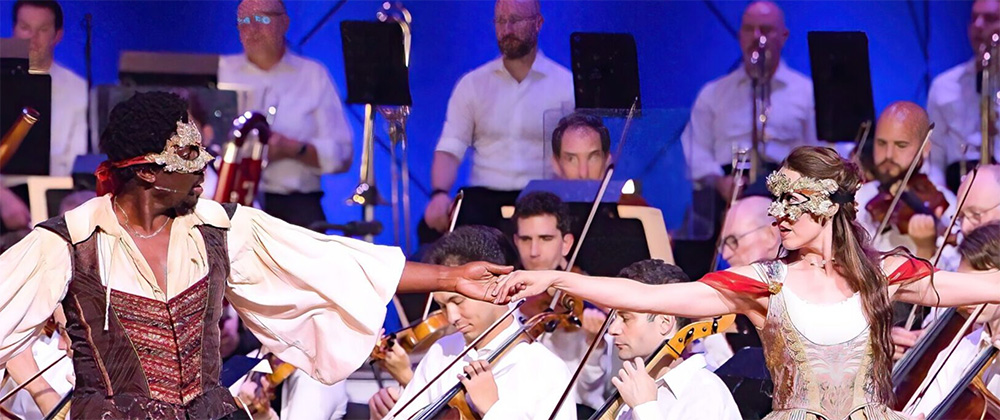
This production of Romeo and Juliet began in conversations with The Royal Albert Hall in London about making live music feel essential in a digital age. We know classical music struggles to connect with young people, a challenge with which each generation has valiantly wrestled. The idea was hatched to create a new version of Shakespeare’s most famous play with some of the finest music it has inspired. The Royal Albert Hall commissioned Concert Theatre Works to devise something trim and taut, roll it out internationally to allow an opportunity for young people all over the world to see this story of Shakespeare’s “star-crossed lovers” that is really about them, and fall in love with great music along the way. My company, Concert Theatre Works, has been creating theatrical concerts for ten years to build new audiences, believing, as I do, that musicians have seen it all and are the best story keepers, if not the best storytellers. To illuminate canonical works from within, we merge classical music with actors, dancers, puppets, film, illusions, juggling and even this production’s major innovation — live sword-fighting with orchestra. These connections make the music visible and help to tell its phenomenal story.
Prokofiev’s 1935 ballet score for Romeo and Juliet contains multitudes, and, what is more, leans into the wit and humor that elevates the first half of Shakespeare’s tragedy. This is important, as a classroom may overlook the reality — plainly obvious on its feet — that this play is hilarious until Mercutio is killed. Prokofiev knew his Shakespeare, and his enormous fondness for these characters is visible on every page of his score. I employ two techniques learned from seven years as director of music at Shakespeare’s Globe: 1) cross-dressing is fun (and historically correct); and 2) we only need to present the silhouette of reality to encourage your minds to complete the picture. When you “piece out our imperfections with your thoughts,” you own your own image, and the artform is created collaboratively with you. We forget that before loudspeakers made musicians largely redundant in straight theatre, a production of Romeo and Juliet without an onstage orchestra would have been a box office failure. Live music accompanied onstage action for over 300 years de rigueur, and we still enjoy various concert suites derived from those events. Prokofiev’s ballet was not intended as incidental music of course, but he composed it during the revolution in amplified sound in the 1930s, and its epigrammatic structure of short, colorful movements makes it wonderfully adaptable as “concert–theatre.”
This Romeo and Juliet, like Concert Theatre Works’ earlier productions of Peer Gynt, L’Histoire du Soldat, The Magic Flute and A Midsummer Night’s Dream, was created with the realization that there is more at stake here than an evening’s entertainment. In coming years, funding cuts and digital advances (particularly in artificial intelligence) will create formidable headwinds for all live arts to defend their pivotal role in civic health. It is of paramount importance that we labor now to create works that clearly show our value and force as collaborators in nurturing the Performing Arts.
Our aims in all our productions are to deepen our love for the repertoire we cherish, to share that love with newcomers and experienced listeners alike, to build community around great art, and to celebrate what is truly alive in our digitizing world. Like Shakespeare’s “star-crossed lovers,” we in the performing arts are fragile. Our love affair with art may begin as child’s play, but its future is ultimately a matter of life and death.
Credits:
Arthur Oliver, costume designer
Robert Walsh, fight director
Kristin Wold, choreographer
Justin Seward, properties designer
Diane Healy, stage manager
MUSIC DIRECTOR
Carolyn Kuan
Endowed by the Beatrice Fox Auerbach Foundation at the Hartford Foundation for Public Giving
ASSISTANT CONDUCTOR
Adam Kerry Boyles
FIRST VIOLIN SECOND VIOLIN VIOLA CELLO BASS | FLUTE PICCOLO OBOE ENGLISH HORN CLARINET BASS CLARINET BASSOON CONTRABASSOON HORN TRUMPET TROMBONE TUBA TIMPANI PERCUSSION HARP PIANO LIBRARIAN PERSONNEL MANAGER Stage Manager |
After the first two desks of violins, and the first desk of violas, cellos, and basses, the remaining string musicians participate in rotational seating and are listed in alphabetical order.
AFM Local 400
The musicians of the Hartford Symphony Orchestra are members of the American Federation of Musicians of the United States and Canada.
Stagehands Local 84
The Stagehands of the Hartford Symphony Orchestra are members of the International Alliance of Theatrical Stage Employees (I.A.T.S.E.).

Musician List subject to change. Please see our digital playbill for the most
up-to-date listing.